
I’m an artist who works with glass – here’s how the physics and chemistry of glassblowing work
From colorful orbs to delicate spirals, heating and manipulating glass allows artists to create beautiful translucent sculptures.

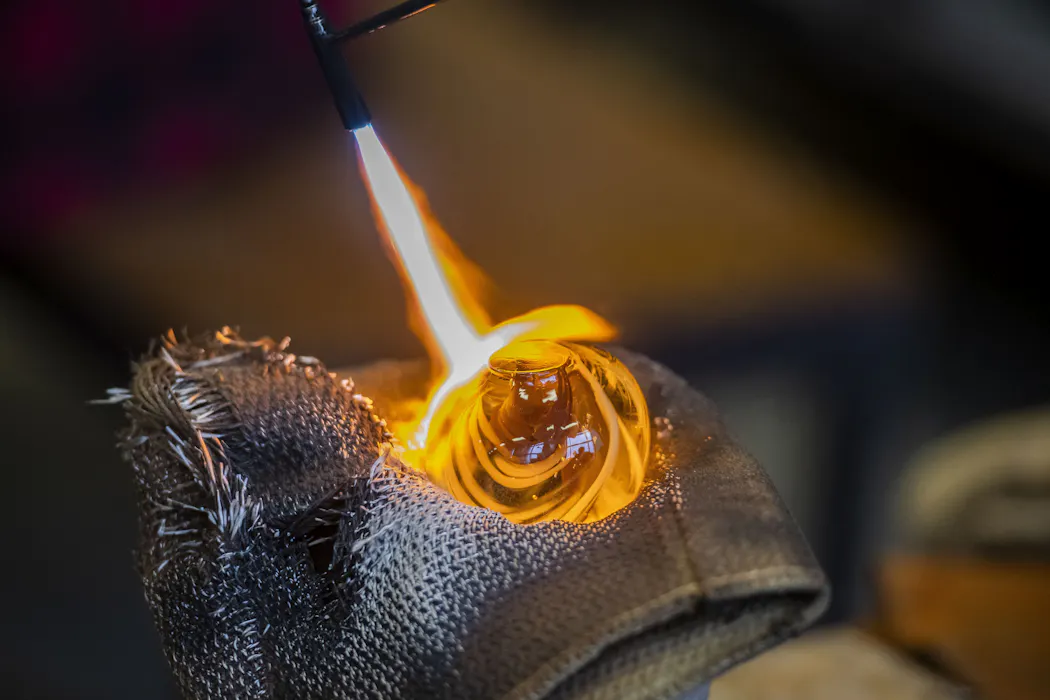
Glass as a material is full of contradictions. Depending on the form and use, glass can be fragile or strong, opaque or transparent, rough or smooth. The studios my colleagues and I teach and learn in, as glass instructors, echo this abundance of physical opposites. These environments are simultaneously immersive, complex, seductive and demanding.
When the studio is in action, you might hear glass breaking, hot metal being quenched in water, glassblowing pipes rolling on the workbench rails, and some good tunes on the stereo. You might smell hot beeswax and burning newspaper. You might feel a bit of waste glass under your shoe or the intense heat from the furnaces and a breeze from a well-placed fan. Glassblowers learn to listen, to feel and to find some focus within and among the kinetic.
The constant stimuli of the glass studio may not seem anything like a sterile science lab, and yet glass artists need to accrue knowledge of physics and chemistry to achieve any kind of control with this dynamic material. They must choose a material with the desired properties and during the process judge factors such as heat and malleability.
Glass as a material
At Rochester Institute of Technology, where I help run the glass program, we primarily use two types of glasses. In our hot glass studio we melt “soft” glass. This glass is specifically formulated to be melted in a furnace and used by the glassblower. It’s a combination of fine mesh silica sand, soda ash and lime, with small amounts of a few additional ingredients that keep the glass beautiful when it’s at its top temperature of 2,200 degrees Fahrenheit (1,204 degrees Celsius).
In our flameworking studio, we use a borosilicate glass. You might recognize this glass as the brand Pyrex made in Corning, New York. This is a super heat-resistant glass. It melts at a higher temperature than soft glass and arrives to our students in preformed rods that they can melt and shape by torch in our flameworking studio. The differences in chemistry really change how these glasses look and behave.

Glass, from a material science perspective, is categorized as an amorphous solid, meaning that glass’s molecules are arranged in a near-random pattern and there is no sharp melting point. Rather, glass gradually softens over a wide temperature range.
Gathering glass
Once you’ve adjusted to the chaos of the studio, it’s time to start working.
We have two furnaces in our hot glass studio, where we work with soft glass, so anytime during the school year there is between 700 to 1,200 pounds of glass. It’s kept in the furnace at its molten state (2,200 degrees F or 1,204 degrees C), ready to be gathered and transformed.

When we work with the material, transforming it with tools and breath and heat, it needs to be kept in a workable heat zone – probably between 1,100 and 2,000 F (593 and 1,094 C). When the glass dips below that range, we perceive it as solid, though at the molecular level it is still dynamic and acting more like a liquid.
To make anything – a sculpture, a tumbler, a celestial magical orb or a pumpkin – you start by gathering glass out of the furnace on a metal rod. Once you’ve gathered your glass, you start making decisions.

You might ask yourself: What tools do I need to begin to shape and transform this glass into the object I have in mind? If you wait too long and the glass begins cooling down, you’ll need to reheat it to reintroduce malleability, allowing you to continue working it without breaking it.
A big part of glasswork is moving between the reheating chamber and the bench, where the artist uses tools to move and stretch the molten glass into the desired shape. You’ll need to alternate between these two stations many times.
Glassblowing is a team activity. I have physical and intellectual support from my colleagues: breath from their lungs, protection from the heat, additional bits of glass brought from the furnace to add to my object. We almost never work alone.
So, say I want to make a very basic clear tumbler. This is a simple conceptual object – utilitarian, domestic and intimate. It is also a tricky one to make well: too heavy and it feels bad in the hand, too thick at the lip and it dribbles when you drink, too thin at the bottom and it will break before it is complete.
Maybe I want to design it so it is slightly conical: wider at the bottom than the top, so it’s less likely to tip over. Maybe I want it to have a little indent for the user’s thumb as a gentle invitation to her hand. First I make my design: I draw it. I share it with my team so they can predict the process and the object’s needs. Then we begin.
Working with physics
I gather glass out of the furnace, let it cool a bit, then introduce a bubble in the glass by blowing into the pipe, the hollow rod that attaches to the object I’m making. I reheat, sit at the bench and begin to shape the glass using both gravity and the Jills, a cooling and shaping tool. The Jills is kind of like a large pair of tongs. It hasn’t changed much in design for 2,000 years.

I ask for some air from my teammate, and she blows into the pipe while I’m shaping the glass. The bubble transforms into a pill shape, slightly wider at the bottom. I constrict the area right in front of the pipe. I’m focusing on shape and heat, taking care to not let the glass get too cold. If the glass drops to about 1,000 F (538 C), it enters a danger zone. If it’s not yet finished, it needs to be warmed up in the reheating chamber; or if it is done, put away in a kiln to cool slowly.
If glass cools too quickly, the molecules freeze into a chaotic pattern, which causes stresses that result in fracture. To combat this volatility, when the glass object is done and ready to be cooled, we place the object in an annealer: a kiln set to a resting temperature of 930 F (500 C).
This temperature is like a Goldilocks zone for our glass: It’s not so hot that the glass will deform, but not so cool that the glass will stress and break. Once the kilns are full, a computer guide takes them down to room temperature over about 10 hours.
As I continue to work on my cup, I get more heat, focusing on the very end of the bubble – the part that will be the base of the cup. I then sit down and have another member of my team flatten the bottom with a wooden paddle while I tool the glass with the Jills to keep its shape. The cycle continues on and on.
The process is quick, but also there are so many little steps that it would take nearly a full-length book to describe them all. When asked how long it takes to make a tumbler, I’ll often answer, “About 10 years or 10 minutes, depending on how you think about time and material knowledge.” This is both glib and true. Glass demands attention, dedication and a willingness to make connections between physics and chemistry and your observable experiences. It is a highly challenging and equally rewarding material to work with and alongside. I count myself very lucky.
Suzanne Peck does not work for, consult, own shares in or receive funding from any company or organization that would benefit from this article, and has disclosed no relevant affiliations beyond their academic appointment.
Read These Next
5 ways countries stymie climate negotiations without actually saying ‘no’
The methods can be subtle but effective at slowing progress, particularly when fossil fuels are involved.…
Why do farts smell so bad? A microbiologist explains the odors brewing in your gut
Your farts’ aromas are tuned to your diet – and your overall health.
Leadville’s Irish pauper graves speak to the dangers of Colorado’s mining boom – and raise questions
Conditions for migrant workers in the 21st century are often as precarious as they were for immigrant…