
‘I heard a barnacle’ – how paying attention to nature’s background noise can reveal animal secrets
Letting the ordinary become interesting again is a key part of studying natural history and animal behavior.

During four days on Washington’s Olympic Peninsula, I saw an Olympic marmot, a species found nowhere else on Earth; four bumblebee species working the same lavender plant; three western hermit crab species new to me; and five orcas slicing through the dark water off Ediz Hook. Any one of them could have been the trip’s highlight.
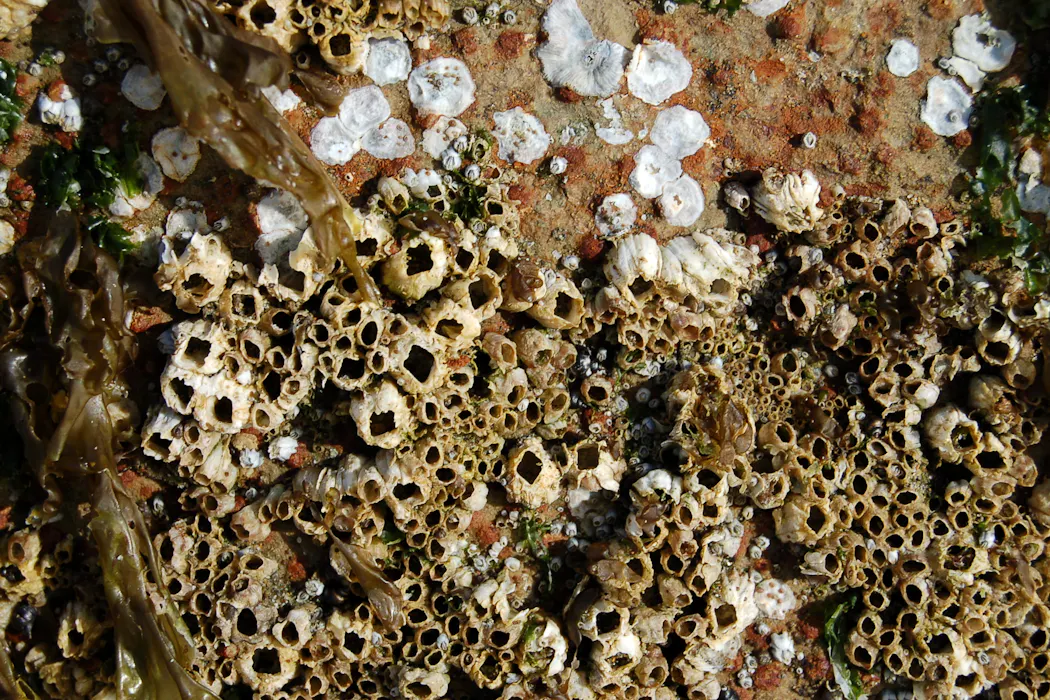
Yet the encounter I cannot stop talking about occurred at low tide at Tongue Point, when I heard a barnacle.
While I had seen thousands of barnacles, I had never imagined I could hear one. It made a noise that sounded like: Clickety-clack. Clickety-clack. Pop.
As a professor who teaches about animal behavior, I know that the distinction between encountering an animal and actually noticing what it is doing is one of the simplest ways into natural history. It requires no laboratory and, at first, no special expertise.
Mostly it requires learning how to let something ordinary become interesting again.
At low tide
My habit in places like a rocky shore is to become still and let my vision soften. Instead of staring at one point, I allow movement anywhere in the visual field to pull my attention.
At Tongue Point, I was thinking about the demands of life in the intertidal zone, the shore between high and low tide: temperature swings, desiccation and the cost of remaining clamped shut in open air. Then I noticed the soundscape.
At first, the clicking was just coastal noise. I attributed it to small shore crabs moving among the mussels, or hermit crab shells knocking against them. Then one sharp pop pulled my attention to a single acorn barnacle. Its tiny opening was slightly unsealed, and two small plates were moving against its deeply ridged shell. The movement appeared to coincide with another pop. Then another.
The repetition gave me something to follow. You can train yourself to do this almost anywhere.
When I take students or my sons to watch honeybees, I tell them not to stare directly at the hive entrance. Instead, sit nearby, look toward the open sky, and relax your gaze. At first you see empty air. Then a bee crosses it. Then another. Within moments the emptiness becomes a busy airport of arrivals and departures.
Nothing new has entered the scene. You have just changed what you are capable of noticing.
A web of assumptions
Observation has its own traps. Sometimes you can miss behavior because it blends into the background. Other times you see something perfectly but stop asking questions because somebody has already told you what it means.
Orb-weaver spiders offer a good example. Some add conspicuous bands or patches of dense silk to their webs. These structures are called stabilimenta, a name inherited from the old idea that they stabilize or strengthen the web. But they don’t.
Researchers later found evidence for several possible functions: attracting prey, deterring or confusing predators, protecting webs from larger animals, and, in some cases, helping with temperature regulation. Different functions may matter in different species, environments or stages of life.

I first became interested in the debate over stabilimentum function because I was unconvinced that one explanation could account for all the evidence. I started out asking whether somebody was wrong. The better question turned out to be why researchers expected one universal answer in the first place.
That remains one of my favorite lessons from animal behavior: A name can be useful, but it can also sneak in an explanation. Once you think you know what something is, you become less likely to watch what it actually does.
Seeing isn’t knowing
The opposite mistake is just as easy: seeing something interesting and immediately deciding you understand it.
After I returned from the Olympic Peninsula, I emailed a retired marine invertebrate zoologist and described what I had seen and heard. His response was delighted and appropriately skeptical: “Doubt it. Take a short video next time.”

I saw an open barnacle move and heard a pop at the same time. That is an observation. I did not demonstrate that the barnacle produced the sound. A mussel bed contains crabs, moving shells and a host of other possible sources. A close-up video with synchronized audio could test whether the same visible movement repeatedly coincided with each pop.
Noticing something is the start of science. It does not let you skip the work that follows.
Look again
For anyone who wants to become a better naturalist, a simple sequence helps:
- Notice something.
- Describe it carefully.
- Ask what else could explain it.
- Decide what evidence would distinguish among those possibilities.
Try it somewhere familiar: a backyard, city park, pond edge, patch of flowers or shoreline. Stay longer than feels necessary. Let the sights and sounds become background.
Then look for repetition. One movement, then another like it. One sound that separates from the rest. An animal returning to the same place.
And once something catches your attention, resist the urge to explain it too quickly. Watch again. You may discover something genuinely unusual. More likely, you will discover something ordinary that you had never actually seen before.
I may not have witnessed rare behavior at Tongue Point or identified a rare species. But I stayed long enough to wonder what I was hearing. Maybe that was rare enough.
Phil Starks does not work for, consult, own shares in or receive funding from any company or organization that would benefit from this article, and has disclosed no relevant affiliations beyond their academic appointment.
Read These Next

I’m an athletic trainer – here’s how to know when kids sports are too intense
It can be tempting to ratchet up training intensity for kids in youth sports, but focusing on fun and…
Flesh-eating screwworm is spreading in the US, threatening livestock and wildlife – hunters can be t
Over 100 screwworm cases have appeared in US animals in 2026, including in elk. How America’s 11.5…
The hidden ways insects support animal life – from habitat to health – go way beyond being food
As insect biodiversity declines, people and all the other species on Earth stand to lose the beneficial…