Mars rovers give scientists a ground-level view of the red planet – peek inside their NASA control r
Each day in the control room of the Curiosity rover is jam-packed with important scientific decisions, as a NASA project scientist describes.

Lights blink on as I enter the Rover Operations Center at NASA’s Jet Propulsion Laboratory in Pasadena, California, at 7:30 a.m. I’m the first to arrive, even though I already feel late.
Sometime during the night on Earth, the Curiosity rover finished its day exploring on Mars and beamed its latest collection of images and measurements to a Mars orbiter zooming by overhead. The orbiter relayed the data to Earth, where it now waits on servers here and at partner institutions around the globe.
Once our rover operations shift kicks off at 8:15 a.m., a few dozen engineers and scientists will have just three hours to check the health of the rover, analyze the new science data and agree on the next set of rover activities. Then we’ll spend another four hours turning those plans into rover commands for tomorrow, making sure they are safe and fit within the rover’s available time and energy. Not long after that, the Sun will rise on Mars, and Curiosity will look toward Earth, expecting its next instructions.
As Curiosity’s project scientist, it’s my job to ensure that what emerges from this rush is a set of measurements that advance the mission’s science objectives and keep it on track to achieve what our team promised NASA and, ultimately, the public. It’s a seemingly overwhelming task given everything that must happen in the next seven hours. But after repeating it over a thousand times since Curiosity landed in 2012, our team has gotten pretty good at it.
Reading the rocks
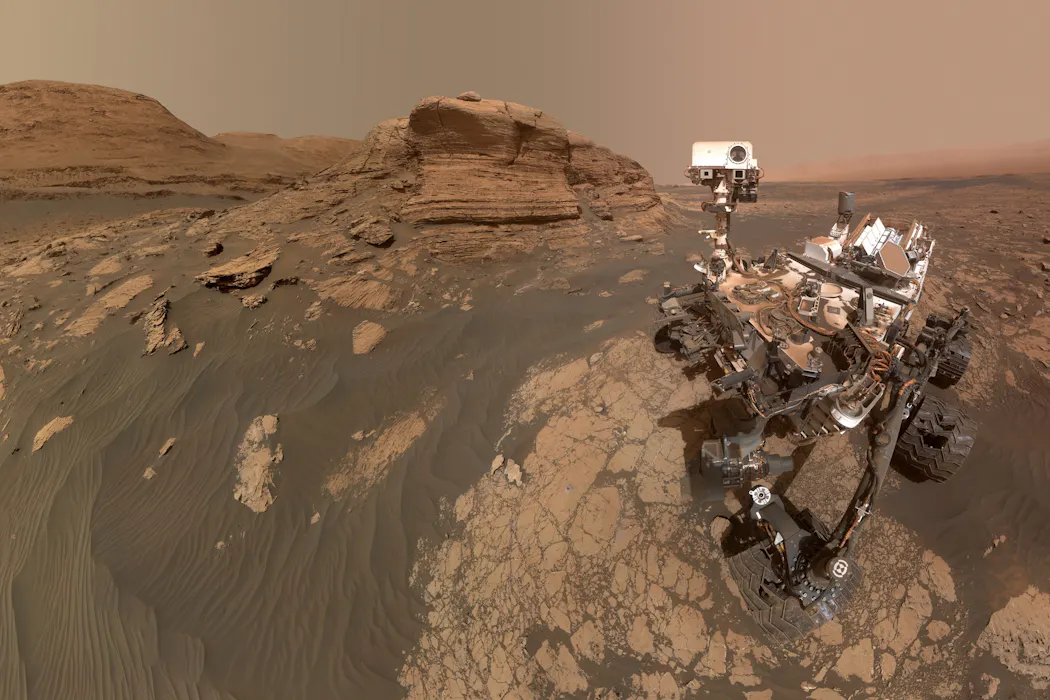
NASA created Curiosity to search for evidence of ancient habitable environments, such as those with liquid water and the chemicals, nutrients and energy sources required for life. The investigation called for a long-lived, mobile spacecraft that would allow scientists on Earth to virtually explore a local area on Mars, select and acquire rock samples, and analyze them in onboard laboratories.
JPL responded with the car-size, drill-equipped Curiosity rover. NASA added a suite of scientific instruments and a science team from the United States and around the world.
NASA sent Curiosity to Mars’ Gale Crater to climb Aeolis Mons, a mountain whose 3 miles (5 kilometers) of sedimentary rock layers hold a record of environmental conditions from about 3.5 billion years ago. The evidence suggests that back then a thicker, ancient atmosphere sheltered flowing streams and sparkling lakes.
Curiosity has climbed through a vertical half-mile (1 kilometer) of rock layers so far, finding clay-rich, mudstone layers that give way at higher elevations to younger sandstones full of salty minerals. Our team determined that lakes persisted for millions of years before the climate became arid and sand dunes overtook the lakes, although groundwater occasionally breached the surface to produce streams that wove among the dunes.
Samples Curiosity drilled from the lake sediments contain small organic – meaning carbon-based – molecules, the raw materials for potential life. The association of wet environments, organic molecules and a mix of chemicals similar to those that microbes harness for energy on Earth allowed our team to conclude that conditions in Gale were once capable of supporting life. Determining conclusively whether life actually took hold will require bringing such rocks back to laboratories on Earth.
Preparing a plan
As my colleagues arrive in the building and online, I’m lost in the latest images. Curiosity is well into the higher and drier strata of Aeolis Mons, yet the rocks have salts, scours and other signs of ancient water. These images suggest that perhaps even Mars’ dry period provided habitats for life.
During our previous shift, I asked the engineers who plan the rover’s route to take it into an area that appears exceptionally smooth and flat on images taken from orbit. After years of rough offroad driving, they were excited to open up the throttle and let the rover drive 120 feet (37 meters) across this Martian “parking lot” – a pretty long distance for Curiosity.

What I’m looking at now is taking my breath away. Instead of smooth slabs, every surface around the rover is textured by small polygons, each a few inches across, as if someone covered Mars in honeycomb wallpaper. Our geologists suspect that the polygons outline fractures that formed through drying, like cracks in mud do, or through thermal cycles, or compression.
My computer screen shows the area in front of Curiosity covered by dots, each one representing a candidate target for the rover to observe with its cameras, its laser spectrometer, or the sensors on its arm. There are way too many dots, which is not a bad problem to have. A science team member trained to moderate the day’s discussion begins to narrow the list. Distinguished faculty, postdocs and students from around the world take turns advocating for their target.
The debate centers on what set of images and chemical measurements will best help distinguish how the polygons formed. I’m the tiebreaker if our team can’t quickly reach consensus, but that’s rarely needed. It’s Friday, so the three days of activities we plan for the rover today will take place over the weekend, and the results will arrive for our next shift on Monday. Curiosity works weekends.
Engineering the uplink
Later on, I walk into the adjacent room where a robotics engineer visualizes in 3D how Curiosity’s five-jointed arm will reach the winning rock targets. I sit down next to another engineer who is simulating the rover’s next drive. We agree that the terrain ahead is rough: no more parking lot, all curbs. We discuss how she might steer the rover around the rock obstacles to reach the next science waypoint.
By noon, the science team’s role in operations is done, but my colleagues linger online to discuss the latest data in more detail. Meanwhile, the rover and instrument operators begin converting the day’s scientific requests into hundreds of commands that must be sent to NASA’s Deep Space Network in a few hours. There’s still a lot to do, but the team is in the homestretch for the day.
On Mars, the horizon is starting to brighten. Before too long, Curiosity will be expecting to hear from us.
This research was carried out at the Jet Propulsion Laboratory, California Institute of Technology, under a contract (80NM0018D0004) with the National Aeronautics and Space Administration.
Read These Next

These state supreme court races could decide abortion access and trans rights
Ohio, North Carolina and Michigan have open seats on their state supreme court, and these hotly contested…

Why your boss matters more than remote or hybrid work when it comes to burnout and job satisfaction
A return to the office can mean very different things to different workers, which is why this debate…

Missing ambassadors, inexperienced appointees – is Washington dropping the diplomatic ball?
Almost half of US ambassador jobs remain vacant. Meanwhile, political appointees are outnumbering career…