NASA announces its Artemis III crew, which will test important equipment and systems in Earth orbit
The Artemis program’s timeline and architecture has changed over the past year, so Artemis III will not land on the lunar surface.

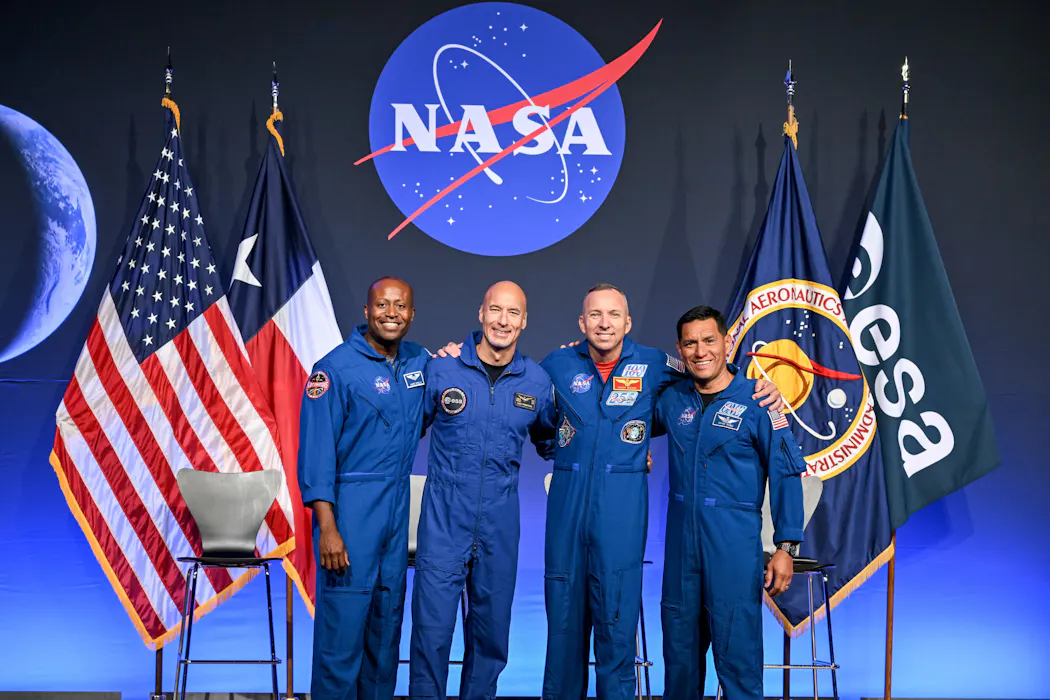
Over the span of a few short months in 2026, NASA’s Artemis III mission lost its original purpose, but gained a crew and some controversy over its composition.
In February 2026, as its predecessor Artemis II was experiencing launch delays, NASA announced the addition of a mission between Artemis II and the first Artemis lunar landing, originally set for Artemis III. This change meant Artemis III would no longer land at the lunar south pole.
The reason for the shift was concerns about safety. NASA wanted an extra mission to test out the technology the crew would later use for a lunar landing. The agency released the new Artemis III mission objectives in May 2026, and in June it announced the crew: Andre Douglas, Randy Bresnik and Frank Rubio from NASA, as well as Luca Parmitano from the European Space Agency.
As planetary geologists, my colleagues and I are excited by this next phase of lunar exploration as humans get closer to the prospect of in-person fieldwork on the Moon again. Douglas’ work at the Johns Hopkins University Applied Physics Laboratory overlapped with spacecraft exploration programs some of my colleagues participated in as scientists.
Crewed and robotic spaceflight communities are typically small, given the training required for careers in the related science, engineering or operations projects. Personnel overlap between crewed and robotic projects, like in Douglas’ case, is another point of pride within the space exploration community.
Artemis III is planned to launch in late 2027 at the earliest, with Artemis IV still slated to land on the Moon in 2028.
A late 2027 launch would allow up to about 18 months of training together for this specific crew. Like any astronaut crew, the resume of each of these astronauts reads like a greatest hits list of science, technology, engineering and math, or STEM, training, including aviation in civilian and military contexts. Douglas, who has yet to fly in space, was an alternate for the Artemis II crew.
Artemis program reshuffling
If the scheduling and numbering changes to the Artemis program seem confusing, it is because they are. Artemis III, when first announced, was slated to land on the Moon in 2024. Engineering readiness factors have caused much of this delay.
Artemis I, the first test of the current Orion crew vehicle in space, resulted in heat shield damage beyond initial expectations.
The purpose of any heat shield is to be sure the extreme temperatures that objects hitting Earth’s atmosphere experience don’t harm the crew or cargo inside the vehicle. It is like a Styrofoam cup, except instead of preventing coffee that’s around 212 degrees Fahrenheit (100 degrees Celsius) from burning your hand, it deals with atmospheric reentry temperatures that can can reach 5,000 degrees F (2,760 degrees C).
Instead of actual Styrofoam, Artemis missions use the material Avcoat, which slowly burns away, transferring heat away from the Orion crew capsule. The importance of heat shields to human crews has a significant and sad legacy: One of the two fatal Space Shuttle accidents was due to damage taken on the shuttle’s heat tiles, a different heat shield material than Artemis uses, during launch.
The Artemis II’s heat shield appears to have survived its passage through the Earth’s atmosphere better than Artemis I’s, though NASA has not yet released its final report. Officials cited the heat shield concerns as part of the need to add additional testing in space to the Artemis timeline.
For the Artemis program, NASA has contracted both SpaceX and Blue Origin to develop lunar landers. Neither of the SpaceX or Blue Origin landers have landed on the Moon with or without a crew, and Artemis III now is now partially focused on testing the interfaces between the Orion crew capsule, which transports the astronauts while in space, and the shortlisted lander systems.
The biggest proof of safety for any spaceflight system is working successfully in space. The delays and reshuffling in the Artemis program reflect the complex nature of engineering in challenging environments.
A savvy observer may point out that NASA has landed humans on the Moon before, and that is fair. However, Apollo 17’s crew left the Moon in the year when Don McLean’s “American Pie” topped the U.S. Billboard music charts and the Senate passed the Equal Rights Amendment.
People have not been back since, so getting back up to speed will first take some careful and measured steps.
Crew selection controversy
The Artemis program started in 2019 with the initial announcement that it would land the next man and first woman on the Moon.
Firsts are an important part of the competitive nature of aviation and exploration. The Artemis program branding from NASA itself has included gender as a factor since its inception, with its goal of putting the first woman on the Moon.
Artemis III’s all-man crew has faced some backlash on social media, requiring NASA Administrator Jared Isaacman to post a response statement on various platforms. Today, the NASA Artemis program homepage no longer includes any reference to the first woman on the Moon.
If astronaut selection was purely random, the odds of a four-person, all-male crew would be about 10%, when taking into account the current reported gender breakdown of the active NASA astronaut corps: 15 women and 21 men. A critical assumption in that calculation is assuming complete randomness, but no workplace team assignment would actually be random. Isaacman’s statement notes that no political appointees participated in this process.
U.S. assignments for International Space Station, or ISS, crews are typically closer to the gender breakdown of the NASA astronaut corps. The ISS has been continuously occupied for most of the 21st century, and demographic studies using public data are underway to understand the ISS as a workplace.
Factors affecting crew selection
Professional astronauts of any kind are extraordinarily capable. However, access to training opportunities for STEM skills and aviation, as well as employment in those fields, is challenging.
Groups like the American Physical Society track the demographic disparities in STEM education at the both undergraduate and graduate levels. The society’s 2022 data shows that women, for example, only account for about 1 in 4 physics undergraduate degrees earned in the United States. Efforts are underway by various organizations to close these participation gaps in science and aviation.
Human spaceflight programs often draw strongly from the pool of pilots in the country. The first American woman received a pilot’s license in 1911, the same year as the first American men; the first American man flew in space in 1961, and the first American woman not until 1983. The Mercury, Gemini and Apollo programs did not consider women candidates, though the Mercury 13 effort, not led by NASA, showed that women could pass similar training tests to the official Mercury astronauts.
Ed Dwight was selected by John F. Kennedy and trained to be the first African American astronaut in 1961, but he did not fly in space until 2024, aboard a private Blue Origin flight alongside William Shatner.
Retired astronaut Mike Mullane described in his memoir “Riding Rockets” that George Abbey, in charge of assigning astronauts to flights during the Space Shuttle era, made decisions that seemed to indicate favoritism.
The public obviously cannot know every factor that went into the Artemis III crew decision, and to the astronauts themselves, flight assignments are part of their workplace life, like getting grouped together for projects are at our own jobs. However, no endeavor, including sending spacecraft and people into orbit and beyond, has been totally independent from the biases and beliefs of the people shaping that effort.
Human spaceflight often expands beyond purely technical or scientific endeavors into ones of national pride and importance. The reactions to the Artemis III crew span the external politics at play in 2026, though every space geek, myself included, hopes for a safe and successful return of the Artemis III crew to Earth.
Margaret Landis receives funding from NASA Science Mission Directorate grant programs as part of her work at Arizona State University. Dr. Landis is also a member of the Planetary Society, a non-partisan space advocacy and education organization.
Read These Next

Boo! Feeling scared on Halloween can be fun for children but can sometimes push their limits
A children’s literature author explains how some of her favorite Halloween-themed children’s books…

PHP is in the foundation of 70% of websites – here’s what it is and why a flaw in the software is a
A cybersecurity researcher explains how a flaw in widespread software makes millions of websites vulnerable…

Why ultra-Orthodox parties hold so much sway in Israeli politics
Ultra-Orthodox Jews, often called Haredim, make up a small but growing percentage of Israel’s population.…