
Why do basketball players miss shots they’ve made a thousand times before? Neuroscience has an answe
Elite athletes miss plenty of shots during March Madness and the NBA playoffs. Training both brain and body can help even beginners and novices get more net.

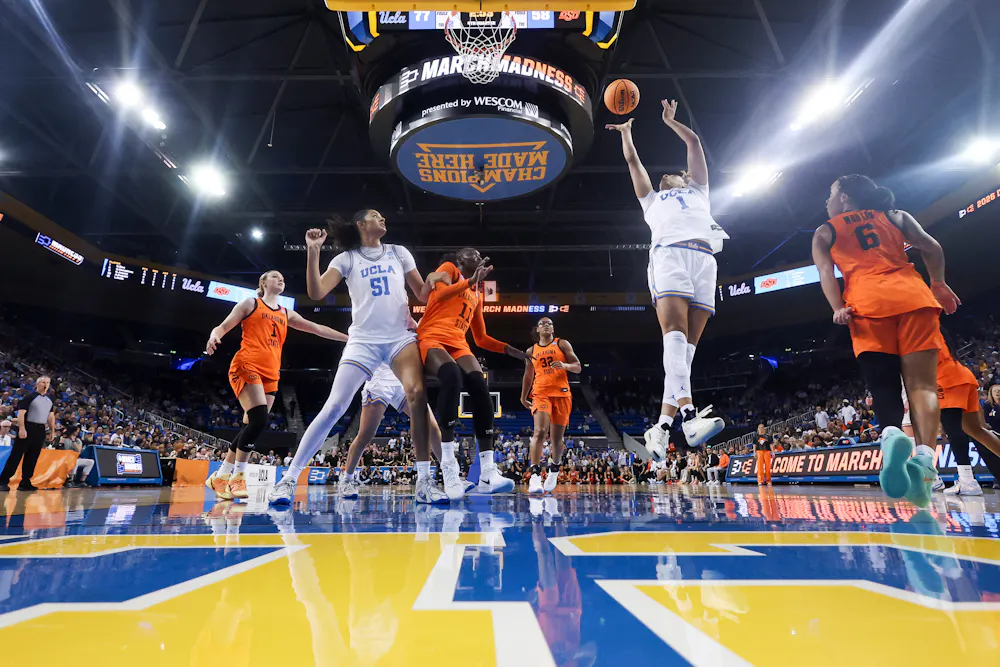
Every March Madness it happens. A player steps to the line, takes the shot and misses. And just like that, there goes your perfect bracket.
These are elite players. The player has made that shot thousands of times before. So what went wrong this time?
Research from my lab has found that the difference between making and missing a shot may come down to stability not only in how you move but how you think.
Measuring brain activity
My team wanted to understand how people build their skill at shooting hoops. So we examined the early phase of learning this particular skill – when coordination between your brain and body is still being formed rather than taken for granted.
Decades of research on the performance of elite athletes suggest that their sport-specific movements are consistent and their brains appear to be optimized for the task. In other words, they show less unnecessary brain activity and more focused processing on executing a specific activity. But it is not known whether these brain states are exclusive to elite performance or whether they can begin early in the learning process.
To investigate this question, my team recorded both the body movement and brain activity of novice and intermediate basketball players as they shot hoops. Specifically, we used motion capture technology to analyze their movement mechanics and electroencephalography to analyze their neural activity. After a brief practice and familiarization phase, each player took 50 shots. We then compared the shots that went in with those that did not.
What we found was telling.

Successful shots for all players were associated with more consistent movement patterns. The feet and lower body were positioned to provide a stable base of support, improving balance and enabling more effective transfer of force to the ball. Joint motion across the body was more coordinated, and variability was reduced in key segments of the movement, particularly at the wrist and elbow.
At the neural level, successful shots were associated with more stable neural activity. There was also increased activity related to the integration of sensory information and motor control.
Unsuccessful shots, by contrast, were much more inconsistent, showing small fluctuations throughout the movement. This suggests the players were continuously correcting their movements mid-execution. Similarly, brain activity during missed shots appeared to reflect a system still trying to figure things out, continuously evaluating, adjusting and correcting.
This trial-by-trial variability and adjustment is exactly what’s expected in early skill acquisition. According to a classic model of learning, beginners rely more heavily on effortful processing of verbal, visual and spatial information as they learn to coordinate perception and action. In other words, they are consciously and actively thinking through the movement. Learning requires exploration, error detection and correction as the brain and body are searching for a solution.
Even within this messy process of learning, successful attempts already showed signs of greater control. Making a shot was not simply about whether the brain was more or less active, but about how consistently it operated. Successful shots were marked by a more stable, less variable brain state, along with activity patterns suggesting the brain was better tuned to the demands of the task.
Mind over matter
But here’s the catch: The processes that help you learn can hurt you when you perform.
Elite athletes are not consciously micromanaging each action. Rather, they rely on systems that have been finely tuned through repetition. As skill develops, performance becomes less about effort and more about consistency. Variability decreases as neural processing becomes more efficient.
Under pressure, however, that stability is exactly what can break down. A college player may be very talented, but they are still developing physically and mentally. In high-stakes, high-pressure moments – especially like those in March Madness, which they haven’t experienced in practice – pressure can push the athlete back into their own heads. They may begin to monitor and control their movements more consciously and explicitly. This reintroduction of conscious processing can disrupt the automatic coordination they have built through practice, inadvertently increasing the variability of their movements and thoughts and therefore reducing performance.
Training that focuses not only on the mechanics of the sport but also the mental side of performance could help athletes enter, maintain or return to the mental state that supports consistent performance, even under pressure. My lab is investigating biofeedback and neurofeedback tools to help make these invisible states and metrics visible to aid in training. If athletes can learn how their brains and bodies react under pressure and practice returning to a more stable state, that may be one path toward more consistent performance.
The goal is not just to learn the right movement, but also to learn when and how to stop trying to control it.
David Van den Heever does not work for, consult, own shares in or receive funding from any company or organization that would benefit from this article, and has disclosed no relevant affiliations beyond their academic appointment.
Read These Next

IceCube is built on decades of research into tiny ‘ghost particles’ – but it was the first to find n
IceCube looks for high energy neutrinos from space. It joins the ranks of complementary experiments…
Many drugs have mirror chemical structures, one helpful and the other harmful – a Nobel-winning disc
From thalidomide to resveratrol, molecules with the exact same chemical properties can have drastically…
Why your boss matters more than remote or hybrid work when it comes to burnout and job satisfaction
A return to the office can mean very different things to different workers, which is why this debate…