NASA’s Artemis II mission will take an astronaut crew around the Moon – a space policy expert descri
Artemis II will test the life control systems on the Orion spacecraft and, if all goes well, take a trip around the Moon.

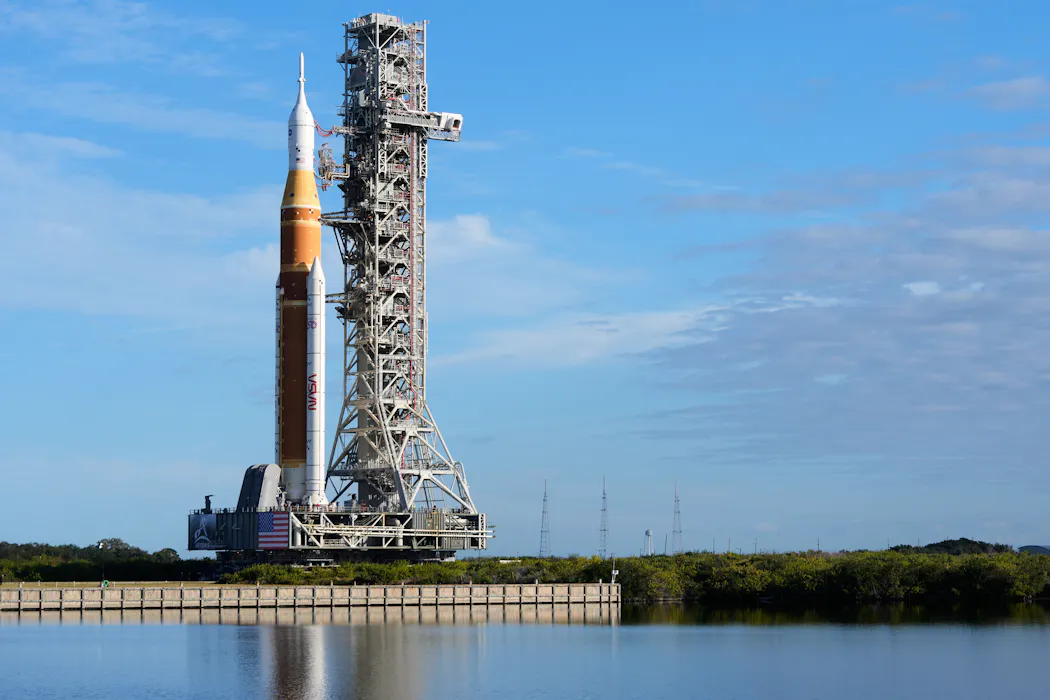
NASA is once again shooting for the Moon, for the first time since the 1970s. As soon as April 2026, NASA will launch its Artemis II mission, using the Space Launch System heavy lift rocket to send a crewed spacecraft, called Orion, into orbit. From there, the crew will journey to and circle around the Moon over 10 days.
In this episode of The Conversation Weekly podcast, we spoke to Scott Pace, the director of the Space Policy Institute at George Washington University. Pace worked with the George W. Bush administration in space policy, and from 2017 served for four years as the executive secretary of the National Space Council during Donald Trump’s first term as president.
In the first paragraph, it makes it sound like the spacecraft is landing on the moon. “From there, the crew to orbit around the Moon over 10 days”
We’re about to send humans in orbit around the Moon again. What’s had to happen to get to this point?
Pace: Let’s go back to the 1980s and 1990s. After the space shuttle Challenger accident, a lot of people were thinking, “What do we do next?”
The space shuttle program was not an economic success. The recurring cost per flight was very expensive. So there was a lot of thinking about different vehicles that could be the shuttles’ successor. NASA pursued some of the higher-risk options, thinking that if they didn’t work out, they could still extend and use the shuttle. Some of those higher-risk ideas were things like single-stage-to-orbit space planes. When they didn’t work, it was OK because NASA was still working on the shuttle.
And then we had the 2003 space shuttle Columbia accident. NASA figured they could either stop for a decade or so and then try to restart a human spaceflight program once they had better technology, or try to transition the infrastructure and industrial base they had with the space shuttle to a new system.
When the second shuttle accident happened, we examined what we had to build a new system with, and we had solid rocket boosters and external tanks. To make something safer, we needed to build crew capsules. A capsule with an escape system onboard was one of the few immediate ways you could increase the likelihood of a crew’s survival.
If your eventual goal is Mars, you’ll then need a really heavy-lift vehicle to launch more crew and a heavier load. All that deliberation led to the current Space Launch System and the Orion capsule.
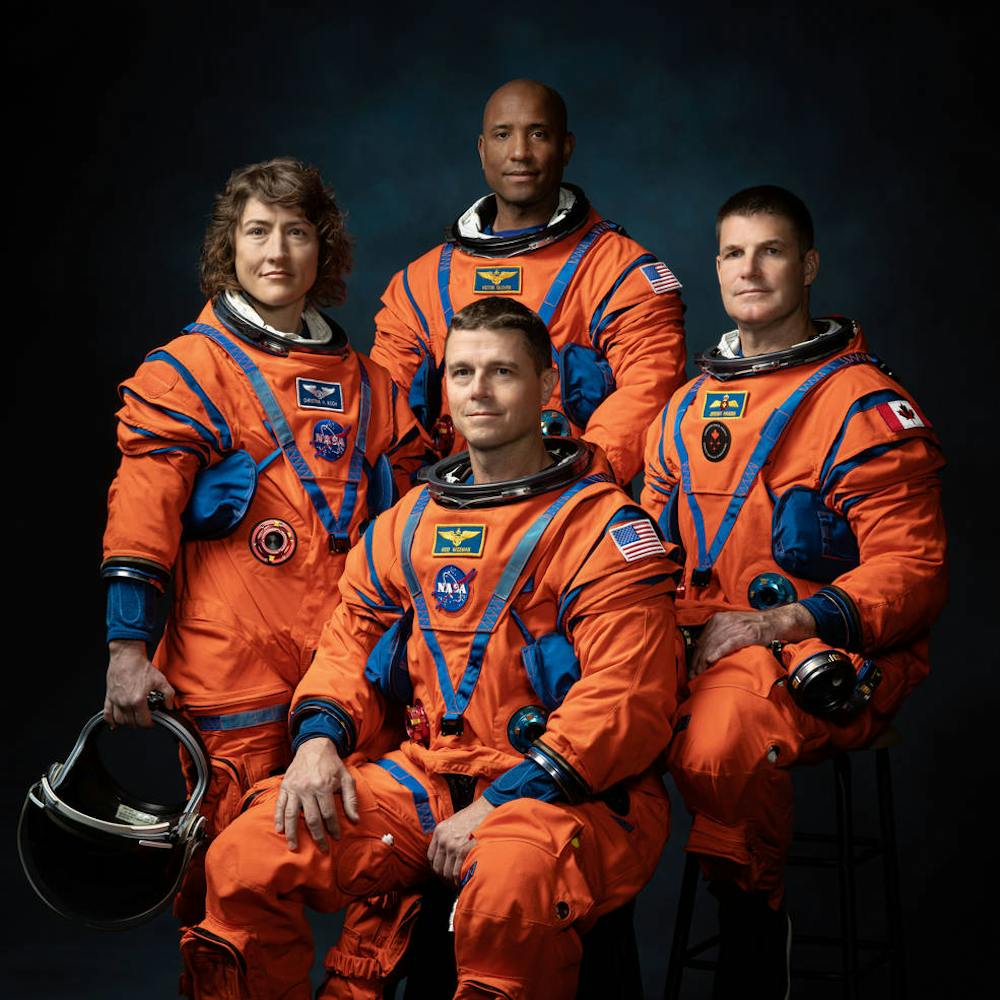
Four astronauts will be sent on a 10-day mission orbiting the Moon. What’s exciting to you about this mission, and what will you be looking out for?
Pace: The first thing is the performance of the solid rocket boosters on launch. Boosters are very reliable, but if they go bad, they go bad pretty quickly. The next thing is a checkpoint in Earth’s orbit when they’re going to make a decision about whether to do a translunar injection. During the translunar injection, they fire the engine to escape Earth’s orbit and get on the right path to orbit around the Moon.
Before they decide, they’re going to check the environmental control and life support system to make sure the passengers are safe and healthy inside the vehicle. Once you make the commitment to head for the Moon, that life support system is going to be essential. And they haven’t yet done a full flight test on Orion of the environmental control and life support system.
The translunar injection is actually fairly straightforward. In many ways, this is less risky than Apollo 8, which went to the Moon and then fired its engines to get into a stable orbit around the Moon. Then, it fired the engines again to come home.
Artemis II is more like Apollo 13. They’re going up, looping around the Moon and using its gravity to whip around and then come back. In some ways, it’s a less risky trajectory than Apollo 8 because you don’t have to fire the engines as much.
When the crew vehicle comes back, we’re going to look at its heat shield performance. The heat shield has had a long and complicated history. It looks like it’ll be safe, but this is a flight test. And so we’re going to look at how it reenters the atmosphere and how it handles the heat load put on it.
The SLS does come with challenges. One is the high cost. Every time you build one of these vehicles, it costs several billion dollars. The other problem is flight rate.

Some people will argue that beating China to the Moon is really important. Does that matter to you?
Pace: It matters to me if China is the only one showing up and they drive all the standards and the operating norms on the Moon. But the issue of beating China back in the near term doesn’t quite seize me as much as the longer term.
This is part of the problem I have with the term “race.” The U.S. had a space race in the past, but what we have now with China is a long-term competition.
Space is not yet contentious in the way the South China Sea is, or border disputes with India are. But I can see why some people are worried by looking at China’s behavior in other areas.
Part of the stated goal for Artemis is to secure a lasting presence on the lunar surface. Do you think there’s a rationale for nations to stay permanently on the Moon now?
Pace: Humanity’s future in space depends on two sub-questions. First: Can you live off the land and use local resources, or are you always dependent upon Earth? Second: How are you paying? Are you also financially dependent upon Earth – for example, supported by taxpayers?
If you can both use local resources and do something economically useful, then you can build space settlements and get permanent human activity beyond the Earth.
If the answer is no on both counts, then space is like Mount Everest: It’s a place of adventure and symbolism. People can go there and take pictures. But nobody really lives there.
If you can do something useful in space and generate an economic return, but still have to come home to Earth because the environment can’t support life long term, then space is like a North Sea oil platform. It’s a dangerous and difficult place, but a place where you can go for economic reasons.
If you still have to depend on taxpayer money, space may be similar to Antarctica – like going to McMurdo Station. You can do science there and have a human presence, but it’s a constrained environment.
Part of the purpose of exploration is to find out which of these futures is feasible. Some people have faith that space settlements are possible. But we really don’t know.
If it turns out there are economically useful things to do on the Moon, there may be an eventual transition. Activity on the Moon would go from a government-led effort to one led by private sector activities, including mining helium-3 or shipping water back to refueling stations.
If it turns out that none of that really makes sense, we’d still have some science presence there, but we would press on to Mars. I think there’ll be some sort of scientific presence regardless – but its size will depend on economics and markets that we, frankly, don’t understand yet.
The world today in space is much more globalized, much more democratized. Many more countries and entities are involved in space. While the U.S. wants to be the leader in this effort, it knows that simply doing it with a NASA logo is really not sufficient. The Artemis program is meant as an international and commercial partnership effort with others to voluntarily shape what space looks like.
Scott Pace is an advisor for Sierra Space and is a member of the Board of Trustees for the Planetary Science Institute, and the Board of Advisors for the National Security Space Association. He was a political appointee in the Administrations of George W. Bush (2002-2008) and Donald J. Trump (2017-2020). He is the Director of the Space Policy Institute at the Elliott School of International Affairs, at George Washington University, Washington, D.C.
Read These Next
IceCube is built on decades of research into tiny ‘ghost particles’ – but it was the first to find n
IceCube looks for high energy neutrinos from space. It joins the ranks of complementary experiments…
Many drugs have mirror chemical structures, one helpful and the other harmful – a Nobel-winning disc
From thalidomide to resveratrol, molecules with the exact same chemical properties can have drastically…

From jargon to impact: Teaching undergraduates the art of public communication
Teaching public storytelling to students can help them communicate better in the world.