
Hundreds of hungry mosquitoes, a student volunteer and a mesh suit helped us figure out how these de
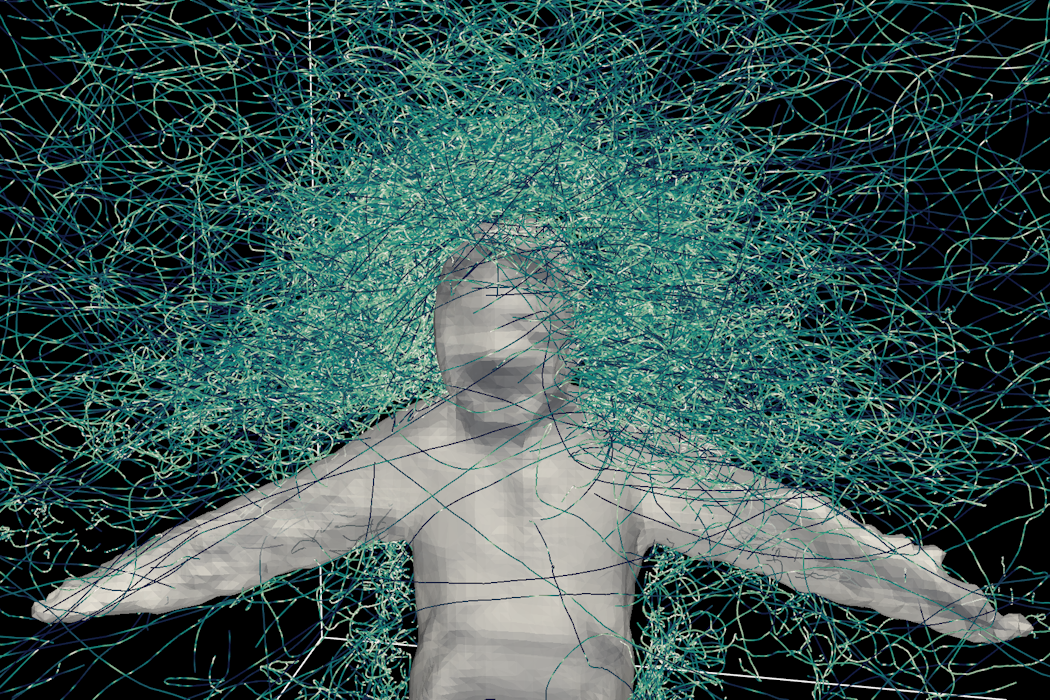
Analyzing 20 million recorded mosquito flight paths revealed the mathematical rules behind how these tiny predators move and zero in on their human targets.

“Four minutes is too long.”

That’s the note undergraduate Chris Zuo sent me along with photos of countless mosquito bites on his bare skin. This full-body massacre wasn’t the result of a camping trip gone awry. He’d spent that limited amount of time in a room with 100 hungry mosquitoes while wearing nothing but a mesh suit we thought would have protected him.
Thus began our three-year journey trying to understand the behavior of a deceivingly simple insect, the mosquito. It may sound like a professor’s sadistic plan, but, really, we did everything by the book. Our university’s institutional review board approved our procedures, making sure Chris was safe and not coerced in any way. The mosquitoes were disease-free and native to our home state of Georgia. And this session resulted in the first and last bites anyone received during the study.
Besides my role as torturer of students, I am an author and professor at Georgia Tech with over 20 years of experience studying the movement of animals.
Mosquitoes are the world’s most dangerous animal. The diseases they carry, from malaria to dengue, cause over 700,000 deaths per year. More people have died from mosquitoes than wars.
The world spends US$22 billion per year on billions of liters of insecticides, millions of pounds of larvicides, and millions of insecticide-treated bed nets – all to fight a tiny insect that weighs 10 times less than a grain of rice and has only 200,000 neurons.
Yet, people are losing the war on mosquitoes. These insects are evolving to thrive in cities and spreading disease more rapidly with climate change. How can such simple animals find us so easily?
Scientists know mosquitoes have terrible eyesight and depend on chemical cues to make up for it. Knowing what attracts a mosquito, though, isn’t enough to predict its behavior. You can know a heat-seeking missile is drawn to heat, but you still won’t know how a missile works.
Enter Chris and his self-sacrifice in the mosquito room. By tracking the flight of many mosquitoes around him, we hoped to determine how they made decisions in response to his presence. Understanding how mosquitoes respond to humans is a first step to controlling them.
How mosquitoes zero in on their meal
Out of 3,500 species of mosquitoes, over 100 species are classified as anthropophilic, meaning they prefer humans for lunch. Certain species of mosquitoes will find the one person among a whole herd of cattle in order to suck human blood.
This is quite a feat considering mosquitoes are weak flyers. They stop flying in a slight 2-3 mph breeze, the same air speed generated by a horse’s swinging tail. In calmer conditions, mosquitoes use their minuscule brains to follow human heat, moisture and odors that are carried downwind.
Carbon dioxide, the byproduct of respiration of all living animals, is particularly attractive. Mosquitoes notice carbon dioxide as well as you notice the stink of a full dumpster, detecting it up to 30 feet (9 meters) away from a host, where concentrations dip to a few parts per million, like a few cups of dye in an Olympic-size pool.

Mosquitoes’ vision isn’t much help as they hunt for their next blood meal. Their two compound eyes have several hundred individual lenses called ommatidia, each about the width of a human hair. They produce a somewhat blurry mosaic or pixelated image. Due to the laws of optics, mosquitoes can discern an adult-size human only at a few meters away. With their vision alone, they cannot distinguish a human from a small tree. They inspect every dark object.
Gathering the flight-path data
The challenge with studying mosquito flight is that, like trash-talking teenagers, most of what they do is meaningless noise. Mosquitoes flying in an empty room are largely making random changes in flight speed and direction. We needed many flight trajectories to cut through the noise.
One of our collaborators, University of California, Riverside, biologist Ring Cardé, told us that back in the 1980s, scientists conducted “bite studies” by stripping down to their underwear and slapping the mosquitoes that landed on their naked bodies. He said nudity prevented confounding variables, such as the color of a shirt’s fabric.
Chris and I looked at each other. Sit naked and wait to become mosquito prey? Instead, we designed the mesh suit that Chris originally wore into the mosquito room. But after seeing Chris’ bites, we needed a better way.
Instead, Chris washed long-sleeved clothes in unscented detergent and wore gloves and a face mask. Fully protected, Chris only had to stand and wait, while a cloud of mosquitoes swarmed him.
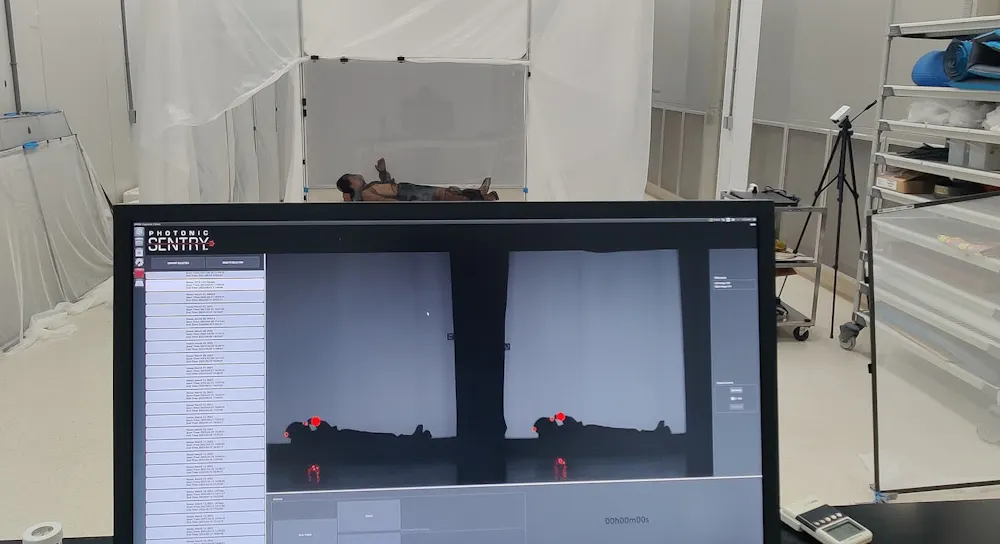
The U.S. Centers for Disease Control and Prevention introduced us to the Photonic Sentry, a camera that simultaneously tracks hundreds of flying insects in a room. It records 100 frames per second at 5 mm resolution for a space like a large studio apartment. In just a few hours, Chris and another graduate student, Soohwan Kim, generated more mosquito flight data than had previously been measured in human history.
Jörn Dunkel, Chenyi Fei and Alex Cohen, our mathematician collaborators at MIT, told us that the geometry of Chris’ body was still too complicated to study the mosquitoes’ reactions. Mathematicians excel at simplifying complex problems to their essence. Chenyi suggested we go easy on Chris – why not replace him with a simple dummy: a black Styrofoam ball on a stick combined with a canister of carbon dioxide.
Over the next two years, Chris filmed the mosquitoes circling the Styrofoam dummies mercilessly. Then he vacuumed up the mosquitoes, trying not to get bitten.
Deciphering the trajectories
A mosquito flies like you would an airplane: it turns left or right, accelerates or hits the brakes. We determined a mosquito’s flight behavior as a function of its speed, location and direction with respect to the target as the first step in creating our model of their behavior.
Our confidence in our behavioral rules increased as we read more trajectories, ultimately using 20 million mosquito positions and speeds. This idea of incorporating observations to support a mathematical hypothesis is a 200-year-old idea called Bayesian inference. We illustrated the mosquito behavior we’d observed in a web application.

Using our model, we showed how different targets cause mosquitoes to fly differently. Visual targets cause fly-bys, where mosquitoes fly past the target. Carbon dioxide causes double takes, where mosquitoes slow down near the target. The combination of a visual cue and carbon dioxide creates high-speed orbiting patterns.
Up until now, we had used only experiments with Styrofoam spheres to train our model. The true test was whether it could predict mosquito flights around a human. Chris returned to the chamber, this time wearing all white clothes and a black hat, turning himself into a bull’s-eye. Our model successfully predicted the distribution of mosquitoes around him. We identified zones of danger, where there was a high chance of a mosquito circling around him.
Predicting mosquito behavior is a first step toward outsmarting them. In mosquito-prone areas, people design houses with features to prevent mosquitoes from following human cues and entering. Similarly, mosquito traps suck in mosquitoes when they get too close but still allow between 50% and 90% of mosquitoes to escape. Many of these designs are based on trial and error. We hope that our study provides a more precise tool for designing methods for mosquito capture or deterrence.
When Chris’ mother attended his master’s degree defense, I asked her how she felt about her son using himself as bait for mosquitoes. She said she was very proud. So am I – and not just because I’m relieved Chris didn’t ask me to take his place in the mosquito chamber.
David Hu does not work for, consult, own shares in or receive funding from any company or organization that would benefit from this article, and has disclosed no relevant affiliations beyond their academic appointment.
Read These Next

Federal spending on climate change before 2024 election boosted incumbents of both parties
Incumbents can still reap electoral rewards when federal money reaches their districts, even if they…
Students take up to 88 standardized tests before high school, but more testing doesn’t improve learn
Students’ scores on standardized tests can affect schools’ ratings, adding to the pressure teachers…