Not just Patriot interceptors: A defense expert explains the various weapons US and allies use to de
Concerns about shortages of interceptor missiles in the conflict between the US and Iran highlight the challenges of defending against missiles and drones.

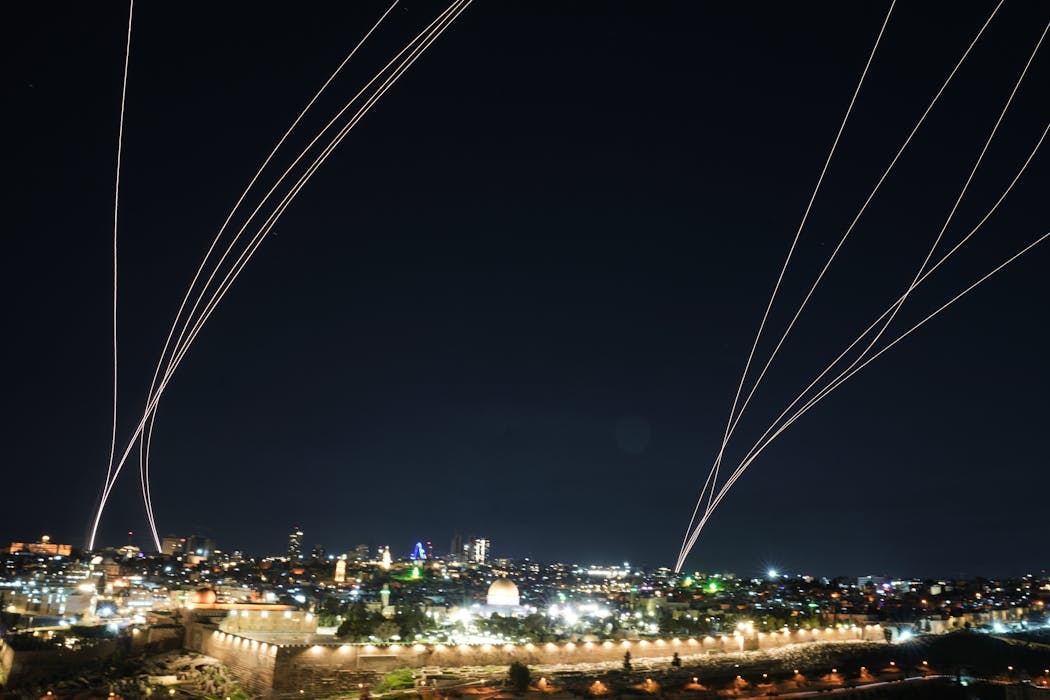
Patriot missile batteries have been the iconic air defense system in the United States’ arsenal for several decades, but evolving threats – from cheap rockets to even cheaper drones – have forced the U.S. and other militaries to develop a range of defensive weapons to match.
In retaliation for ongoing strikes by the U.S. and Israel, Iran has been conducting daily aerial attacks using missiles and drones against Israel and countries in the Persian Gulf region. In December 2025, Iran also launched a large-scale, coordinated raid involving hundreds of missiles and drones against Israel. Hamas launched an even larger assault in October 2023 of many thousands of low-cost rockets and primitive missiles against Israel, overwhelming its highly touted Iron Dome air defense system. And, in the conflict between the Ukraine and Russia, there have been several examples of large-scale drone raids by both sides.
As an engineer who studies defense systems, I see that as the variety and number of missile and drone threats grow, militaries are forced to adapt the defensive side of the equation and respond with matching speed and breadth.
The defensive weapons are components of integrated air defense systems, which include the means to detect and track threats, typically through various forms of radar. Stemming from the Cold War, interceptor missiles have been the established weapon used to disable or destroy the threats.
Well-known examples of air defense systems that use interceptor missiles include the Patriot system and the Israeli Iron Dome. These systems are designed to be effective against small numbers of missiles, including short-range ballistic missiles, as well as aircraft and drones. The U.S. also uses the Terminal High Altitude Area Defense to defend against intermediate range ballistic missiles, including intercepting the missiles before they reenter Earth’s atmosphere.
The numbers
The current conflict in the Gulf provides the latest example of the math at the heart of the air defense challenge. Iran has fired thousands of missiles and drones, and it often requires more than one interceptor to take out an incoming missile. The Gulf states are reportedly running low on interceptors. U.S. stocks are also under pressure, and the United States is reportedly planning to move some interceptors from South Korea to the Gulf region.
Because each interceptor costs several million dollars, it is a losing proposition to use such systems to destroy rockets that only cost US$100,000. Such an asymmetric conflict is not only too expensive on the defensive side, but it is also challenging to replenish interceptors in a timely manner.
In addition, an attacker can overwhelm a defender. In the Hamas attack on Oct. 7, 2023 against Israel, the established interceptor-based air defense approach proved less than effective against the large-scale attack involving thousands of relatively primitive missiles and rockets. There are initial reports of a large barrage of rockets fired by Hezbollah at Israel on March 11, 2026.
What is needed instead are air defense approaches that scale to meet the numbers and sophistication levels of the evolving threats. One example is the U.S. Navy’s Phalanx Close-In Weapon System used to defend ships against missiles as well as small surface craft. It is an automated machine gun that can fire up to 4,500 rounds per minute. It destroys incoming targets by literally shooting them to pieces. Each round costs about $30, and usually about 100 rounds are expended on a target.
While this is a more cost-effective approach than expensive interceptors, a Phalanx magazine can be quickly depleted in 20-30 seconds, thus leaving it open to being overwhelmed by large numbers of incoming missiles. It is also the last line of defense. Ideally, you would address threats long before the Phalanx system is activated.
Drones and anti-drone drones
Large-scale, low-cost air attacks involving weaponized drones have been used in the Ukraine-Russia war and in the Middle East. While drones can be shot out of the sky by missile interceptors, this is not a cost-effective approach. Gun systems such as the Phalanx are effective against drones. U.S., Gulf states and Israeli forces have also downed drones using guns fired from aircraft.
Another new approach that has been used by Ukrainian forces is the development of anti-drone drones, or counter unmanned aircraft systems. Drones can damage or destroy other drones through a variety of mechanisms, including electronic warfare that involves jamming their radio control and communications systems, and kinetic intercepts, in which they ram directly into the target drone. An example is Merops, which the U.S. is reportedly sending to the Gulf region.

Energy weapons
Militaries are also developing non-kinetic defensive weapons that are based on directed energy technologies. The two most common forms of directed energy weapons are high-energy lasers and high-power microwaves. In both cases, they transform electrical power into physical effects that can damage or destroy aerial targets.
One of their key advantages over traditional kinetic defensive weapons is the claim that directed energy systems have an “infinite magazine.” As long as these systems are connected to an electrical power source, they can keep firing. While this is not entirely true – directed energy systems have to be cycled off to allow them to cool down – they are more cost-effective and have deeper magazines than kinetic systems.
Militaries around the world are fielding high-energy laser weapons for protection against light artillery, drones and surface craft. Lasers can create a number of different effects, including burning holes in threats and even setting them on fire.
For example, the U.S. Navy’s High Energy Laser with Integrated Optical-dazzler and Surveillance is a 60-kW kilowatt ship-based system used for aerial protection. It can interfere with, or dazzle, the sensors of missiles and drones.
High-power microwave weapons are not yet as advanced for air defense applications. They operate by causing short circuits in the electrical systems of missiles and drones, causing them to lose control and veer off target.
Rapid evolution
In the cat-and-mouse game of modern warfare, there is a continual carousel of offensive weapons development and responsive defensive countermeasures. Against a recent trend toward the use of large numbers of less capable and relatively inexpensive weapons, the defensive side is responding with affordable, high-volume approaches.
Iain Boyd receives funding from the U.S. Department of Defense and Lockheed-Martin Corporation.
Read These Next

AI can help with academic research but doesn’t always get it right – here are some tips to check the
AI is quickly changing. These tips from university librarians can help people keep pace with the shifts…

Missing ambassadors, inexperienced appointees – is Washington dropping the diplomatic ball?
Almost half of US ambassador jobs remain vacant. Meanwhile, political appointees are outnumbering career…

What is a professional patient advocate, and why might you need one?
Family members can offer invaluable support to patients, but a trained advocate can provide an objective…