I study why zebrafish larva prefer to circle left or right, to understand how and why human brains e
Being left- or right-handed – and the paw, eye, fin and wing equivalents – is a product of genes, development and the environment.

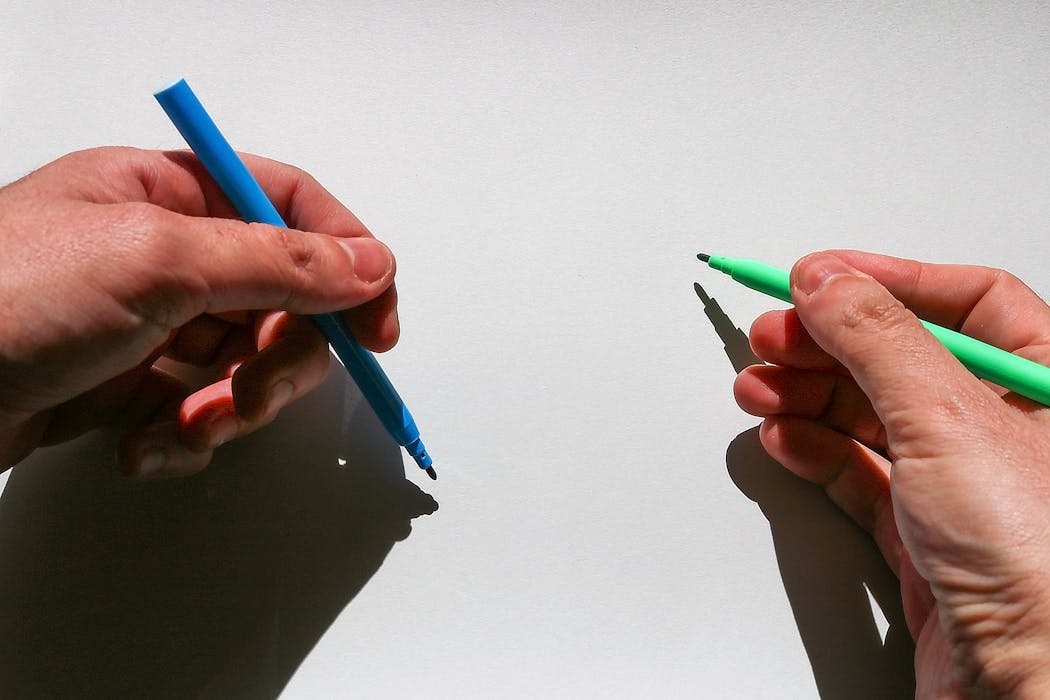
Being right- or left-handed is a familiar fact about yourself you likely don’t think about much on a day-to-day basis. However, your handedness affects how you interact with the world.
For many people, it determines how they brush their teeth, use tools, play sports, write, eat and much more. Simply try to enjoy a bowl of soup or sign your name with your nondominant hand to appreciate the impact a hand preference can have on your daily life.
Interestingly, this behavioral asymmetry is not unique to humans. Preferences for using the right or left hand, paw or eye exist in most species. For example, many primate species have individual left- or right-hand preferences for manual tasks. Similarly, different bird species have varying eye preferences for distinct visual tasks. Even the largest animal alive, the blue whale, shows a preference for the direction of its rolls during feeding. This inherent and often-overlooked feature of behavioral asymmetry is a widespread phenomenon in the animal kingdom.
The universality of behavioral asymmetry suggests that having an assigned hand, eye or other preference is beneficial. But depending on one hand for so many important tasks means that a single injury could be devastating. This paradox poses an important question: Why would having handedness be better for survival than not?
Insights from fish ‘handedness’
To address this question, scientists have tried to understand the genetics of handedness. While large-scale genetic studies in humans have identified dozens of genes associated with handedness, researchers also found that genetics alone only partially accounts for whether someone is left- or right-handed. This means behavioral asymmetry like handedness is likely the product of complex interactions between genetics, development and the environment.
For the past six years, my research lab has been interested in understanding behavioral asymmetry and how such behaviors get encoded in the brain. We primarily use larval zebrafish to explore the neural basis of behavioral asymmetry. These animals have transparent bodies and rapidly develop into adults in just a few days, making them ideal models to study. Additionally, the genetics and brain structure of zebrafish are highly similar to those of humans.
Fish have a form of handedness called motor asymmetry, which involves sustained periods of turning in the same direction. I had previously found that when light was cut off, larval zebrafish start circling in a leftward or rightward direction, sometimes for up to a minute or more. The fish would continue to preferentially turn in that same direction over the course of hours, days and even weeks, looking for a light source. This meant that vision drove their motor asymmetry.

Students in my lab recorded the zebrafish’s neural activity in response to loss of environment light – the trigger for motor asymmetry. They found a subset of approximately 60 neurons in the thalamus – a region of the brain that is evolutionarily conserved among vertebrates and involved in relaying sensory information – was functionally linked to motor asymmetry. Removing these neurons eliminated this motor asymmetry, suggesting a potential neural basis for where behavioral asymmetry is established in the fish brain.
When my lab repeated our experiments on five additional species of larval fish from around the world, we found similar motor asymmetry in response to light. Much like handedness in primates, it appears that handedness in fish is likely more of a rule than an exception.
However, we did find one exemption: the Mexican tetra, also known as cavefish. These animals are found in perpetually dark cave environments and are naturally blind. In collaboration with our colleagues at the Duboué Lab at Florida Atlantic University, we found that these animals showed no motor asymmetry.
These findings suggest that the universal nature of behavioral asymmetries are likely crucial responses to common challenges that different organisms encounter.
Behavioral asymmetry may solve challenges
Hurting your dominant hand does more than just ruin your softball or ultimate frisbee game. Handedness is associated with broad neural asymmetries in the brain that are linked to performance in language comprehension and working memory tasks. In addition, having atypical handedness – such as preferring different hands for different activities – is associated with a range of neurological conditions, including autism and attention-deficit/hyperactivity disorder.
Understanding why animals have behavioral asymmetries offers clues about how the environment influences broader cognitive function. If environmental challenges indeed drive handed behaviors, what problems does motor asymmetry solve for fish?

In nature, animals often circle when searching for something, such as a food source. For larval zebrafish, light is an important resource for their ability to see and capture prey. When we placed a light source at varying locations around them, the larval zebrafish start circling to quickly navigate into illuminated environments conducive to hunting. Based on our work, we hypothesize that the asymmetries in fish that allow them to search more efficiently work in parallel ways to those of other animals, like eye movement in birds or language comprehension in people.
Prior research has suggested that brain asymmetries improve cognitive performance by reducing competition between the two sides of the brain. Our work supports these hypotheses by showing how, for zebrafish, motor asymmetry provides a default response to find light and efficiently catch a needed snack.
With a helping hand from fish handedness, researchers are getting a clearer idea of the universality of behavioral asymmetry and how the environment may be shaping the brain so that one hand, or fin, provides an advantage in daily life.
Eric Horstick receives funding from the National Institutes of Health and National Science Foundation.
Read These Next

IceCube is built on decades of research into tiny ‘ghost particles’ – but it was the first to find n
IceCube looks for high energy neutrinos from space. It joins the ranks of complementary experiments…
Many drugs have mirror chemical structures, one helpful and the other harmful – a Nobel-winning disc
From thalidomide to resveratrol, molecules with the exact same chemical properties can have drastically…

From jargon to impact: Teaching undergraduates the art of public communication
Teaching public storytelling to students can help them communicate better in the world.