Tiny recording backpacks reveal bats’ surprising hunting strategy
By listening in on their nightly hunts, scientists discovered that small, fringe-lipped bats are unexpectedly able to efficiently take down prey nearly their own size.

Deep into the Panamanian night, the forest hums with sound. Chirping insects form a steady backdrop, rain softly trickles from leaves. Somewhere above a stream, frogs call into the darkness.
But I am not there to see this scene.
It’s already passed. What I hold now is a small, mud-smeared biologger, no larger than a Lego brick. This tag recorded the sounds of the previous night.

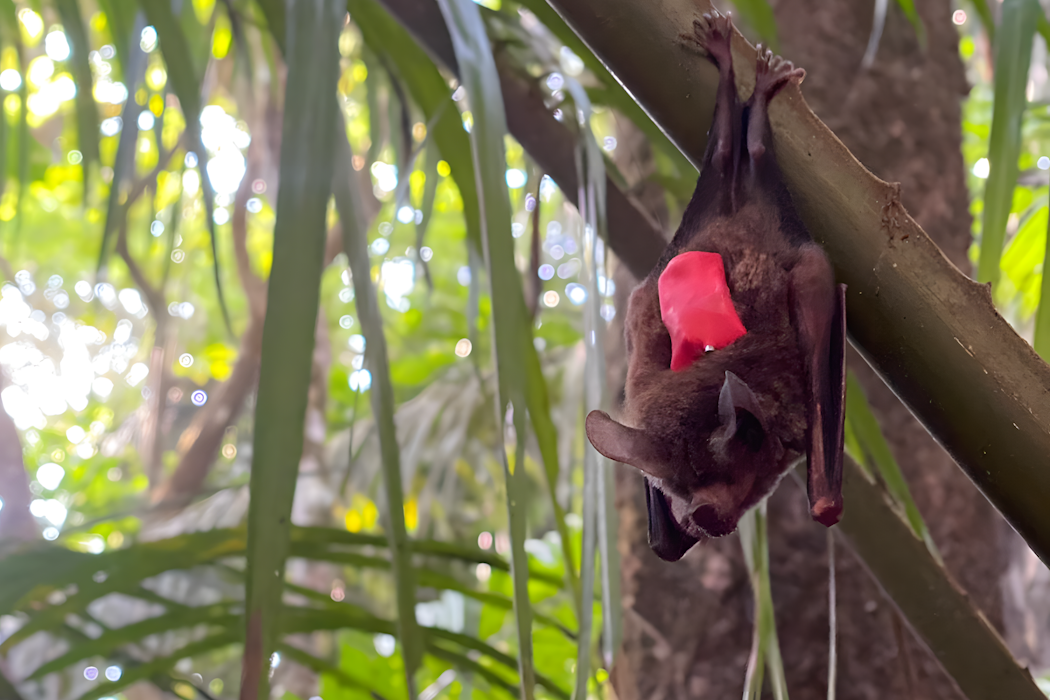
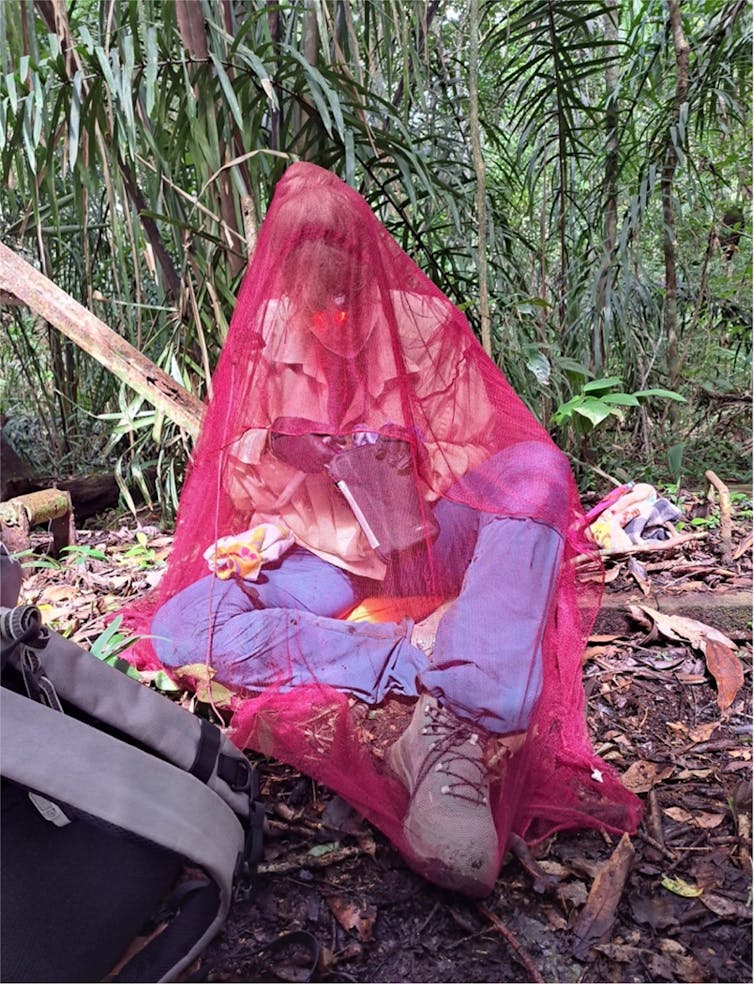
The evening before, my team and I had set nets outside the roosts – hollow trees or human-made structures such as tunnels or bunkers – where fringe-lipped bats (Trachops cirrhosus) sleep during the day. Under the faint glow of red headlamps, we weighed each bat we caught on its way out of the roost, checked its age and sex, and carefully glued a tiny tag to the fur between its shoulder blades.
When we released a tagged bat into the darkness, it vanished into the trees, carrying our recorder into the night.
Within a few days, the tags either fell off naturally or I gently removed them from recaptured bats with a quick trim of fur. Each biologger captured five to six hours of continuous sound and movement data – every flight, every attack, every crunch of prey bones between sharp teeth.
For the first time, I could follow a predator through the forest from its own point of view. And what those recordings revealed surprised me: Our fringe-lipped bats don’t simply grab the first thing they detect. Instead, they stalk the forest’s creatures with a patience and precision I hadn’t expected.
Tiny tags for tiny hunters
I’m a behavioral ecologist, and fringe-lipped bats have been part of my scientific life for years, through my work with animal behavior researcher Rachel Page at the Smithsonian Tropical Research Institute in Panama. In our recent study published in the journal Current Biology, we paired decades of field knowledge with miniature biologging technology, allowing us to accompany the bats through the night.
When I plug a tag into my laptop, I follow that journey in sound and movement. Through my headphones, I hear a familiar note. A túngara frog (Engystomops pustulosus) calls; that distinctive “whiiiiine-chuck-chuck” I know so well.
On my screen, the line charting the bat’s motions stirs: a tremor of movement, then a sharp burst of wingbeats. At the same time, the audio trace fills with a rapid series of ultrasonic echolocation calls, the staccato sound of a hunter steering through darkness. In my ears, a rush of air surges past the tiny microphone, then there’s a splash, more wingbeats, and finally the faint, wet crunching of teeth. A few minutes later, it’s over.
The bat has eaten the frog. I smile; we’ve studied this bat for so many years, the data matches what we have observed in the laboratory. But now, for the first time, I can hear how the hunt unfolds in the wild.
I scroll further in my recording.
A new sequence begins, but this time there are no frog calls. No sound to guide a strike. Just a sudden rush of air, a violent rustling, and then the unmistakable sounds of a fight thrash through my headphones: wings flapping, claws scraping, and the harsh cries of a prey animal fighting to survive.
Eventually – silence.
For a long moment, I hear only the sounds of the forest. Then again, the beat of wings. The bat is flying once more. It lands. And then comes that telltale sound again – slow, steady and deliberate. The bat is eating its catch.
Five minutes pass. Ten. Twenty. The chewing stops. The motion trace falls flat. As the night drifts on, nothing moves. The bat has fallen asleep.
Much later, the silence breaks. A quick shudder, a few brief pulses of echolocation: The bat is awake again. But it doesn’t fly off. It starts chewing again. And again. In the end, I count a total of 84 minutes of chewing, spread out across several bouts. Whatever this tiny bat caught, it was nothing like the quick frog meal I’d heard before.
Size of predator usually matches size of prey
In the animal kingdom, size usually dictates strategy.
Large lions, wolves and polar bears chase prey nearly their own size, at enormous costs: hours of stalking, bursts of sprinting and long fasts between meals. Their energy reserves let them weather failure after failure until finally a single successful kill restores the balance.
Small predators live by different rules. The tiny bodies of weasels, shrews and bats burn energy so fast that skipping even one meal can mean starvation. For bats, the demands of powered flight push those costs even higher. So they hunt small, abundant prey: quick, low-cost meals that keep the metabolic fire burning.
On average, the bats we tracked made around seven attacks per night and succeeded roughly half the time. Hearing that more-than-one-hour-long chewing episode recorded on the biologger left me astonished. Was this individual bat just an exceptionally slow eater? Or had it taken down something very large?
To find out, I turned to a feeding experiment I had run in captivity, where I measured how long bats chewed prey of known weights. That calibration allowed me to translate chewing time in the wild into meal size. I discovered that most prey weighed around 2 grams, about 7% of a bat’s body mass. But some meals were far larger, reaching up to 30 grams – nearly the bat’s own weight.
How can a creature so small, with so little energy to spare, afford to hunt like a lion?
Listening to dinner
Our bats’ style of hunting is close to that of lions or polar bears, but the efficiency of their hunts sets the bats apart from any large predator. After leaving the roost at dusk, they spent just over five minutes flying in total before making their first attack. So rather than spending the whole night in search on the wing, they flew only about 11% of the time – less than half an hour over five hours of recording.
How could they find their meals so quickly? The answer lies in their extraordinary ears.
Fringe-lipped bats are masters of acoustic espionage. Instead of using echolocation alone to detect their prey, they eavesdrop on the sounds that frogs and other animals make. A túngara frog’s distinctive “tuuuuungara,” for example, carries through the forest and serves as a perfect beacon for a hungry bat.
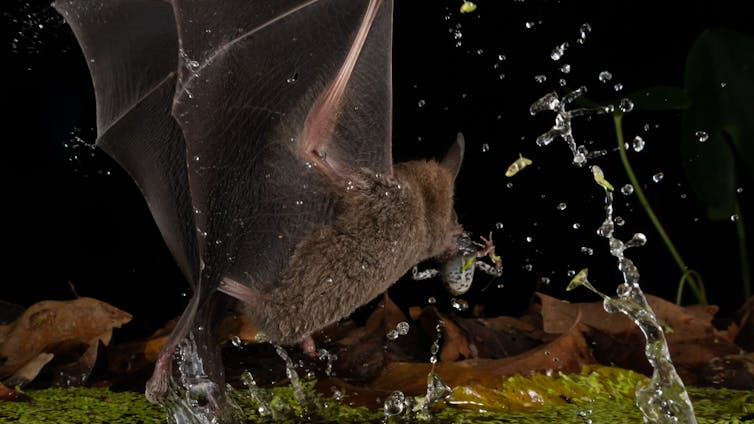
Our recordings show that attacks were eight to 12 times more likely when frog calls were present. Strikes launched from flight clustered near loud choruses, while nearly all attacks from perches occurred in silence.
The bats have a dual ambush strategy. They launch strikes from the air when prey are advertising themselves. When the forest falls quiet, they hang almost motionless from branches to listen for subtler cues, sweeping the scene with their large ears before swooping down onto their prey.
By alternating between active flight and patient perch hunting, they minimize effort and maximize success.
Learning to thrive in a changing world
Fringe-lipped bats have solved the small-predator dilemma by hunting large prey – such as frogs, lizards, birds or rodents – with remarkably little effort.
But not every bat we tracked was equally efficient. Adults tackled a wider range of prey, while juveniles focused only on smaller, more manageable meals – likely smaller frogs, grasshoppers and dragonflies. This variation suggests that experience plays a major role.
Fringe-lipped bats are long-lived – some over 14 years – and have exceptional memories. They can learn new prey sounds by trial and error, or even by observing other bats. Over a lifetime, a bat refines its strategy, becoming more selective in its choice of prey. In this way, it seems that its hunting success is not just a product of anatomy or instinct – it’s also a story of cognitive evolution.
The bats’ success, however, depends on a thriving forest. As amphibians face global declines from disease, habitat loss and climate change, the bats’ longevity gives them some time to respond and learn, offering hope that these extraordinary predators can persist even as ecosystems change – if we work to keep their forests alive.
Leonie Baier has received funding from the European Union’s Horizon 2020 research and innovation program (Marie Skłodowska-Curie Actions) and the Smithsonian Tropical Research Institute.
Read These Next

Indian Gen Z ‘cockroach’ protesters aim to upend assumptions about democracy – and populism – in Mod
The protests challenge the government’s view of who “the people” are, what democracy means, and…

Horror’s monsters find new meaning with queer and trans audiences – how ‘Teenage Sex and Death at Ca
Horror as a genre has traditionally been rife with transphobia and homophobia. But LGBTQ+ fans love…

Horror films exploit how human vision works to deliver movies’ best scares
Scary movies create tension in that space between perception and recognition, as your brain tries to…