Groundhogs are lousy forecasters but valuable animal engineers – and an important food source
Groundhogs predict spring with the same accuracy as flipping a coin. But they’re vital to their ecosystems, feasting through summer to store enough fat to last through their winter hibernation.

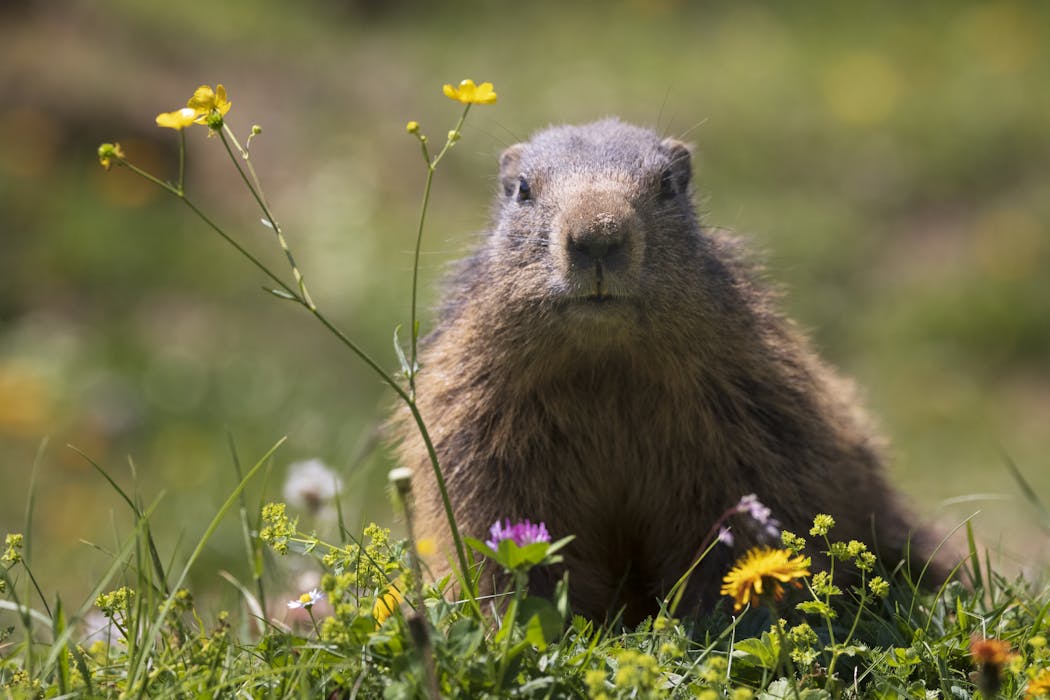
Whether you call him groundhog, woodchuck, whistle-pig or use the full genus and species name, Marmota monax, the nation’s premiere animal weather forecaster has been making headlines as Punxsutawney Phil for decades.
The largest ground squirrel in its range, groundhogs like Phil are found throughout the midwestern United States, most of Canada and into southern Alaska. M. monax is the most widespread marmot, while the Vancouver Island marmot (M. vancouverensis) is found only on one island in British Columbia.
In total, there are 15 species in the genus Marmota, found around the world from as far south as the Jemez Mountains of New Mexico and the Pyrenees Mountains of Spain, north to regions of Siberia and Alaska so dark and cold that the marmots must hibernate for up to nine months of the year.
Hibernating to escape tough times
Marmots, including all the actors who have played Phil over the years, are the largest “true” hibernators: animals that enter a torpor that reduces their biological functions to a level closer to dead than alive.
Because this phenomenon is so interesting, scientists pay attention to all aspects of marmot anatomy and physiology. Basic observational science like this is important to advance our understanding of the world, and it sometimes leads to discoveries that improve human lives. Marmot studies are the foundation for experiments to address obesity, cardiovascular disease, mpox, stress, hepatitis and liver cancer, and they may inform work on osteoporosis and organ transplantation.
Aging seems to nearly stop during hibernation, as the marmot heart rate drops from nearly 200 beats per minute when active to about nine during hibernation. Similarly, their active body temperature can be 104 degrees Fahrenheit (40 degrees Celsius) – about the same as a dog or cat – but plummet to 41 F (5 C) when hibernating. Humans, in comparison, become hypothermic at a core temperature of 95 F (35 C).
Fueling feast and famine
Marmots’ only source of energy during the hibernation period is stored fat, which they may metabolize as slowly as 1 gram per day. But even that is a large amount when it must suffice for more than half a year.
So, marmots need to double their weight during the summer, even in places where the season is only a few months long. To do so, they double the size of their hibernation-state gastrointestinal tract and liver, and then carefully select the most nutritious plants, including legumes, flowers, grains and grasses. Despite their corpulence, they can also climb trees to eat buds and fruit.
Gardener, architect and menu item
The digging and seed dispersal that accompany foraging create flower-filled meadows. Some marmots, like Mongolia’s Tarbagan marmot (M. siberica), are keystone species whose presence is associated with increased diversity of plants and predators.

Marmot burrows are a key architectural component of many other animals’ habitats. Abandoned marmot excavations can provide temperature- and humidity-controlled housing for dozens of species, from frogs to foxes and snakes to owls.
The same activities can make groundhogs a pest to people. In most of the Midwest, groundhog predators were largely eliminated at the same time that agricultural fields became vast marmot buffets. Today, many groundhog populations are tightly controlled by invasive coyotes, as well as recovering populations of bobcats.
Because they are such a high-quality meal, marmots are an important conduit of energy from plants to carnivores. Everything from hawks to eagles, weasels to wolves may eat them. And, like most native birds and mammals, marmots are on the menu of house cats, too. Humans also have long exploited marmots for meat and fur. As a result, once-common marmot species are rare in many places.
But marmots breed like the proverbial bunnies and so have the potential to come back quickly from population declines. They can be reintroduced to former haunts, benefiting the ecosystem.
Hibernation must end at the right time
Shortly after waking from hibernation, marmots mate, giving birth about 4½ weeks later to half a dozen or more offspring. Ideally, pups are born just as the first plants peak through the snowmelt – maximizing the time available to pack on fat for the coming hibernation season.
Given the food needs of these big ground squirrels, and the fact they may be seen poking their heads above the snow before any food is available, it seems reasonable to assume that they have some power of weather prediction. Indeed, people celebrate scores of individual groundhogs across the U.S. and Canada for their ability to anticipate weather six weeks hence.
This American groundhog tradition apparently started with German immigrants recalling the spring emergence of badgers and hedgehogs in the old country. Brown bears have a similar spring schedule and are still celebrated in Romania and Serbia.
People ascribe weather-predicting abilities to other species, too, including woolly bear caterpillars, sheep, cats and dormice.
One tradition holds that tree squirrel nests, called dreys, can predict the severity of the coming winter. Leafy dreys are well ventilated and private – good choices if you need less protection during a warm winter. More insulated hollow trees are cozy in the cold but communal, and so come with the risk of sharing parasites. As a squirrel researcher, I’ve noted the location, number and size of nests for years but seen no discernible patterns related to weather.
Weather responders, not weather predictors

Despite traditional claims, you’ve probably already guessed that Phil and his friends are about as good at predicting the coming weather as that kid who answers “C” for every multiple choice question. A 2021 study on the subject reported that groundhogs’ “predictions of spring onset (are) no better than chance.” That’s right, groundhogs are correct 50% of the time.
One big problem with relying on any species on a specific calendar day is that seasons follow latitude and altitude. Anyone who has hiked the Appalachian Trail can tell you that trekking from south to north maximizes your time in cool spring weather. Similarly, if you venture to the peaks of the Rockies in August, you’ll find spring wildflowers.
For this reason, groundhogs in Alabama emerge from their dens much earlier than those in Wisconsin. As one Canadian newspaper put it in 1939, “Here in Manitoba, no woodchuck in his senses would voluntarily emerge into the cold on February 2.”
Animals’ senses are tools for survival
Modern technology can accurately predict the average weather – that is, climate – far into the future, and the precise weather five days in advance. But the accuracy of a forecast at a given point on Earth 10 days in the future is only about 50% – as good as a groundhog.
However, many animals are sensitive to phenomena that humans need tools to even notice.
Flocks of warblers, sparrows and other birds sometimes seem to appear out of nowhere before a storm. These species often migrate at night, navigating across land and sea by the stars and Earth’s magnetic fields. To avoid getting lost in fog or blown off course, they’ll “fall out” of the sky at good resting spots when bad weather is building. At such times, take the warbler’s advice and don’t venture out on the water.
Frogs chirping in spring indicate that water temperatures are warm enough for eggs, while air temperatures influence caterpillar hatching and activity. Farmers over the centuries have recorded the blooming dates of flowers over the years as a way to predict when to plant and harvest.

Noticing and tracking timing of annual events
Phenology is the study of these natural phenomena and their annual cycles, from the first springtime peek of a groundhog to the last autumn honk of a goose. When does the first flower bloom in your neighborhood, the first thunder clap rumble, or the last cricket chirp?
No individual observation, even Phil’s, has the power to predict the weather. But in aggregate, these observations can tell us a lot about what the world is doing and predict how it will change. You can be like Phil and look for your shadow, or a nice legume to eat, and then contribute to science by adding your observations to the National Phenology Network.
Traditions don’t need to be factually true to be useful. Groundhog shadows bring people together at a cold time of year to look at the clouds, notice buds on the trees and track down the earliest green sprouts, such as skunk cabbage, which warms the snow around it. This Groundhog Day, get out there and enjoy nature as you celebrate the lengthening days and increased activities of the organisms we share this planet with.
Steven Sullivan does not work for, consult, own shares in or receive funding from any company or organization that would benefit from this article, and has disclosed no relevant affiliations beyond their academic appointment.
Read These Next

US inequality is getting worse in ways you might not expect
From tax policy to gas prices and tariffs, a mix of new factors is making inequality in the US more…

How governments worldwide are shaping what AI can say about politics
Some governments use legitimate AI concerns as a pretext to control political discussion, particularly…

Are partisan politics even changing up our accents? They just might be, y’all
Vowels have become the latest players in partisan politics, a barometer of how beliefs and values fit…