
How are dark matter and antimatter different?
Normal matter – which makes up everything we see and touch – isn’t the only type of matter present in the universe.

Curious Kids is a series for children of all ages. If you have a question you’d like an expert to answer, send it to CuriousKidsUS@theconversation.com.
What is dark matter and what is antimatter? Are they the same or different? – Namrata, age 13, Ghaziabad, India
Imagine an epic video game with your favorite hero as a character. Another character is a mirror-image twin who shows up occasionally, exploding everything they touch. And, to add an extra level of difficulty, the game includes a mysterious hive of minions hiding at every corner, changing the rules of the game, but never showing themselves.
If you think of these characters as types of matter, this video game is basically how our universe works.
The hero is regular matter, which is everything we can see around us. Antimatter is the mirror-image explosive twin that scientists understand well but can barely find. And dark matter is the invisible minions. It is everywhere, but we cannot see it, and scientists have no idea what it is.
Despite having similar-sounding names, dark matter and antimatter are completely different. Interestingly, physicists like me know exactly what antimatter is, but there is almost none of it around. On the other hand, we have no idea what dark matter is, but there is a lot of it everywhere.
Antimatter: The mirror-image twin
All the regular matter around you is made of basic building blocks called atoms. Atoms have positively charged particles called protons surrounded by tiny negatively charged electrons.
Think of antimatter as regular matter’s oppositely charged twin.
All particles, like protons and the electrons, have antimatter siblings. Electrons have positrons, which are anti-electrons, while protons have antiprotons. Antiprotons and positrons make up antimatter atoms, or anti-atoms. They’re like mirror images, but with their electric charges flipped. When matter and antimatter meet, they destroy each other in a flash of light and energy and vanish.
Luckily, antimatter is very rare in our universe. But some special regular matter atoms, such as potassium, can decay to produce antimatter. For example, when you eat a banana, or any food rich in potassium, you are eating tiny amounts of these antimatter-producing atoms. The amount is too small to affect your health.
Antimatter was discovered almost 100 years ago. Today, scientists can create, store and study antimatter in the laboratory. They understand its properties very well. Doctors even use it for PET scans. They inject tiny amounts of antimatter-producing atoms into your body, and as these atoms travel through your body, the scan takes pictures of the flashes of light from the annihilation of the antimatter and regular matter in your body. This process lets doctors see what is happening inside your body.
Scientists have also figured out that when the universe was born, there were almost equal amounts of matter and antimatter. They met and annihilated each other. Fortunately, just a tiny bit more regular matter survived to make stars, planets and all of us.
Dark matter: The invisible minions
Dark matter is far more mysterious. Have you ever spun very fast on a merry-go-round? If so, you know how hard it is to stay on it without getting thrown off, especially if you’re the only one on the merry-go-round.
Now imagine there are a bunch of invisible minions on that merry-go-round with you. You can’t see them and you can’t touch them, but they hold you and keep you from flying off as it spins super-fast. You know they’re there because the merry-go-round is heavier than it looks, and it is harder to push and get it spinning. The invisible minions don’t play or talk to anybody; they just hang around, adding their weight to everything.
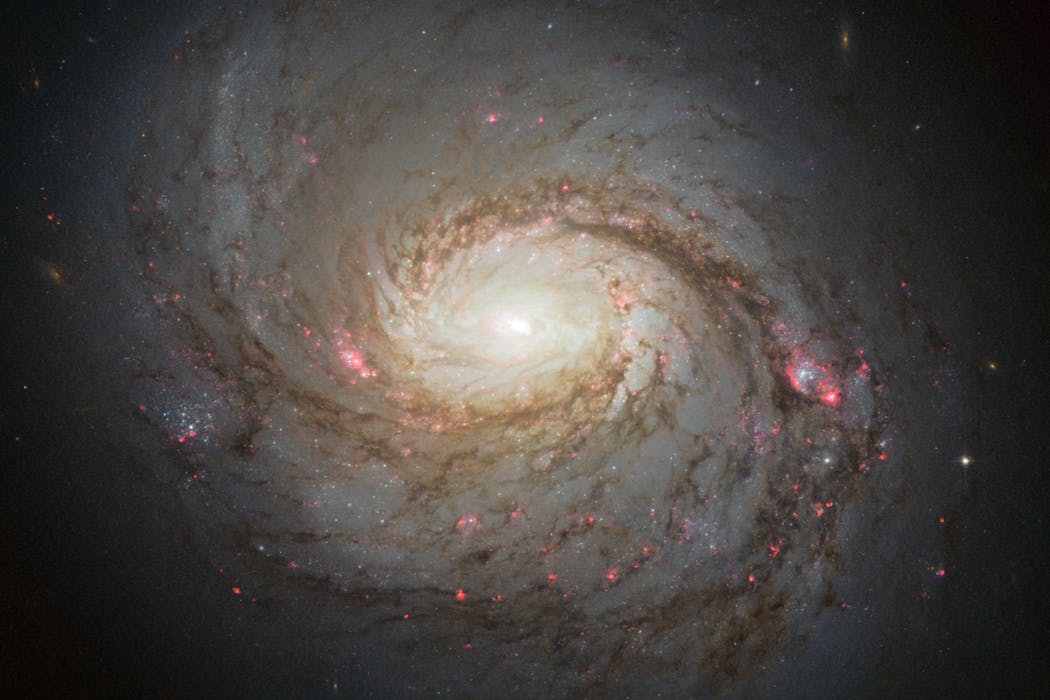
About 50 years ago, astronomer Vera Rubin discovered a similar mystery in spiral galaxies. She looked at spinning galaxies, which are like cosmic merry-go-rounds, and noticed something strange: The outer stars in these galaxies were spinning much faster than they should. They should have gone flying off into space like sparks from a firework display. But they did not.
It was like watching kids on a merry-go-round move at incredible speed but somehow stay perfectly in place.

The only explanation? There must be a sea of invisible “stuff” holding everything together with their extra gravity. Scientists called this mystery material “dark matter.”
Since then, astronomers have observed similar strange behavior happening throughout the universe. Galaxies within large clusters move in unexpected ways. Light gets bent around galaxies more than it should be. Galaxies stick together far more than the visible matter alone can explain.
It is as if our cosmic playground has swings moving by themselves, and seesaws tipping with nobody visible sitting on them.
Dark matter is just a placeholder name until scientists figure out what it is. For the past 50 years, many scientists have been running experiments that are trying to detect dark matter or produce it in the lab. But so far, they have come up empty-handed.
We don’t know what dark matter is, but it’s everywhere. It could be unusual particles scientists have not discovered yet. It could be something completely unexpected. But astronomers can tell by observing how fast galaxies rotate that there is about five times more dark matter than all the regular matter in the entire universe.
Hello, curious kids! Do you have a question you’d like an expert to answer? Ask an adult to send your question to CuriousKidsUS@theconversation.com. Please tell us your name, age and the city where you live.
And since curiosity has no age limit – adults, let us know what you’re wondering, too. We won’t be able to answer every question, but we will do our best.
Dipangkar Dutta receives funding from US Department of Energy and the National Science Foundation.
Read These Next

Meet the ‘independent voters’ who will likely decide which party triumphs in the 2026 midterm electi
Republicans and Democrats need to make inroads with independent voters. But the themes that motivate…
IceCube is built on decades of research into tiny ‘ghost particles’ – but it was the first to find n
IceCube looks for high energy neutrinos from space. It joins the ranks of complementary experiments…
Many drugs have mirror chemical structures, one helpful and the other harmful – a Nobel-winning disc
From thalidomide to resveratrol, molecules with the exact same chemical properties can have drastically…
