Far-right extremists have been organizing online since before the internet – and AI is their next fr
Neo-Nazis and other far-right extremists were early adopters of bulletin board systems, pioneering online recruiting and radicalization techniques long before the social media revolution.


How can society police the global spread of online far-right extremism while still protecting free speech? That’s a question policymakers and watchdog organizations confronted as early as the 1980s and ’90s – and it hasn’t gone away.
Decades before artificial intelligence, Telegram and white nationalist Nick Fuentes’ livestreams, far-right extremists embraced the early days of home computing and the internet. These new technologies offered them a bastion of free speech and a global platform. They could share propaganda, spew hatred, incite violence and gain international followers like never before.
Before the digital era, far-right extremists radicalized each other primarily using print propaganda. They wrote their own newsletters and reprinted far-right tracts such as Adolf Hitler’s “Mein Kampf” and American neo-Nazi William Pierce’s “The Turner Diaries,” a dystopian work of fiction describing a race war. Then, they mailed this propaganda to supporters at home and abroad.
I’m a historian who studies neo-Nazis and far-right extremism. As my research shows, most of the neo-Nazi propaganda confiscated in Germany from the 1970s through the 1990s came from the United States. American neo-Nazis exploited their free speech under the First Amendment to bypass German censorship laws. German neo-Nazis then picked up this print propaganda and distributed it throughout the country.
This strategy wasn’t foolproof, however. Print propaganda could get lost in the mail or be confiscated, especially when crossing into Germany. Producing and shipping it was also expensive and time-consuming, and far-right organizations were chronically understaffed and strapped for cash.
Going digital
Computers, which entered the mass market in 1977, promised to help resolve these problems. In 1981, Matt Koehl, head of the National Socialist White People’s Party in the United States, solicited donations to “Help the Party Enter The Computer Age.” The American neo-Nazi Harold Covington begged for a printer, scanner and “serious PC” that could run WordPerfect word processing software. “Our multifarious enemies already possess this technology,” he noted, referring to Jews and government officials.
Soon, far-right extremists figured out how to connect their computers to one another. They did so by using online bulletin board systems, or BBSes, a precursor to the internet. A BBS was hosted on a personal computer, and other computers could dial in to the BBS using a modem and a terminal software program, allowing users to exchange messages, documents and software.
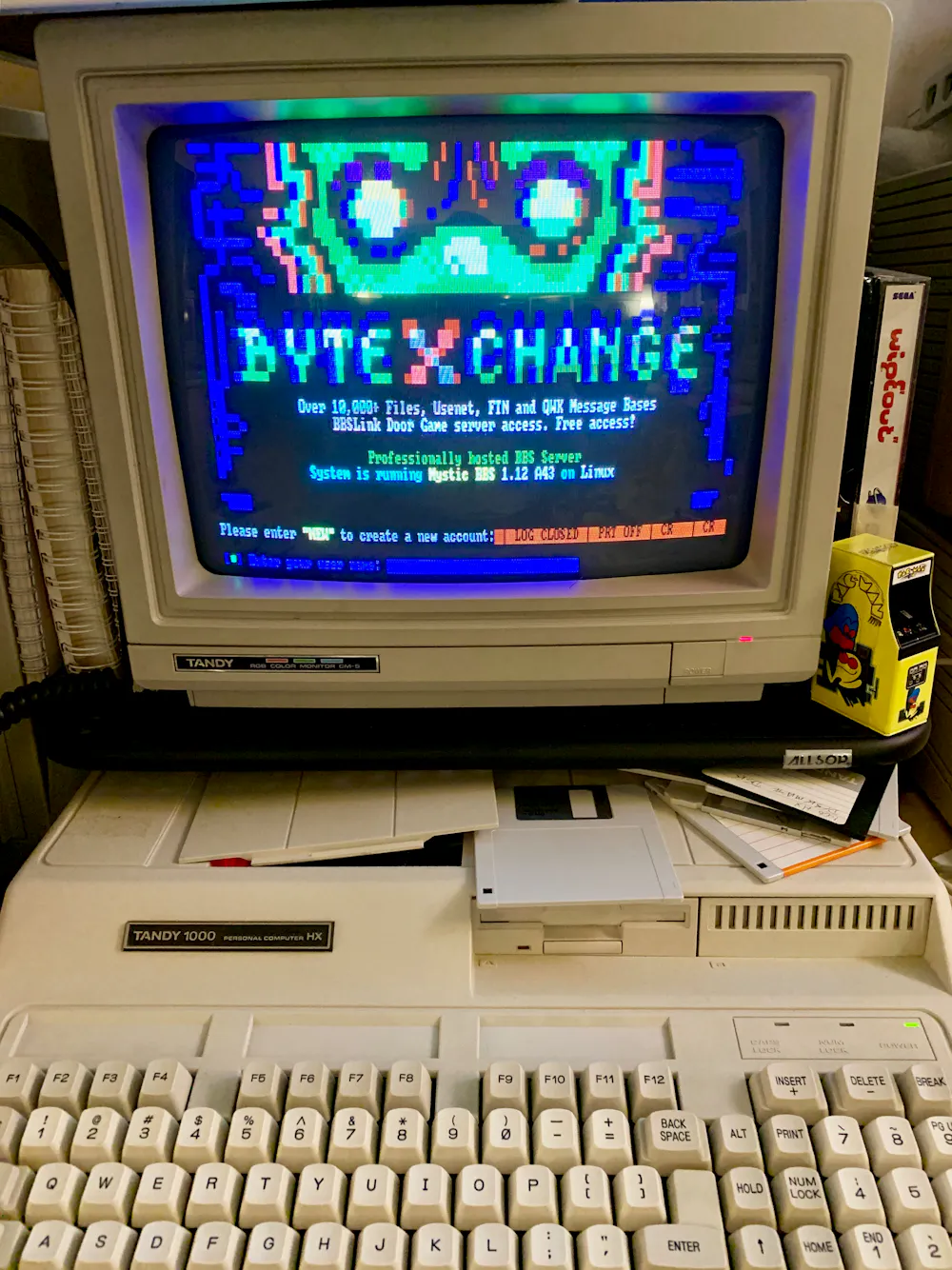
With BBSes, anyone interested in accessing far-right propaganda could simply turn on their computer and dial in to an organization’s advertised phone number. Once connected, they could read the organization’s public posts, exchange messages and upload and download files.
The first far-right bulletin board system, the Aryan Nations Liberty Net, was established in 1984 by Louis Beam, a high-ranking member of the Ku Klux Klan and Aryan Nations. Beam explained: “Imagine, if you can, a single computer to which all leaders and strategists of the patriotic movement are connected. Imagine further that any patriot in the country is able to tap into this computer at will in order to reap the benefit of all accumulative knowledge and wisdom of the leaders. ‘Someday,’ you may say? How about today?”
Then came violent neo-Nazi computer games. Neo-Nazis in the United States and elsewhere could upload and download these games via bulletin board systems, copy them onto disks and distribute them widely, especially to schoolchildren.
In the German computer game KZ Manager, players role-played as a commandant in a Nazi concentration camp that murdered Jews, Sinti and Roma, and Turkish immigrants. An early 1990s poll revealed that 39% of Austrian high schoolers knew of such games and 22% had seen them.
Arrival of the web
By the mid-1990s, with the introduction of the more user-friendly World Wide Web, bulletin boards fell out of favor. The first major racial hate website on the internet, Stormfront, was founded in 1995 by the American white supremacist Don Black. The civil rights organization Southern Poverty Law Center found that almost 100 murders were linked to Stormfront.
By 2000, the German government had discovered, and banned, over 300 German websites with right-wing content – a tenfold increase within just four years.
In response, American white supremacists again exploited their free speech rights to bypass German censorship bans. They gave international far-right extremists the opportunity to host their websites safely and anonymously on unregulated American servers – a strategy that continues today.
Up next: AI
The next frontier for far-right extremists is AI. They are using AI tools to create targeted propaganda, manipulate images, audio and videos, and evade detection. The far-right social network Gab created a Hitler chatbot that users can talk to.
AI chatbots are also adopting the far-right views of social media users. Grok, the chatbot on Elon Musk’s X, recently called itself “MechaHitler,” spewed antisemitic hate speech and denied the Holocaust.
Countering extremism
Combating online hate is a global imperative. It requires comprehensive international cooperation among governments, nongovernmental organizations, watchdog organizations, communities and tech corporations.
Far-right extremists have long pioneered innovative ways to exploit technological progress and free speech. Efforts to counter this radicalization are challenged to stay one step ahead of the far right’s technological advances.
Michelle Lynn Kahn has received funding from the National Humanities Center, United States Holocaust Memorial Museum, American Historical Association, and American Jewish Archives.
Read These Next

AI is changing pilgrims’ journeys, but sacred journeys have always adapted to new technology
From the printing press to smartphone apps, technology has continually transformed the experience of…

AI can help with academic research but doesn’t always get it right – here are some tips to check the
AI is quickly changing. These tips from university librarians can help people keep pace with the shifts…

I’m a physicist who worked on the Nobel-winning neutrino search – here’s how a cubic kilometer of An
The 2026 Nobel Prize in physics recognizes Francis Halzen’s vision in building an unusual telescope…