The University of Florida revives the ‘Gator bait’ cheer, reversing a ban over its troubling history
For most University of Florida football fans, the chant is simply about school spirit. But the debate over its return can’t be separated from the phrase’s racial history.

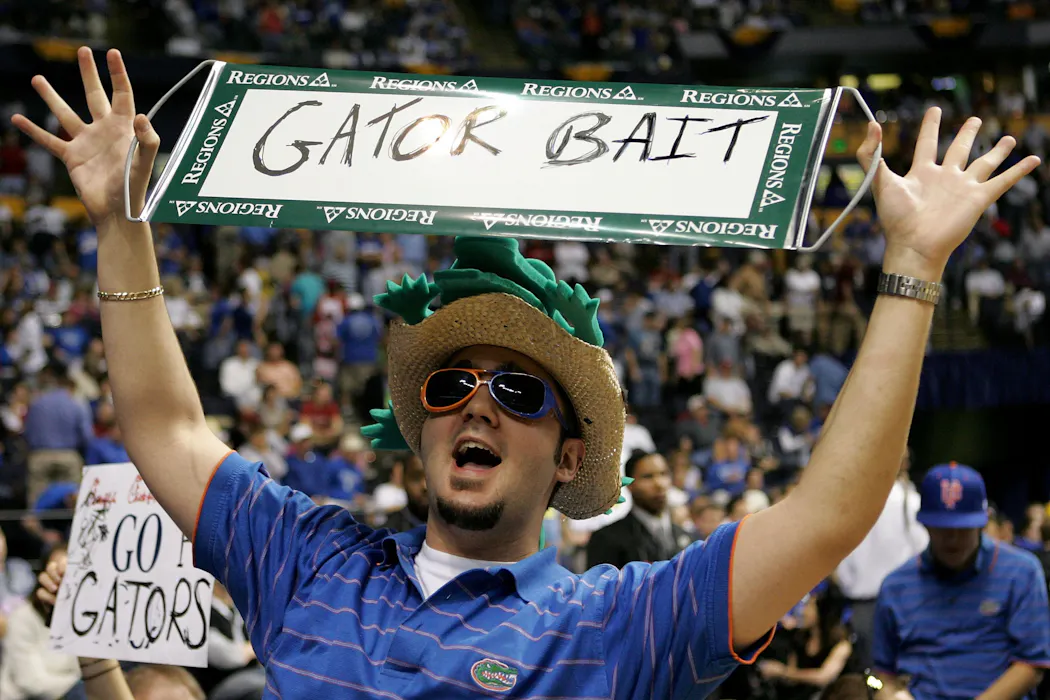
The sold-out crowd at Ben Hill Griffin Stadium, better known as “The Swamp,” roared with excitement as the University of Florida revived its “Gator bait” cheer at its 2026 season opener.
When the marching band played the familiar cue, thousands of fans responded with the “Gator chomp,” raising their outstretched arms and repeatedly opening and closing their hands like alligator jaws while shouting “Gator bait!”
The decision to bring back the popular cheer reversed a ban imposed in 2020 by University of Florida President Kent Fuchs, who was concerned about its racist origins amid the nationwide reckoning over race that followed the murder of George Floyd.
Current university president Stuart Bell remarked in an interview prior to his official appointment that “traditions matter” and suggested that the cheer could return because it remained “meaningful to the Gator family.” Since then, the university has restored the cheer, though it has not publicly identified who formally authorized its return.
The controversy surrounding this chant has often been framed narrowly by its supporters as a dispute over tradition versus political correctness. However, it raises important questions about whether a public university should continue to embrace a tradition that risks making some students and alumni feel less welcome on campus.
As an environmental and cultural historian and author of “Gator!: The Making of America’s Iconic Reptile, from First Encounters to Florida Man,” I’ve spent years researching how alligators became intertwined with ideas about race, nature and Southern identity. My research points to a deeper history largely absent from the public debate over the cheer.
The making of ‘alligator bait’ as a racial slur
The roots of the “alligator bait” trope stretch back to the 18th century, when French explorers in North America claimed that a “certain exhalation” given off from Black skin attracted the voracious reptiles.
White plantation owners eagerly took up this racist theory because it discouraged enslaved people from fleeing into Southern swamps and marshes, where pursuing runaways was often difficult.
After the Civil War, as formerly enslaved people sought economic, educational and political advancement, many white Americans responded with efforts to reassert white supremacy. Alongside disenfranchisement, Jim Crow segregation and racial terrorism, they promoted stereotypes that demeaned and dehumanized African Americans.
One of these racist stereotypes was the depiction of Black Americans, especially children, as natural prey for alligators. Though it operated through images and ideas rather than physical force, the stereotype reinforced beliefs in Black inferiority. It also helped justify the intimidation, exclusion and violence that African Americans routinely faced during this period.
It was in this context that the racial slur “alligator bait” began circulating widely in the late 19th century. A bestselling photograph bearing that title, published in 1897, helped popularize the slur. Although the composite image of nine naked African American toddlers did not include an actual alligator, its title invited viewers to imagine Black children as special targets of the reptile.
The epithet soon spread through newspapers, postcards, editorial cartoons, songs and films. Ostensibly humorous images of alligators threatening or consuming Black Americans, especially children, also circulated widely across the U.S.
Whether Black children were ever actually used as bait to hunt alligators remains a subject of historical debate. But what is beyond dispute is that these images helped entrench degrading associations between African Americans and alligators in American popular culture for decades.
‘Gator bait’ comes to campus
As the phrase alligator bait gained currency across the United States, it also began appearing in a new setting: University of Florida football games. The earliest published reference to the cheer seems to be a 1939 newspaper account of a home game against Georgia Tech.
When Georgia Tech’s Yellow Jackets took the field, Florida students taunted the all-white team with cries of “alligator bait.” Georgia Tech’s coach used the insult to motivate his players, asking whether they could imagine “anything lower than that.”
While it is impossible to know precisely how everyone present understood the phrase, it entered Florida football culture at a time when “alligator bait” remained a recognizable racial slur. By the late 1940s, the shortened form, “Gator bait,” which was both easier to chant and more closely aligned with the university’s “Gators” nickname, had become a regular fixture at Florida football games.
The cheer remained firmly embedded in campus culture as the university navigated the slow and often contentious process of desegregation. Like most Southern universities, the University of Florida resisted admitting Black students, enrolling its first African American law student, George H. Starke, only after a court order in 1958. The first Black undergraduates arrived four years later, and the football team remained segregated until 1968.
Desegregation did not immediately transform the broader campus culture. The university continued to embrace traditions that celebrated the Confederacy and romanticized the Old South. In 1962, football coach Ray Graves placed decals of the Confederate battle flag on his players’ helmets before the Gator Bowl.
As late as the 1970s, the all-white Kappa Alpha fraternity continued a decades-long tradition of staging an annual “Old South” weekend that featured students parading in Confederate uniforms. In the 1950s and 1960s, that celebration even included a mock execution of Union General William T. Sherman and a secession proclamation.
When the student newspaper surveyed the campus in 1968 about whether to continue playing “Dixie” – the unofficial anthem of the Confederate States of America – at football games, 83% of students supported the practice. But the majority of Black students surveyed opposed it. “Dixie” remained a game-day staple until 1973.

The many meanings of ‘Gator bait’
By the late 20th century, most Florida fans no longer understood “Gator bait” through the lens of Jim Crow-era racial stereotypes. Decades of use at football games had transformed the chant into a symbol of school spirit and athletic success.
No individual played a larger role in that transformation than Lawrence Wright, the hard-hitting safety who helped lead Florida to its first national championship. Wright, who is African American, did not invent the cheer, as is often claimed, but he helped elevate it to iconic status. Following Florida’s victory over rival Florida State in 1995, he famously rallied fans with the refrain, “If you ain’t a Gator, you must be Gator bait.”
When the Gators became national champions the next season, the chant became even more deeply enshrined in Florida football culture. For most fans, “Gator bait” came to symbolize pride in the university rather than anything connected to the phrase’s earlier racist history.

History clashes with the present
Yet that history never disappeared.
While most fans were unaware of it, “alligator bait” remained a documented racial slur, creating a tension between the phrase’s historical origins and its modern meaning.
That tension came to a head in 2020, when Fuchs suspended the cheer amid a broader university effort to address racism and inequity. While acknowledging that he knew of “no evidence of racism associated with our ‘Gator Bait’ cheer at UF sporting events,” Fuchs argued that the phrase’s “horrific historic racist imagery” warranted its retirement.
Critics, including Wright, responded that the cheer’s meaning at Florida had become detached from those historical associations. “Gator bait” was a cherished university tradition, they argued, neither generally understood nor intended as racist.
Six years later, under Bell, the university has reinstated the cheer amid a political and cultural climate markedly different from the one that had prompted its suspension.
Still, I believe the debate surrounding its return reveals that the controversy has never simply been about political correctness or school spirit. In my view, it is also about how institutions reckon with difficult histories and whether traditions can be separated from the historical meanings that gave rise to them.
Even if most fans today understand the cheer as an expression of school spirit, universities do not simply inherit traditions. They choose which ones they wish to preserve, modify or discard.
Whether the university made the right decision is open to debate. What is not in dispute is that the “Gator bait” cheer emerged during a period when “alligator bait” functioned as a racial slur and the University of Florida excluded Black students while embracing traditions that celebrated the Confederacy.
The Conversation reached out to the university, and it declined to add to Bell’s previous comments on this matter.
The University of Florida is a founding partner of The Conversation.
Mark V. Barrow, Jr. earned his BA in History at the University of Florida in 1985 and has received funding from the National Endowment for the Humanities.
Read These Next

Some people claim to speak many languages. But what does it really mean to be a polyglot?
Fluency in a language is not an all-or-nothing achievement. It is a spectrum, ranging from basic conversational…

What’s behind the bedazzling mania that’s taken over high school and college campuses?
Gen Zers see it as a form of ‘whimsymaxxing,’ or imbuing playfulness and joy into everyday life.
Stevie Wonder’s ‘Songs in the Key of Life’ – which spread an audacious message of love – turns 50 as
Wonder is performing his ambitious concept album in its entirety as part of an international tour celebrating…