Election officials are fighting wavering voter trust by making mundane processes visible and recruit
A midterm election is coming. In the face of wavering voter trust – some of it driven by forces outside their control – what can election officials actually do to keep elections credible?

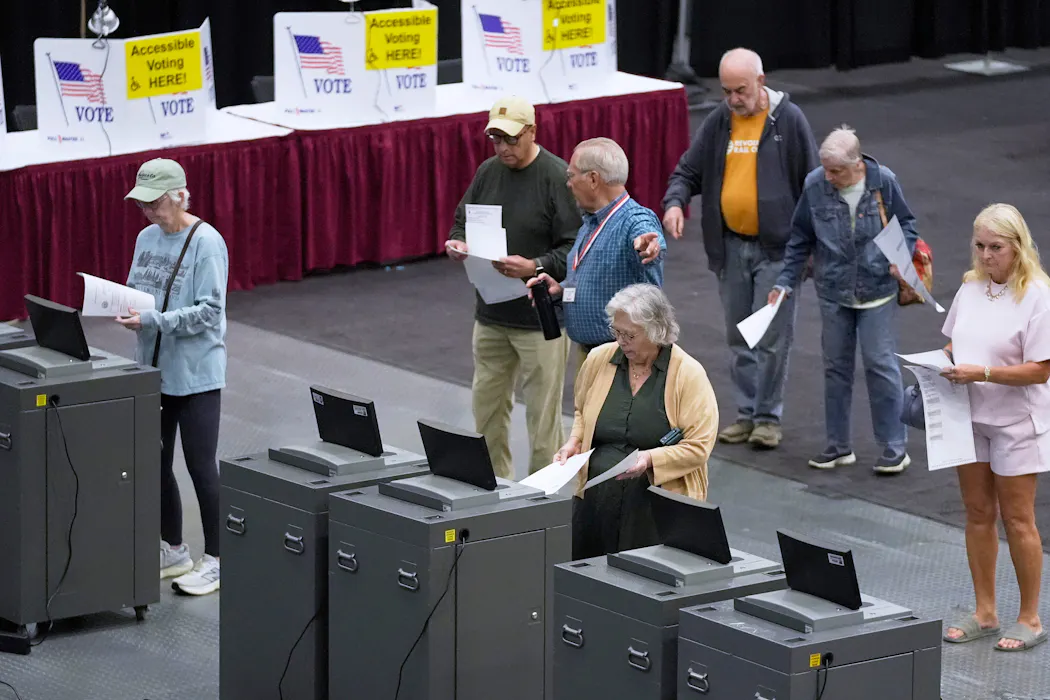
Recently, I moderated a national event that had college students speaking with election officials, something I often find myself doing this time of year. This year, a new question kept coming up: “If I’m voting by mail, can I trust my ballot will actually show up?”
For college students, such considerations have urgency. Many are voting in their first major election, often while living away from home. They may be deciding whether to register where they attend college or request an absentee ballot from home. This year, many are weighing whether they trust the process that will bring their vote from the mailbox to the ballot box to be counted.
This uncertainty comes after a monthslong legal fight over the U.S. Postal Service’s role in mail voting, sparked by President Donald Trump’s attempts to dramatically limit mail voting. On Sept. 14, 2026, the Supreme Court barred new Postal Service restrictions on election mail from taking effect.
The court’s decision resolved the immediate question of whether the restrictions would stand. But it did not settle the larger question that now hangs over this election: Can voters trust the machinery of elections in the first place?
I’m a political scientist, and I study elections and voting. For more than a decade, I’ve helped lead nonpartisan student voter engagement efforts at the University of Maine and helped recruit and train student poll workers. I also serve alongside them, administering elections.
That dual role has given me an unusual view of elections – both as a researcher studying public attitudes and as someone who has spent many long days watching the wheels of American democracy turn firsthand.
Why voters trust elections
Research on confidence in elections points to several factors that play a role in whether voters trust outcomes at the polls.
The most obvious factor is their experience. Voters who encounter problems casting a ballot are likely to have less confidence in the election process.
But the people they encounter matter as well.
Research shows that competent, well-trained poll workers increase voter confidence and that voters’ perceptions of election legitimacy can be affected by whether the people administering the election reflect the racial and ethnic identities represented in the communities they serve.
Familiarity is also critical. If voters are familiar with the processes that translate voter will into outcomes – such as how access to ballots is kept secure and how they are tabulated – they’re likely to have higher confidence in elections. When individuals lack that familiarity, conspiracy theories and misinformation may fill in the gaps.
And then there is one factor that election administrators do not and cannot control: who wins. What political scientists call the “winner-loser” effect can be striking. Pew Research Center reported after the 2024 election, which Trump won, that 93% of Trump voters felt the 2024 elections were administered at least somewhat well, compared with just 21% of Trump’s supporters after the 2020 election, which Trump lost.
So in the face of wavering voter trust – some of it driven by forces outside their control – what can election officials actually do?
‘Come look!’
One response from election officials has been simple: Mundane processes that most voters once had little reason to think about are increasingly being made visible to the public.
In Maricopa County, Arizona, voters can watch livestreams of signature verification, early-ballot processing, ballot tabulation and more. The county opens testing of its voting equipment for public observation and even offers tours of its election center.
In Maine, where I live, the secretary of state’s office uses live feeds to invite viewers into recounts and ranked-choice voting tabulations. The process can run for days. Much of it consists of watching election officials sit quietly at tables until someone approaches the camera to say something like, “We’re going to reconcile the ballots from Sagadahoc County.” Then it’s back to watching people work.
What voters see is almost comically mundane: checklists, sealed containers, bipartisan teams of observers, rigorous procedures to track who has had access to ballots, and individuals doing repetitive administrative work.
And that’s the point. Election officials cannot control whether voters like the outcome, but they can make the processes that produce it visible and comprehensible.

Democratic inoculation
There is an even more immersive way to make elections understood and thus credible: invite the public to help run them.
American elections require an extraordinary amount of community labor. Researchers have estimated that a presidential election requires roughly 1.4 million poll workers – a temporary civilian workforce about the size of the active-duty U.S. military.
Yet until recently, researchers have paid surprisingly little attention to what happens when people move from voting in an election to actually administering one.
My colleagues and I have been studying that question in Maine. We surveyed poll workers before and after they served in the 2022 and 2024 elections. After working an election, their concerns about voter fraud and voter or poll worker intimidation declined. And those changes weren’t confined to one political party.
Interestingly, serving didn’t necessarily change what people believed about whether fraud or intimidation happens. Instead, firsthand experience seemed to change how threatening those possibilities felt.
We call this process “democratic inoculation.”
Spending a day checking voters in, accounting for ballots and watching election safeguards operate doesn’t make someone completely immune to doubts about elections. But it may make sweeping claims about a chaotic or easily manipulated system harder to square with what they witnessed with their own eyes.
Maintaining faith
None of this means that transparency or firsthand experience can eliminate distrust in elections.
The harder question is whether seeing how elections actually work can help people maintain faith in the system even when their candidate loses.
With another national election just weeks away, we may soon find out how far that confidence can stretch.
Robert Glover has received funding for election-related research from the Scholars Strategy Network.
Read These Next
US inequality is getting worse in ways you might not expect
From tax policy to gas prices and tariffs, a mix of new factors is making inequality in the US more…
How governments worldwide are shaping what AI can say about politics
Some governments use legitimate AI concerns as a pretext to control political discussion, particularly…
State takeovers of struggling Texas school districts come at a high cost, with little evidence of su
The number of uncertified teachers rose, while enrolled student numbers dropped, following a state takeover…