How ‘portfolio reasoning’ explains Trump’s constant reevaluation of America’s value
Trump has approached governing through the same framework as his former business portfolio, where he casts the US as a flagship holding whose value he was elected to increase.

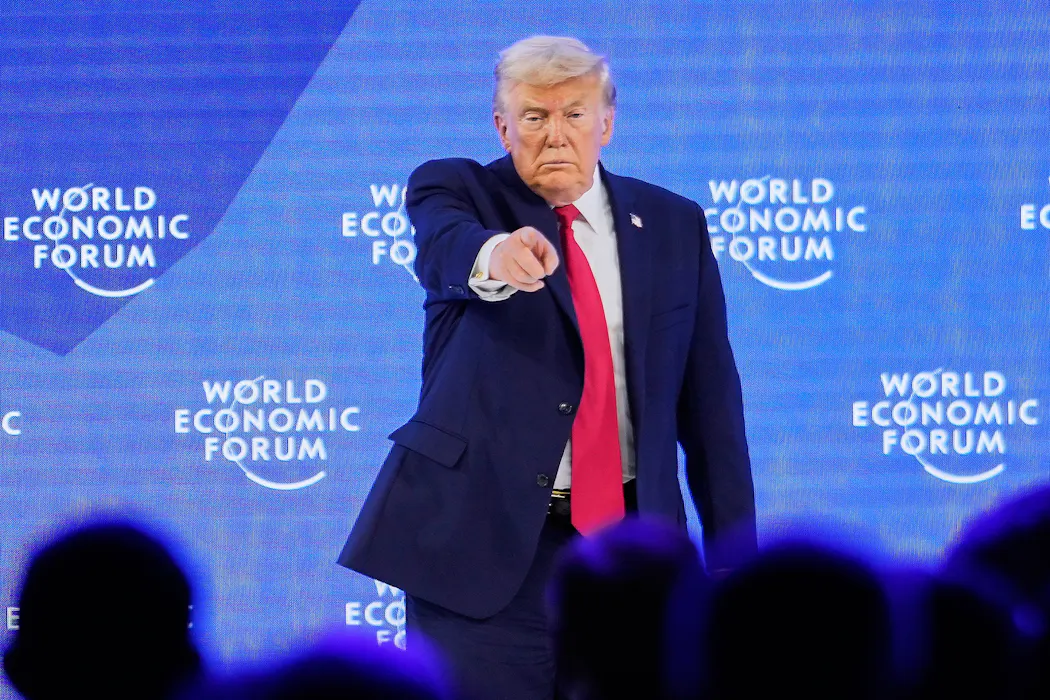
In January 2026, President Donald Trump told an audience of business and political leaders in Davos, Switzerland, that the United States needed the “right, title and ownership” to Greenland “because you need the ownership to defend it. You can’t defend it on a lease.”
A territory of roughly 57,000 people appears to the president as property to be acquired.
Trump’s various actions during his second term have prompted no shortage of explanations. The “flooding the zone” strategy treats his flurry of executive orders and legal battles as efforts to overwhelm the courts’ and news media’s ability to keep up. Psychological explanations of Trump’s behavior point to narcissism. Other political commentators interpret his actions through authoritarianism and demagoguery.
I believe these accounts overlook something simpler. Before entering politics, Trump spent five decades running a commercial real estate business. In my assessment, he still reasons the way his professional career taught him to.
I study how forms of reasoning shape political arguments, and in analyzing Trump’s rhetoric across his second term, I find a president who approaches governing through the same framework as his business career – a mode of thinking I call portfolio reasoning.
Portfolio theory
Portfolio reasoning is a financial way of thinking that treats what one has – from property and money to relationships and obligations – as a collection of holdings to be continually managed and reassessed to maximize its value.
The recurring questions are familiar: What do I have? What is performing well and what isn’t? What should I keep, acquire, renegotiate or get rid of? And how do I make sure I can walk away?
Modern portfolio theory originated with economist Harry Markowitz in the 1950s as a way to manage financial risk. As finance came to dominate the wider economy, these habits spread well beyond Wall Street.
Consider a college sophomore today who, between classes, checks which stocks to hold or sell on the financial services platform Robinhood, reshuffles a fantasy football roster based on changing player values, and adjusts bets on future cultural and political events on a prediction market. Across very different activities, the same habit is at work: managing a shifting set of positions as their value changes.
The US, a flagship holding
It’s not difficult to imagine Trump’s second term through this lens.
According to portfolio theory, the soaring stock market, foreign investment growth and more tariff revenue become proof of the United States’ rising value. Previous presidents were bad negotiators who left money on the table. Alliances, treaties and obligations become holdings whose worth depends on maximizing their returns through continuous renegotiation. And states that vote the wrong way become candidates for divestment.
But a resemblance is not evidence. The more important question is whether Trump’s own words show that he reasons about politics this way.
Trump’s rhetoric repeatedly casts the U.S. as the flagship holding whose value he was elected to increase. He opened his 2026 State of the Union address by announcing that the nation was “back, bigger, better, richer and stronger than ever before.” The evidence that followed read like an investment performance report: The stock market had set “53 all-time record highs,” and the typical 401(k) was “up by at least $30,000.”
At a Las Vegas rally in August, he put it in the language of capital flows: “Money is pouring” into the U.S.
In Davos in January, in the State of the Union in February and again in Las Vegas in August, Trump described the country he inherited as a “dead country” that is now “the hottest country anywhere in the world.”
It’s the language of a distressed property turned around.

Holdings are continuously reassessed
Existing holdings get reassessed by Trump, too, and those judged to be underperforming are repriced.
In his State of the Union, Trump reported that NATO members had “just agreed, at my very strong request, to pay 5% of GDP for military defense rather than the 2%.” He added that the U.S. had been “paying the freight of many of them” and that NATO now pays in full for weapons sent to Ukraine.
Canada has faced the same reassessment. When it sought coverage under the proposed Golden Dome missile defense system, Trump put a price on protection – some $71 billion. He then offered an alternative: “Why don’t you just join our country? Become the 51st state and you get it for free.”
In this case, long-standing terms are reopened because one side can afford to walk away and the other cannot.
Portfolios acquire new positions
A portfolio also grows by acquiring what it doesn’t yet own.
Greenland is the clearest geopolitical example – Trump wants ownership, not access.
Venezuela follows a similar logic. After American forces removed President Nicolás Maduro, Trump announced that Venezuela would transfer up to 50 million barrels of oil. He said U.S. companies would go in and “start making money,” and noted that the country had been “pumping almost nothing by comparison to what they could have been” – an underperforming asset with a plan to improve it.
Not every acquisition is territorial. Since 2025, the federal government has taken ownership positions in roughly 30 companies, including 9.9% of Intel.
Portfolio reasoning and democratic limits
It’s fair to ask whether this is simply a more explicit version of what presidents have always done: pursue growth, expand power, defend the country’s interests.
Trump officials have suggested as much. White House deputy chief of staff Stephen Miller has described a world “governed by strength,” “force” and “power” – what he called “the iron laws of the world that have existed since the beginning of time.”
The difference has to do with limits – what stays open to negotiation and what doesn’t. Democratic governments may renegotiate treaties and alliances, but they also make durable commitments that are not continually reassessed according to what produces the best return.
Portfolio reasoning favors keeping your options open as circumstances change. Commitments are therefore provisional: Keep a position if it yields a high return, renegotiate if it doesn’t, and exit if something better comes along.
Trump applies that logic to nearly everything, leaving few political commitments settled and helping to explain the turbulence of his second term.
A second limit concerns the public. Viewed through a portfolio framework, people appear less as parties whose claims must be answered than as positions to be valued – assets when they contribute, liabilities when they don’t. Portfolio reasoning can assess value and risk. It cannot, by itself, distinguish right from wrong.
Applied to a population, portfolio logic does not necessarily deny human rights, but it offers no reason of its own for putting them beyond the reach of calculation. A portfolio presidency is not anti-democratic so much as indifferent: Democratic commitments have no privileged place in its financial calculations.
J. Christian Spielvogel does not work for, consult, own shares in or receive funding from any company or organization that would benefit from this article, and has disclosed no relevant affiliations beyond their academic appointment.
Read These Next

From jargon to impact: Teaching undergraduates the art of public communication
Teaching public storytelling to students can help them communicate better in the world.
Armed poll watchers: New Jersey’s 1981 racist voter intimidation campaign is a cautionary tale ahead
An armed voter suppression campaign in New Jersey in 1981 finds echoes today in the Trump administration’s…

Missing ambassadors, inexperienced appointees – is Washington dropping the diplomatic ball?
Almost half of US ambassador jobs remain vacant. Meanwhile, political appointees are outnumbering career…