Federal election observers once played a key role in securing voting rights for all − but times have
After the Voting Rights Act, federal election observers helped ensure fair voting, but that oversight has increasingly shifted focus − to monitor what Washington says is voter fraud and accusations of cheating.

President Donald Trump appeared on former Deputy FBI Director Dan Bongino’s podcast in February 2026, where he stated: “The Republicans should say, ‘We want to take over, we should take over the voting.’ The Republicans ought to nationalize the voting.”
Trump’s call to nationalize elections, to transfer the constitutionally mandated control of elections from local to federal authorities, drew bipartisan opposition and added to Democratic fears that the president may attempt to interfere with upcoming midterm elections.
Despite Trump’s call to “nationalize the voting,” the U.S. Constitution clearly notes that states run elections – not the federal government.
The federal government, however, has a role to play in national elections – as an observer. Federal observation ensures that Americans cast their votes on election day without reprisal.
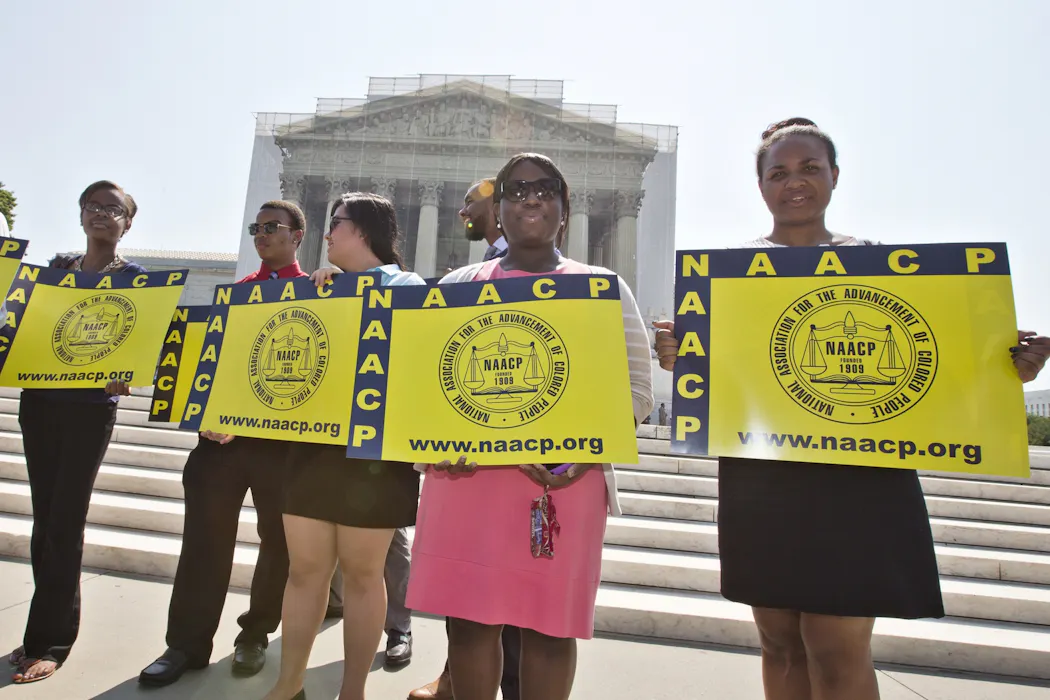
Initially dispatched to deter voter discrimination against Black Americans after passage of the Voting Rights Act of 1965, election observers ensured that those qualified to vote could do so without trouble.
But with its 2013 ruling in the Shelby County v. Holder case, the U.S. Supreme Court changed the federal government’s relationship to the election process. The ruling significantly weakened the federal govenment’s ability to send federal observers to the polls.
As a scholar of civil rights and voting rights, I know that federal oversight during elections has always been a valued part of the electoral process, even when subject to criticism.
Yet, this current moment, with the Trump administration’s efforts to cast doubt on the legitimacy of the 2026 midterms, feels different. What I have noticed recently is how the public’s thinking has shifted about the federal oversight of elections. Where once it was largely welcomed as an ensurer of fairness and proper procedures, now it is seen as a misuse of authority.
Establishment of federal observers
The key contribution of the Voting Rights Act that Americans are typically taught about in school is its abolition of racial discrimination in voting. The measure put a stop to poll taxes and literacy tests, which had disproportionately reduced Black voter registration.
But the act also created the type of federal observation of elections that is most familiar to Americans today.
The measure allows the Department of Justice to deploy federal observers to polling stations. That deployment can happen through a court order or by requirement to places with documented histories of voter suppression. The latter was determined by a section of the Voting Rights Act that also details the guidelines for which places merit that designation.

Federal observers take notes, often beside poll monitors, and document potential unlawful practices by poll workers.
Unlike monitors, federal observers are stationed inside polling stations. They keep notes on the tallying of votes and verify those thrown out. And where the Justice Department requires the permission from respective districts to send monitors, federal observers are sent by the U.S. attorney general and do not require the same permission.
Historically, observers were also charged with registering voters at polling stations and local registrars’ offices with the specific goal of assisting disenfranchised minorities.
Perception of federal observers
Determined to maintain Jim Crow laws that enforced racial segregation, several Southern Democrats opposed the Voting Rights Act.
Some Americans also criticized the act as government overreach. And they castigated the U.S. attorney general in 1965 when he dispatched federal registrars to the South following the passing of the measure, and when he sent federal observers to the South for the 1966 congressional elections.
Despite this opposition to federal observers, and just months after the Voting Rights Act’s passage, the U.S. Commission on Civil Rights wrote that federal observers received “praise from registration workers and the (voter registration) applicants.”
Within a few years of the act, roughly 1 million Black Southerners had registered to vote. Over time, federal election observers began to focus less on registering voters, practically phasing out this practice by the 1980s, and serving only as observers.
The change
Over the decades, conservative politicians, as they gained more seats in Congress and state legislatures, developed new strategies – they filed lawsuits, rearranged voting districts – to circumvent what they argued was federal overreach in the election process. These changes helped them gain political influence and promoted their philosophy of states’ rights. They were successful.
The increase in conservative political influence gave way to an increasingly conservative Supreme Court. This was reflected in the U.S. Supreme Court’s 5-4 ruling in Shelby County v. Holder.
In that ruling, the court struck down the section in the Voting Rights Act outlining the guidelines for deciding whether a county or state needed federal oversight. With no guidelines to follow, the federal government removed most of its oversight.
After the court’s ruling, several states – Texas, Alabama and Mississippi, for example – made rapid changes to the voting process. Those included new voter ID laws, the purging of voter registration rolls and gerrymandering. These changes have resulted in further voter disenfranchisement, disproportionately effecting Black and Hispanic voters.
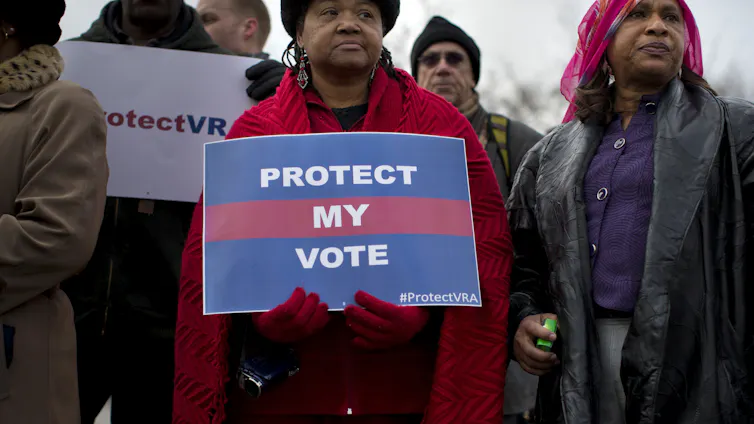
The Voting Rights Act guidelines had also helped determine where to send federal observers. With this section revoked, the federal government’s ability to send federal observers, in the way it had done for roughly 50 years, also disappeared.
The Justice Department sent federal observers to five states during the 2016 presidential election, compared to 23 states during the 2012 presidential election.
Since Shelby, disagreements over federal oversight persist and the role of federal observers has changed.
In 2024, the Justice Department announced it planned to send out 86 monitors on Election Day, the most federal monitors in two decades, due to concerns of possible partisan interference in elections. Some Republican-led states threatened to ban them from the polls.
To send out federal observers, the Justice Department needs a court order. But during the 2024 elections, courts determined that only four states needed federal observer oversight.
Redefining federal observers
During the Civil Rights Movement, federal election observers were the strongest line of defense to ensure fair voting.
Recently, however, the federal government’s election focus – such as attempting to require voters to provide documentary proof of U.S. citizenship when registering to vote – has shifted to what it says is voter fraud and accusations of cheating.
Still, one thing has remained certain. Federal observers are important. Their history, even now as they are less prevalent, can inform how we discuss the federal government’s role in elections.
Allison Mashell Mitchell does not work for, consult, own shares in or receive funding from any company or organization that would benefit from this article, and has disclosed no relevant affiliations beyond their academic appointment.
Read These Next

Many drugs have mirror chemical structures, one helpful and the other harmful – a Nobel-winning disc
From thalidomide to resveratrol, molecules with the exact same chemical properties can have drastically…

These state supreme court races could decide abortion access and trans rights
Ohio, North Carolina and Michigan have open seats on their state supreme court, and these hotly contested…
AI can help with academic research but doesn’t always get it right – here are some tips to check the
AI is quickly changing. These tips from university librarians can help people keep pace with the shifts…