How Jesse Jackson set the stage for Bernie Sanders and today’s progressives
The coalitions that Jackson built during his presidential campaigns created enduring infrastructure for later progressives, particularly in Vermont.

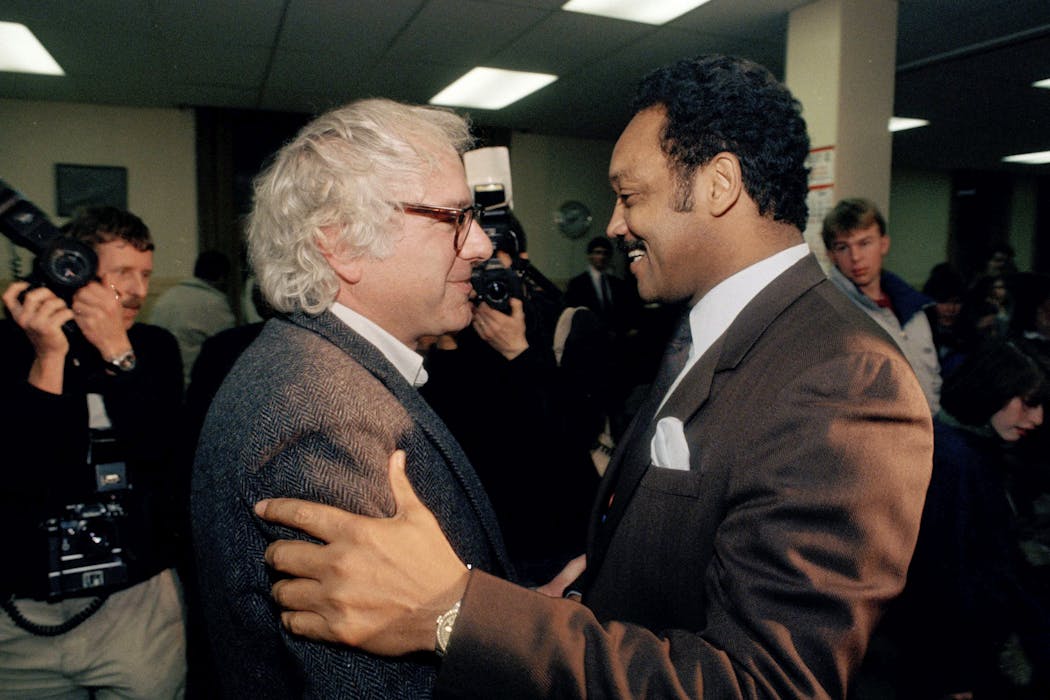
Jesse Jackson’s two campaigns for president, in 1984 and 1988, were unsuccessful but historic. The civil rights activist and organizer, who died on Feb. 17, 2026, helped pave the way for Barack Obama’s election a generation later as the nation’s first – and so far only – African American president.
Jackson’s campaigns energized a multiracial coalition that not only provided support for other late-20th-century Democratic politicians, including President Bill Clinton, but helped create an organizing template – a so-called Rainbow Coalition combining Black, Latino, working-class white and young voters – that continues to resonate in progressive politics today.
Vermont, where I teach political science, did not look like fertile ground for Jackson when he first ran for president. Then, as now, Vermont was one of the most homogeneous, predominantly white states in the country. But if Jackson seemed like an awkward fit for a mostly rural, lily-white state, he nonetheless saw possibilities there.
He campaigned in Vermont twice in 1984, buoyantly declaring in Montpelier, the state capital, “If I win Vermont, the nation will never be the same again.”
He did not win Vermont, taking just 8% of the Democratic primary vote in 1984 but tripling his share to 26% in 1988. Appealing to voters in small, rural New England precincts was a remarkable achievement for a candidate identified with Chicago and civil rights campaigns in the South.
Jackson’s presidential ambitions coincided with a pivotal moment in Vermont politics: The state’s voting patterns were shifting left, with new residents arriving and changing the state’s culture and economy. In 1970, nearly 70% of Vermonters had been born there. By 1990, that figure had dropped by 10 percentage points.
The Vermont Rainbow Coalition, which was formed to support Jackson’s first campaign, organized a crucial constituency in a fluid time, establishing patterns that would persist for decades.
Setting the standard in Vermont
Jackson created a “People’s Platform” that would sound familiar to today’s progressives, calling for higher taxes on businesses, higher minimum wages and single-payer, universal health care.
In light of Jackson’s efforts, Vermont activists saw the potential for a durable statewide organization. Rather than disband the Vermont Rainbow Coalition after the 1984 primary, they kept the group going, endorsing candidates in campaigns for the legislature and statewide office in each of the next three election cycles. The coalition also endorsed Bernie Sanders’ failed bid for Congress in 1988.
Sanders served eight years as mayor of Burlington as an “independent socialist,” cultivating a core collection of local allies known as the Progressive Coalition who sought to wrest power away from establishment members of the city’s Board of Aldermen.
In 1992, the Vermont Rainbow Coalition merged with Burlington’s Progressive Coalition to form the statewide Progressive Coalition.
The Jackson-Sanders lineage
Sanders eventually went on to win election to the House as an independent in 1990, serving in the chamber until winning his Senate seat, also as an independent, in 2006. His presidential runs in 2016 and 2020 made him a prominent national figure and a leader among progressives.
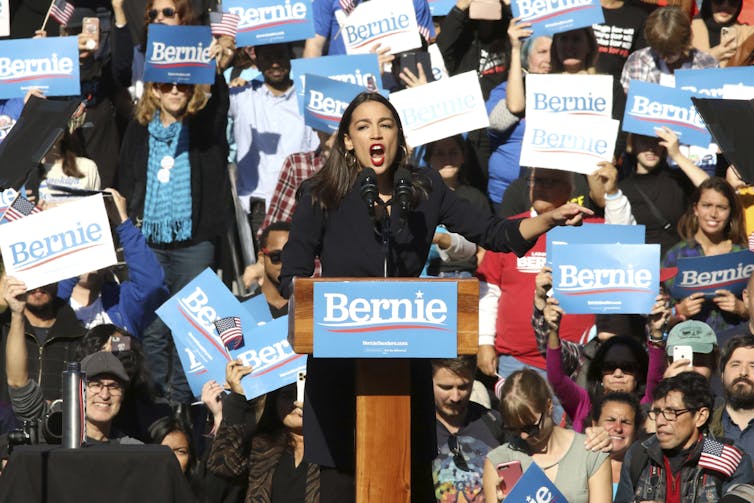
Alexandria Ocasio-Cortez, who unseated a member of the House Democratic leadership in a stunning 2018 primary upset in New York, had been a Sanders campaign organizer and remains his close ally. On Jan. 1, 2026, Sanders swore in Zohran Mamdani – like Ocasio-Cortez, a Democratic socialist – as mayor of New York City.
Sanders had endorsed Jackson for president in 1988. Years later, Jackson returned the favor.
Sanders paid tribute to Jackson at the 2024 Democratic National Convention. “Jesse Jackson is one of the very most significant political leaders in this country in the last 100 years,” Sanders said. “Jesse’s contribution to modern history is not just bringing us together – it is bringing us together around a progressive agenda.”
Not just Vermont
In Vermont, Jackson performed surprisingly well in unlikely places – taking nearly 20% of the 1984 primary vote in working-class Bakersfield and Belvidere, for example.
Today’s Vermont Progressive Party, which emerged out of the old Vermont Progressive Coalition, is one of the most successful third parties in the nation, winning official “major party” status in the state shortly after its official founding in 2000. The party has elected candidates to the state legislature, city councils and even a few statewide offices, including that of lieutenant governor.
Vermont was not alone in experiencing the catalyzing effect of Jackson’s presidential runs. Jackson had a significant mobilizing impact on Black voters nationwide. In Washington state, the Washington Rainbow Coalition started in Seattle and spread across the state between 1984 and 1996. New Jersey and Pennsylvania had their own successful and independent Rainbow Coalitions. In 2003, the Rainbow Coalition Party of Massachusetts joined the Green Party to become the Green Rainbow Party.
In my own research, I’ve investigated the durability of the “Jackson effect” in Vermont. There is no better test of what differentiates the Vermont Progressive Party from the state’s Democratic Party than the 2016 Democratic primary race for lieutenant governor, which pitted progressive David Zuckerman against two prominent, mainstream Democrats.
Zuckerman beat the Democrats most handily in towns that had voted the most heavily for Jesse Jackson in 1984, an effect that persisted even when controlling for population, partisanship and liberalism.
Many people would point to Sanders as the catalyst for Vermont’s continuing progressive movement. But Sanders and the progressives owe much to Jackson.
Bert Johnson does not work for, consult, own shares in or receive funding from any company or organization that would benefit from this article, and has disclosed no relevant affiliations beyond their academic appointment.
Read These Next
Why do people still get polio in some countries and not in others?
Polio can survive only where it finds kids who aren’t protected by a vaccine.

I composed music about infertility and pregnancy loss, then performed it in a Pittsburgh hospital
1 in 4 known pregnancies in the US ends in loss. A composer explains how those numbers, along with doctors’…

50 years later, Amory Lovins’ soft energy path meets electrification
Five decades ago, he charted two paths for energy use in the US. His soft path rightly emphasized efficiency…