What Franco’s fascist regime in Spain can teach us about today’s America
Comparisons of Trump to Hitler have become common. But some of Trump’s policies may more closely resemble those of Francisco Franco of Spain, says a Spanish scholar.

Minneapolis residents say they feel besieged under what some are calling a fascist occupation. Thousands of Immigration and Customs Enforcement agents have been swarming a city whose vast majority in 2024 did not vote for Donald Trump – or for a paramilitary roundup of its diverse population.
Tragically, two residents have been killed by federal agents. Consequently, social media is aflame with comparisons of Trump’s immigration enforcers to Hitler’s Gestapo.
While comparisons to Hitler’s fascist regime are becoming common, I’d argue that it may be even more fitting to compare the present moment to a less-remembered but longer-lasting fascist regime: that of Francisco Franco, dictator of Spain from 1936 until his death in 1975.
In 2016, critics warned that Trump’s campaign rhetoric was grounded in textbook fascism, exhibiting signs such as racism, sexism and misogyny, nationalism, propaganda and more. In return, critics were met with intense backlash, accused of being hysterical or overly dramatic.
Now, even normally sober voices are sounding the alarm that America may be falling to fascist rule.
As a scholar of Spanish culture, I, too, see troubling parallels between Franco’s Spain and Trump’s America.
Putting them side by side, I believe, provides insightful tools that are needed to understand the magnitude of what’s at risk today.

Franco’s rise and reign
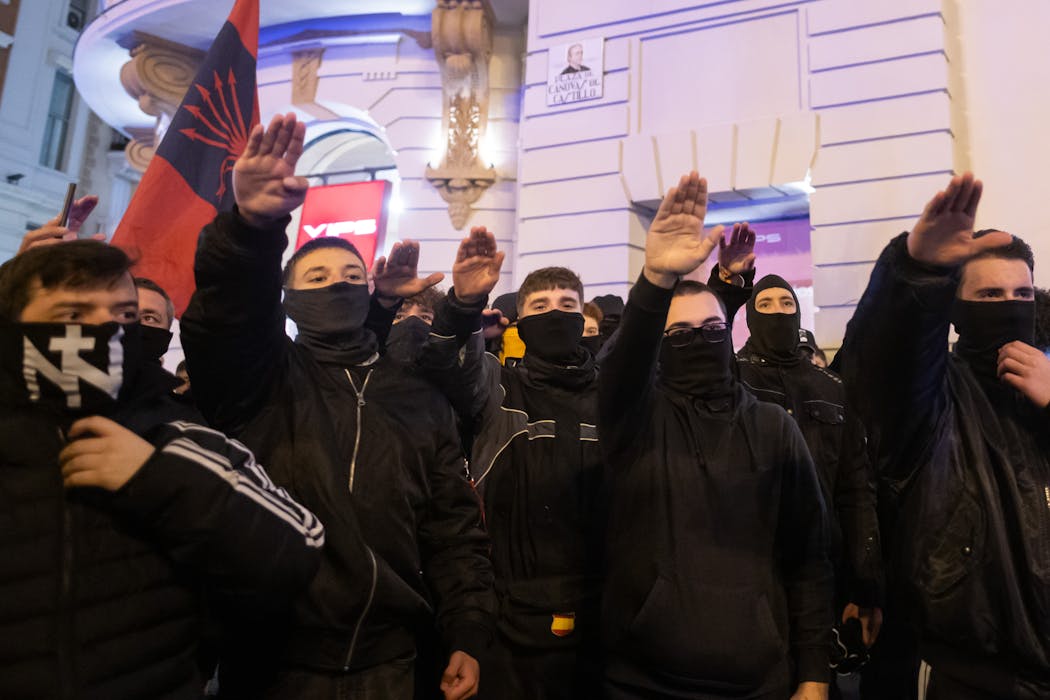
The Falange party started off as a a small extremist party on the margins of Spanish society, a society deeply troubled with political and economic instability. The party primarily preached a radical nationalism, a highly exclusive way to be and act Spanish. Traditional gender roles, monolingualism and Catholicism rallied people by offering absolutist comfort during uncertain times. Quickly, the Falange grew in power and prevalence until, ultimately, it moved mainstream.
By 1936, the party had garnered enough support from the Catholic Church, the military, and wealthy landowners and businessmen that a sizable amount of the population accepted Gen. Francisco Franco’s coup d'etat: a military crusade of sorts that sought to stop the perceived anarchy of liberals living in godless cities. His slogan, “¡Una, Grande, Libre!,” or “one, great, free,” mobilized people who shared the Falange’s anxieties.
Like the Falange, MAGA, the wing of the U.S. Republican Party named after Trump’s slogan “Make America Great Again,” repeatedly vilifies the left, who mostly live in cities, as godless anarchists who live like vermin.
Once in power, the Francoist regime commissioned a secret police force, the Political-Social Brigade – known as the BPS – to “clean up house.” The BPS was charged with suppressing or killing any political, social, cultural or linguistic dissidents.
Weakening resistance
Franco not only weaponized the military but also proverbially enlisted the Catholic Church. He colluded with the clergy to convince parishioners, especially women, of their divine duty to multiply, instill nationalist Catholic values in their children, and thus reproduce ideological replicas of both the state and the church. From the pulpit, homemakers were extolled as “ángeles del hogar” and “heroínas de la patria,” or “angels of the home” and “heroines of the homeland.”
Together, Franco and the church constructed consent for social restrictions, including outlawing or criminalizing abortion, contraception, divorce, work by women and other women’s rights, along with even tolerating uxoricide, or the killing of wives, for their perceived sexual transgressions.
Some scholars contend that the repealing of women’s reproductive rights is the first step away from a fully democratic society. For this reason and more, many are concerned about the U.S. Supreme Court’s recent overturning of Roe v. Wade.
The #tradwife social media trend involves far-right platforms echoing Francoist-style ideologies of submission, restriction, dependence and white male dominance. One of TikTok’s most popular tradwife influencers, for instance, posted that “there is no higher calling than being a wife and a mother for a woman.” She also questioned young women attending college and rebuked, on air, wives who deny their husbands sexual intimacy.
Weakening the economy
Economically, Franco implemented autarkic policies, a system of limited trade designed to isolate Spain and protect it from anti-Spanish influences. He utilized high tariffs, strict quotas, border controls and currency manipulation, effectively impoverishing the nation and vastly enriching himself and his cronies.
These policies flew under the motto “¡Arriba España!,” or “Up Spain.” They nearly immediately triggered more than a decade of suffering known as the “hunger years.” An estimated 200,000 Spaniards died from famine and disease.
Under the slogan “America First” – Trump’s mutable but aggressive tariff regime – the $1 billion or more in personal wealth he’s accumulated while in office, along with his repeated attempts to cut nutrition benefits in blue states and his administration’s anti-vaccine policies may appear to be disconnected. But together, they galvanize an autarkic strategy that threatens to debilitate the country’s health.
Weakening the mind
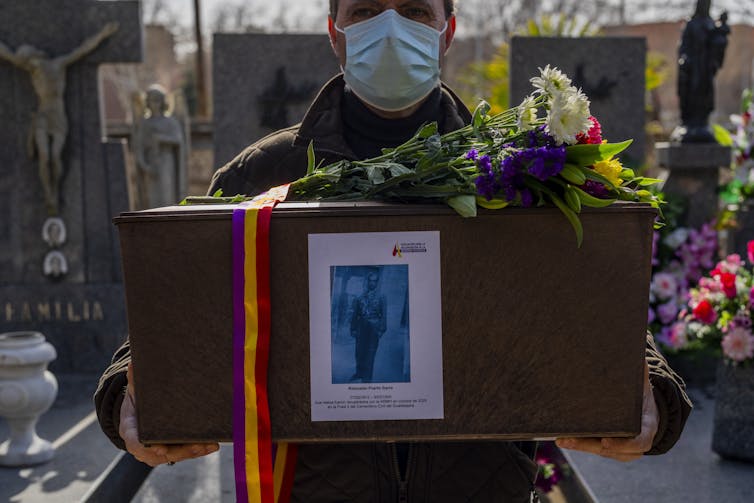
Franco’s dictatorship systematically purged, exiled and repressed the country’s intellectual class. Many were forced to emigrate. Those who stayed in the country, such as the artist Joan Miró, were forced to bury their messages deeply within symbols and metaphor to evade censorship.
Currently in the U.S., banned books, banned words and phrases, and the slashing of academic and research funding across disciplines are causing the U.S. to experience “brain drain,” an exodus of members of the nation’s highly educated and skilled classes.
Furthermore, Franco conjoined the church, the state and education into one. I am tracking analogous moves in the U.S. The conservative group Turning Point USA has an educational division whose goal is to ‘reclaim" K-12 curriculum with white Christian nationalism.
Ongoing legislation that mandates public classrooms to display the Ten Commandments similarly violates religious freedom guarantees ratified in the constitution.
Drawing comparisons
Trump has frequently expressed admiration for contemporary dictators and last week stated that “sometimes you need a dictator.”
It is true that his tactics do not perfectly mirror Francoism or any other past fascist regime. But the work of civil rights scholar Michelle Alexander reminds us that systems of control do not disappear. They morph, evolve and adapt to sneak into modern contexts in less detectable ways. I see fascism like this.
Consider some of the recent activities in Minneapolis, and ask how they would be described if they were taking place in any other country.
Unidentified masked individuals in unmarked cars are forcibly entering homes without judicial warrants. These agents are killing, shooting and roughing up people, sometimes while handcuffed. They are tear-gassing peaceful protesters, assaulting and killing legal observers, and throwing flash grenades at bystanders. They are disappearing people of color, including four Native Americans and a toddler as young as 2, shipping them off to detention centers where allegations of abuse, neglect, sexual assault and even homicide are now frequent.
Government officials have spun deceptive narratives, or worse, lied about the administration’s actions.
In the wake of the public and political backlash following the killing of Alex Pretti, Trump signaled he would reduce immigration enforcement operations] in Minneapolis, only to turn around and have Defense Secretary Pete Hegseth authorize the use of an old military base near St. Paul, suggesting potential escalation, not de-escalation. Saying one thing while doing the opposite is a classic fascist trick warned about in history and literature alike.
The world has seen these tactics before. History shows the precedent and then supplies the bad ending. Comparing past Francoism to present Trumpism connects the past to the present and warns us about what could come.
Rachelle Wilson Tollemar does not work for, consult, own shares in or receive funding from any company or organization that would benefit from this article, and has disclosed no relevant affiliations beyond their academic appointment.
Read These Next
El Niño is threatening California’s fragile coast again – the 1982-83 El Niño opened eyes to the ser
The destructive 1982-83 El Niño, then the strongest on record, eroded cliffs, leaving homes hanging…

Horror’s monsters find new meaning with queer and trans audiences – how ‘Teenage Sex and Death at Ca
Horror as a genre has traditionally been rife with transphobia and homophobia. But LGBTQ+ fans love…
What the failed attack on an Illinois temple reveals about anti-Hindu hate in the United States
Hostility toward Hindu worship practices draws on a long history of prejudice portraying the faith’s…