US turns its back on global efforts for women and children terrorized by violence and conflict
The Trump administration’s move to withdraw the US from these organizations risks undercutting lasting peace and global human rights accountability.

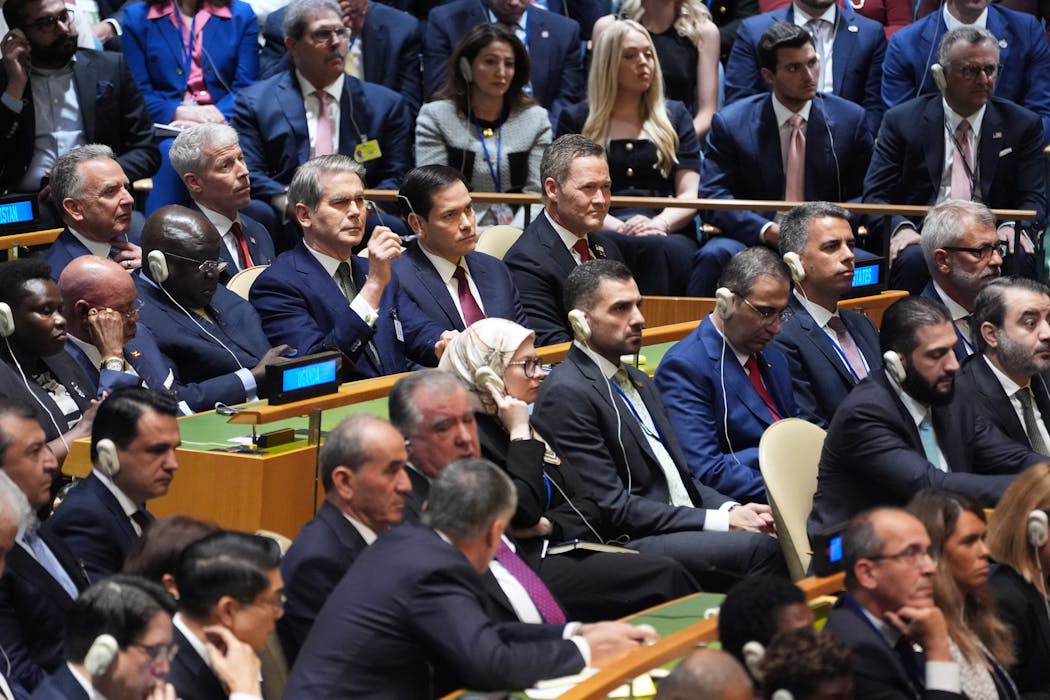
The Trump administration’s recent announcement that it is withdrawing from 66 international organizations and treaties is another blow to the global system where all countries unite to share concerns, agree on rules of conduct and determine agendas for collective action.
Coming on the heels of the U.S. attack on Venezuela – considered a violation of international law – the White House claims, without specific justification, that these organizations and initiatives “operate contrary to U.S. national interests, security, economic prosperity or sovereignty.”
Some experts say many of these organizations are niche and peripheral initiatives. They say the groups receive little money from the U.S., anyway.
Additionally, most of the U.N. entities on the administration’s list are part of the U.N.’s main body, the Secretariat, which gets its funding primarily from membership dues that are required by legal obligations. In fact, the U.S. can’t technically withdraw from these groups without leaving the U.N. completely. It can, however, select not to participate in meetings of these bodies or finance them through additional funds.
Moreover, with the White House already defunding the foreign assistance that supported many of these organizations and the U.N. system, regardless of congressional appropriations, this stated withdrawal is unlikely to alter much for these organizations in the short term.
The loss is likely greater to America.
Foreign policy experts assert that leaving empty the U.S. seat at the table will result in an increasingly isolated America and enable its adversaries, such as China, to fill the void.
As a democracy and peacebuilding scholar, and from my years working at the U.N., I know U.S. withdrawal from these organizations also risks undercutting lasting peace and human rights accountability, especially for women and children terrorized by violence and conflict.
Women and children die first
Peace and human rights-related groups loom large on the list of organizations the U.S. has withdrawn from.
The list includes key U.N. bodies that seek to hold states accountable for rape and use of child soldiers in conflict, among other crimes.
The U.N. offices of the Special Representative on Children in Armed Conflict and on Sexual Violence in Conflict are unique global repositories of detailed reporting used by countries, courts and advocates.
These offices can identify violations and trigger action to prevent rape and violence against women and children. This can lead to targeted sanctions against people and other restrictions, national action plans compelling reform, and even international criminal prosecutions.
Additionally, the U.S. will no longer support U.N. peacebuilding efforts. That includes the Peacebuilding Commission and its attendant Peacebuilding Fund. Yet by virtue of its permanent member status on the Security Council, the U.S. is a member of the commission.
Established in 2005 to help countries avoid a return to conflict, the Peacebuilding Commission claims among its successes formerly war-torn but now stable countries such as Sierra Leone and Liberia, which had Africa’s first democratically elected female leader. These bodies prioritize women and youth engagement in building peace.

Also on the list is the United Nations group focused on gender equality and women’s empowerment, known as UN Women. Established in 2010, the agency promotes women’s rights and helps women and girls prosper. UN Women has helped improve laws and policies for women in 83 countries and leads major efforts, including the Spotlight Initiative that aims to end violence against women and girls in more than 25 countries.
More than half of UN Women’s current budget of over US$2 billion for 2026 through 2029 goes to empowering women in war-affected societies and tackling violence against women and girls.
The U.S. served multiple times on the UN Women executive board, which steers the direction of the organization, including between 2023 and 2025. It does this, in part, by approving its strategy, plans and budget.
With the U.S. leaving its seat in steering the organization, Secretary of State Marco Rubio recently said that UN Women has failed “to define what a woman even is.”
With such an adversarial approach, the absence of the Trump administration seeking to spoil human rights protections might be advantageous for these groups in the short term.
But the lack of U.S. financial and political support may weaken these organizations in the long term, eroding their legitimacy and even opening the door for other countries to further undermine their efforts. That might endanger the already politically sensitive challenge of promoting accountability for serious violations of women’s and children’s rights.
‘Adapt, shrink or die’
The specter of the U.S. further abandoning peace and human rights efforts remains.
Rubio said on Jan. 7, 2026, that the administration’s review of additional organizations continues. That reinforces a recent State Department statement to the U.N. – “adapt, shrink or die.”
Some key international and U.N. entities that promote peace and human rights were not on the list, including the Office of the High Commissioner for Human Rights, the U.N.’s chief human rights institution – a bully pulpit that has been used sparingly against the second Trump administration so far.

But the U.S. has recently been disrupting long-standing, U.N.-mediated agreements on human rights concerns, including for children.
In 2025, it voted against 38 resolutions in the General Assembly’s human rights committee alone. For example, for the Rights of the Child resolution, the U.S. took the unusual and divisive step of calling for a general vote, even though text had been previously agreed upon. Despite the U.S. “no” vote, the resolution passed, with over 170 states voting in favor.
The Trump administration has also selectively funded certain U.N. peace efforts. For example, of its $682 million contribution to U.N. peacekeeping, it has earmarked $85 million for Haiti – around half of what it actually owes.
It cherry-picked the conflict areas to fund – excluding Yemen, Afghanistan and Gaza – with its $2 billion in humanitarian aid, a steep decline from the U.S. contribution of around $14 billion in 2024.
And it refused to participate in the U.N’s Universal Periodic Review – the only global peer review process for all countries’ human rights efforts. The group’s recommendations, though voluntary, often trigger action to improve human rights. Failure to show up in November 2026 for a postponed review would mean that America becomes the first country ever to undermine this singular means of accountability.
For now, most other U.N. member states are not following suit.
While the U.S. has been able to force changes to language on sexual- and gender-based violence in Security Council resolutions – where it holds a veto – its efforts have gained little traction in the broader body. Losing that language erases years of progress in recognizing that men and boys are also subject to sexual violence and exploitation and deserve international protection.
Most tellingly, the Trump administration’s new Board of Peace – ostensibly for Gaza – appears designed to displace the U.N. itself without reference to the core principles, including human rights, on which the U.N. Charter stands.
From May 2023 until July 1, 2025, the author served in the Bureau for Democracy, Human Rights, and Governance at the United States Agency for International Development (U.S.A.I.D.).
Read These Next

An AI model’s false tip to Philadelphia police reveals how digital agents can do as they’re told and
An expert on AI governance explains why these rare mistakes may soon be common, and with much higher…
Offering cash for votes is quite common – but here’s why it doesn’t work
Money or other material benefits are often not enough to override a voter’s preferences and partisanship.

El Niño is threatening California’s fragile coast again – the 1982-83 El Niño opened eyes to the ser
The destructive 1982-83 El Niño, then the strongest on record, eroded cliffs, leaving homes hanging…