
Executive order on vaccines bypasses an evidence-based process that has kept kids safe
The most important thing for parents to know is that the order does not change which vaccines are available to children and is not based on any new data about vaccine safety.

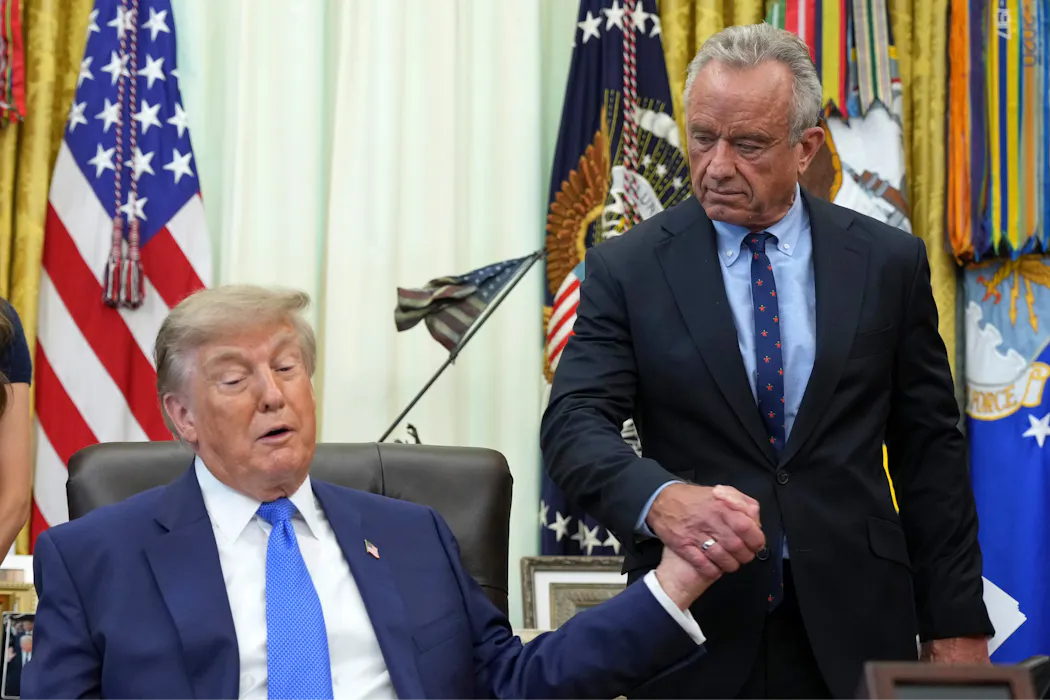
President Donald Trump signed an executive order on Aug. 10, 2026, calling for the combined measles, mumps and rubella vaccine to be given as three separate shots at three separate appointments. The combined MMR vaccine is currently given at 12 to 15 months of age and again between ages 4 and 6.
In the order, Trump also urges states to revisit their school vaccination laws and instructs the Justice Department to challenge state rules on religious and medical exemptions.
It is the latest move in the administration’s effort to dismantle the U.S. childhood immunization schedule, a set of recommended vaccines given from birth through adolescence to prevent a range of serious infections that has been in place in some form since 1995. The order endorses the January 2026 decision by the Department of Health and Human Services that cut universally recommended childhood vaccines from 17 diseases to 11 – despite the fact that those changes were blocked by a federal court in March 2026.
An executive order cannot by itself change which vaccines are recommended or required, but it sets the administration’s direction and puts federal agencies to work on it.
I am an infectious disease physician who treats vaccine-preventable diseases and reviews the clinical trial evidence behind immunization recommendations. The most important thing for parents to know is that this order changes nothing at the pediatrician’s office. Every vaccine on the schedule remains available and covered by insurance, the American Academy of Pediatrics continues to recommend the full set, and no new evidence prompted any of this.
What the order will do is create confusion at a bad moment. It arrives as children return to school, when measles cases are at their highest number since 1991, and it tells parents that a vaccine their pediatrician recommends should be broken into three shots that no longer exist in this country. In the longer term, the order’s most consequential provisions are aimed at state school vaccination requirements, which is where American vaccine policy is actually made.
A science-backed schedule
The U.S. childhood immunization schedule, the grid of colored bars that pediatricians share with parents and which explains when and what vaccines all children should receive, wasn’t designed in a single stroke. It was built gradually over decades, shaped by disease outbreaks, technological breakthroughs and hard-won lessons about reducing childhood illness and death.
The U.S. adopted a coordinated, national vaccine policy in 1964, when the surgeon general established the Advisory Committee on Immunization Practices, or ACIP, to evaluate the evidence and issue recommendations on vaccine use to the Communicable Disease Center, later renamed the Centers for Disease Control and Prevention. At that point, the CDC recommended children receive a vaccine against smallpox, a combination vaccine against diphtheria, tetanus and pertussis, known as the DTP vaccine, and a vaccine against polio. Most states did not yet require any of them for school entry; comprehensive school requirements came later, largely out of the measles elimination efforts of the 1960s and 1970s.
Through the 1960s, vaccines against measles (1963), mumps (1967) and rubella (1969) were licensed and eventually combined into what’s known as the MMR shot in 1971. Each addition followed a similar pattern: a disease that killed or disabled thousands of children annually, a vaccine that proved safe and effective in trials, and a recommendation that transformed a seemingly inevitable childhood illness into something preventable.
The rubella vaccine went beyond protecting the children who received it. Rubella, also called German measles, is mild in children but devastating to fetuses, causing deafness, heart defects and intellectual disabilities when pregnant women are infected. By 2015, rubella had been eliminated from North America and South America.
In 1991, the CDC added the hepatitis B vaccination at birth to the schedule. Before then, around 18,000 children every year contracted the virus before their 10th birthday. But with the birth dose, since the early 1990s, hepatitis B infections in American children have fallen by 99%.
The schedule continued to evolve: The ACIP recommended vaccinations for chickenpox in 1996; rotavirus in 2006, replacing an earlier version withdrawn after safety monitoring detected a rare side effect; and HPV, also in 2006.
Each addition followed the same rigorous process: evidence review, risk-benefit analysis and a public vote by the advisory committee.

More vaccines – but fewer antigens
Vaccine skeptics, including HHS Secretary Robert F. Kennedy Jr., often claim erroneously that children’s immune systems are overloaded because the number of vaccines they receive has increased. This argument is routinely marshaled to argue for a reduced childhood vaccination schedule – and to give credence to the thoroughly debunked link between childhood vaccines and autism.
One fact often surprises parents: Despite the increase in recommended vaccines, the number of immune-stimulating molecules in those vaccines, called antigens, has dropped dramatically since the 1980s, which means they are less demanding on a child’s immune system.
The whole-cell pertussis vaccine used in the 1980s alone contained roughly 3,000 antigens. Today’s entire schedule contains fewer than 160 antigens, thanks to advances in vaccine technology that allow precise targeting of only the components needed for protection.
Dismantling without evidence
In December 2025, the ACIP reconstituted by Kennedy voted to drop a long-held recommendation that all newborns be vaccinated against hepatitis B, despite no new evidence that questions the vaccine’s long-standing safety record.
Then, in January 2026, the CDC moved vaccines against rotavirus, influenza, hepatitis A, hepatitis B and meningococcal disease from routine recommendations to “shared clinical decision-making,” a category that shifts responsibility for initiating vaccination from the healthcare system to individual families.
Routine recommendations trigger automatic reminders in medical records and let nurses vaccinate under standing orders. Moving a vaccine to “shared clinical decision-making” puts a physician in the middle of every dose, which reduces the number of kids getting vaccinated – especially among the more than 100 million Americans without regular access to primary care.
The executive order endorses and extends these changes, and none of them follow from new safety findings. They stem from a 33-page assessment comparing the U.S. schedule with Denmark’s, a country of 6 million people with universal healthcare and a registry that tracks every patient. The U.S. has 330 million people, 27 million uninsured, and a system where millions move between providers. The assessment’s authors, senior officials at the Food and Drug Administration and at HHS, are both longtime critics of the existing vaccine schedule.

The executive order’s charge to split the MMR vaccine dose into separate injections, given at separate appointments, is similarly nonsensical. Single-disease measles, mumps and rubella vaccines have not been sold in the U.S. since 2009, when Merck stopped producing them. They were discontinued because the ACIP and the American Academy of Pediatrics held that separate shots would mean more needles, more appointments and children left unprotected for longer.
Merck has estimated that producing these shots again would take more than a decade.
The order also calls for childhood vaccines generally to be spread across separate visits rather than given at one appointment. That will discourage families further. Combination vaccines were developed to reduce needles and appointments, and children who receive them finish the series more often. Even families who want their children vaccinated can end up skipping their kids’ shots, simply because a third appointment is harder to reach than a first. For parents without paid leave, reliable transportation or a regular pediatrician, that is the difference between protected and not.
Intervening in states’ vaccine policies
The provisions with the most practical force have nothing to do with medicine. They are aimed at the states.
States write their own school vaccination laws. Major medical organizations, including the American Academy of Pediatrics and the American College of Obstetricians and Gynecologists, have said they will keep recommending the full set of childhood vaccines, and states including California, New York and Illinois will follow established guidelines rather than the new federal ones. Nothing in the order prevents that. It asks states to consider revising their requirements. Asking is all it can do.
The exception is the section on exemptions. Every state requires certain vaccines for school entry, and every state allows some children to opt out, usually for medical reasons and in most states for religious ones as well. A handful of states, including California, have narrowed those exemptions in recent years.
The order directs the U.S. attorney general to pursue legal challenges to states over their religious and medical exemption rules, and tells the Justice, Education and Health and Human Services departments to hold their contractors and grantees to the same standard, which could put federal funding in play.
Whether any of that succeeds will be decided in court rather than in a clinic.
Portions of this article originally appeared in a previous article published on Jan. 6, 2026.
Jake Scott serves on the board of Vaccinate Your Family, a nonprofit vaccine advocacy organization. He receives no funding from vaccine manufacturers.
Read These Next

More rehab centers should mean fewer overdoses. In one California region, we found the opposite
When people travel out of state for addiction treatment, overdose risk is greater than many realize.

Americans are stressed about grocery prices, so why do they toss or overlook so much ‘misfit’ food?
Quality, rather than discounts or environmental benefits, is what’s needed to encourage shoppers to…

Across the US, people don’t want data centers coming to their communities
Opposition to data centers is widespread across the US, uniting people despite other differences on…