Today’s Thanksgiving holiday was invented amid the Civil War to unite a divided country
Thanksgiving as we know it today was created in the mid-1800s to unify a nation and was often used to assimilate new immigrants.

It is hard to imagine a more American holiday than Thanksgiving. Every year, elementary schoolers learn about the first celebration: that after surviving a terrible year, New England’s first European immigrants, the Pilgrims, invited their Indigenous neighbors to a feast in gratitude for their help and God’s providence.
Children learn the story as if it were history – and as though Americans have commemorated Thanksgiving the same way ever since. The only existing eyewitness account of this event does not, however, say much about what was eaten. A slightly later account of the 1621 harvest mentions seasonal food such as venison, corn – and, yes, turkeys.
The idea of a straight line connecting that “first Thanksgiving” to Thanksgivings today is, in fact, an American myth. It is a story created in the 19th century to unify a nation and long used to assimilate new immigrants into it.

Creating today’s Thanksgiving
The Pilgrims and Puritans, who started arriving in Massachusetts shortly afterward, regularly held fasts and feasts. On fast days, the community atoned for sins they believed they had committed. On feast days, they gave thanks to God. Some governors of colonies – and later, states – declared fall holidays of thanksgiving, but did not coordinate with each other.
The Thanksgiving that we know, with the traditional recipes and the close connection to the Pilgrims, was largely the creation of one woman: Sarah Josepha Hale, who was born in New Hampshire in 1788. In the 1830s she became the editor of Godey’s Lady’s’ Book, which had the largest circulation of any U.S. magazine before the Civil War.

Godey’s included clothing patterns, recipes, articles on home management, essays on educating children, recipes and fiction. Hale believed that the woman was the heart of the home and responsible for creating an upstanding, God-fearing, wholesome family.
She was also deeply committed to her young country and believed that homemakers could help create its national identity. According to historian Elizabeth Pleck, Hale began publishing editorials calling for a national Thanksgiving, along with instructions for what the day could look like.
Godey’s taught readers how to celebrate the day, with recipes for seasonal food such as turkey and cranberry sauce. The centerpiece of the table was the pies, which featured elaborate pastry decorations: the Mayflower or a cornucopia, created out of pie crust. The full table was a celebration of “women’s work,” at a time when the Industrial Revolution was shifting the economy toward factories and other business, making the importance of unpaid domestic labor less obvious.
Hale’s idea of Thanksgiving also emphasized returning to loved ones, as those factories were drawing many workers away from home. She saw it as a day to tell family stories – and the story of the nation, starting with the first Thanksgiving.
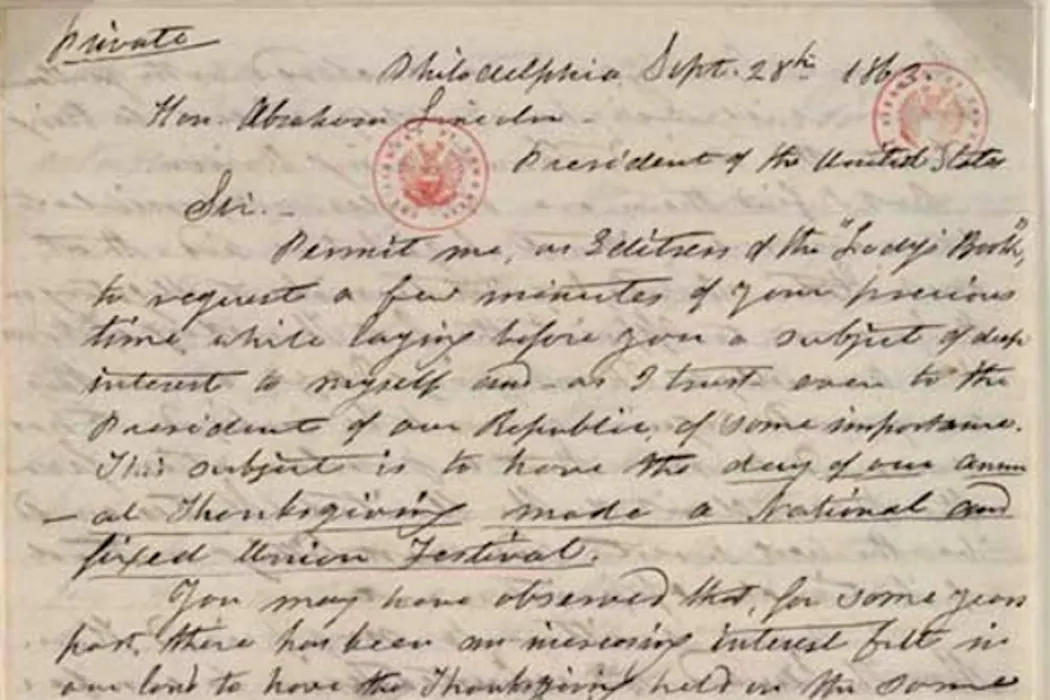
Hale petitioned five presidents to declare Thanksgiving a national holiday. Abraham Lincoln finally took her up on it, hoping that a national holiday emphasizing the country’s origin story would prove uniting during the Civil War.

Northern women sent pies to the families of soldiers and turkeys to the men at the front. Pleck notes that abolitionist Sojourner Truth went door to door, collecting funds to provide Thanksgiving dinners to African American troops.
The holiday caught on gradually. Given the Protestant origins of early Americans’ feast and fast days, Catholics were slow to embrace it. Given its association with Lincoln and the war, the South was also late to adopt it. And given the day’s emphasis on family, it was less celebrated on the frontier, where single men dominated.
Wherever Thanksgiving was celebrated, however, Godey’s Lady’s Book taught Americans how to celebrate it. The magazine’s op-eds connected the holiday menu and the past, using the Pilgrims’ courage to inspire 19th-century Americans dealing with massive changes in their own lives: war, industrialization, urbanization and the frontier.
Assimilating immigrants
Before long, Thanksgiving was also seen as a way to assimilate immigrants.
This vision was, in part, popularized by political cartoonist Thomas Nast. “Uncle Sam’s Thanksgiving Dinner,” which appeared in Harper’s Weekly in 1869, depicted Americans from any number of races and ethnicities in their national dress: men, women and children sitting as equals around a dinner table, with portraits of presidents on the wall, while Uncle Sam carved a turkey.

The image suggested that immigrants could be incorporated into the nation – and formerly enslaved people, too. It was printed just one year after the 14th Amendment granted citizenship to anyone born in the U.S. and four years after the 13th Amendment formally ended slavery.
Nast’s image contrasted sharply to another cartoon, also called “Uncle Sam’s Thanksgiving Dinner,” that G.F. Keller drew for the San Francisco Wasp eight years later. Keller’s disheveled and entirely male collection of diners each ate their own national food, or offensive stereotypes thereof, suggesting immigrants could never truly become American.
But many Americans believed they could – although they demanded most immigrants give up their “Old World ways” and take on customs of their new country. Thanksgiving was part of the engine of that assimilation.

In the early 20th century, public schools taught about Thanksgiving and sent children home with recipe cards so that their parents could cook the same kinds of recipes Hale had popularized in the previous century. Schools framed the Pilgrims and their first Thanksgiving as the spiritual, if not literal, ancestors of all Americans: the first “immigrants.” They didn’t dwell on how the Pilgrims’ arrival looked more like colonization than immigration.
The holiday became a way to include newcomers in the national myth. By the 1920s, in fact, Thanksgiving was the most celebrated holiday in public schools. Pleck quotes one Jewish immigrant reflecting on his childhood and saying the Pilgrims were a way to connect “us offspring of Jewish immigrants – our own exiled fathers who had crossed the seas – and the traditions of Protestant America.” Students acted out the first Thanksgiving and were told they belonged to a “nation of immigrants.”

While some immigrant parents rejected the holiday, others embraced it, with spins to make it their own. Many served a turkey surrounded by the celebratory dishes of their own cultures. For Jews, the early 1900s invention of Crisco as a nondairy butter substitute allowed them to create a truly “American” Thanksgiving and dessert, without violating kosher rules against mixing meat and milk.
The fact that most families celebrate at home allowed immigrants and their children to take part in the national culture, while still expressing their own. During my own New England childhood, an Indian neighbor had my mother’s fairly classic cranberry relish, and by the end of the weekend she’d worked out a cranberry chutney with Indian spices. When we had Thankgiving dinner with my parents’ friends the Stalzmans, who were Jewish, matzah ball soup was the opening course.
At times, the idea of the Pilgrims arriving on the Mayflower has been used to exclude – to imply that only Americans whose literal ancestors came over on the ship, and other white Protestants like them, truly belong. Yet on the holiday in their memory, generations of new Americans affirmed that they, too, belonged.
Samira Mehta receives funding from the Henry Luce Foundation. I serve on the Jewish Life Committee of the Rose Community Foundation.
Read These Next
How the US power rivalry with Russia and China is turning outer space into the next battlefront
After the recent US deployment of a weapon in Earth’s orbit, the space arms race looks increasingly…
The stunning transformation of the Southern Democratic Party, in one lifetime
To understand the magnitude of Mississippi Democrat Scott Colom’s election to the Senate, you have…
A Westmoreland County easement shows how landowners can protect farmland without selling it
A Westmoreland County easement and a property law scholar’s own ranch negotiations show what landowners…