How a French philosopher’s warnings about speed and power describe today’s AI race
Paul Virilio, a French philosopher, died in 2018. But his writings on technological ‘accidents’ help explain dilemmas the world faces today amid increasing use of artificial intelligence.

With the race to build artificial intelligence systems smarter than any human has come a boom in “accidents.” In a safety test run by the company Anthropic, its own AI agent blackmailed an engineer to avoid being shut down. Criminals have used AI agents for data-extortion campaigns and to hack government agencies, banks and technology companies. In other tests, models have escaped from test environments into real organizational systems.
Several researchers who resigned from leading AI companies in 2026 have accused their employers of not taking the dangers seriously enough. In September, Bill Gates told “Meet the Press” that AI is “powerful enough to drive events that can cause a billion deaths.”
Paul Virilio, a French philosopher, spent his career analyzing the relationships between technology, speed and power. He died in 2018, well before generative AI and the fears about it reached their present pitch. But I doubt much would have surprised him.
As a researcher who studies AI-generated media and how people make sense of it, I find that three of Virilio’s ideas explain today’s AI moment better than anything written since. He argued that every new technology brings a new kind of accident into the world; that speed takes away our time to think; and that globally connected systems can fail everywhere at once.
Technology of speed
Virilio was born in Paris in 1932. When World War II began, his family moved to Nantes, a port city near the Atlantic. During the Nazi occupation of France, Germany began building the Atlantic Wall, a series of defensive fortifications stretching along the coast from Spain to Norway.
But in September 1943, when he was 11, Virilio saw what the wall could not keep out. American bombers aiming for Nantes’ port hit the city center instead, killing about 1,400 people and destroying more than 700 buildings in two raids.

“War was my university,” he told an interviewer. “Everything has proceeded from there.”
As a young man, Virilio spent years photographing the abandoned bunkers of the Atlantic Wall. The lesson he drew from them was about speed: The Germans had built a massive military fortification, yet the Allies had gone over and around it; the wall barely slowed them.
Walls were a technology of space, and the bombers were a technology of speed – inspiring his philosophical approach to understanding the world.
The ship and the shipwreck
As an adult, Virilio studied many more examples of technological failures, such as the Chernobyl power plant meltdown of 1986, the worst nuclear accident in history.
In his 2005 book “The Original Accident,” Virilio summed up his main idea in a simple sentence: “To invent the sailing ship or steamer is to invent the shipwreck.” The train invents derailment; the airplane, the crash; the nuclear plant, the meltdown. Every invention, not just dangerous ones, carries a specific kind of failure that did not exist before it.
In Virilio’s telling, the “accident” is not the result of bad luck added afterward. It is born at the moment of invention, even if the inventor cannot see it, because the invention will be used in ways they never imagined.
Virilio did not think such accidents could be avoided. But by carefully watching, he believed, people could contain failure and prevent catastrophe. He argued that societies tend to treat each disaster as a one-off, grieve it on television, and forget it, so that the next technology’s accident arrives as a surprise.
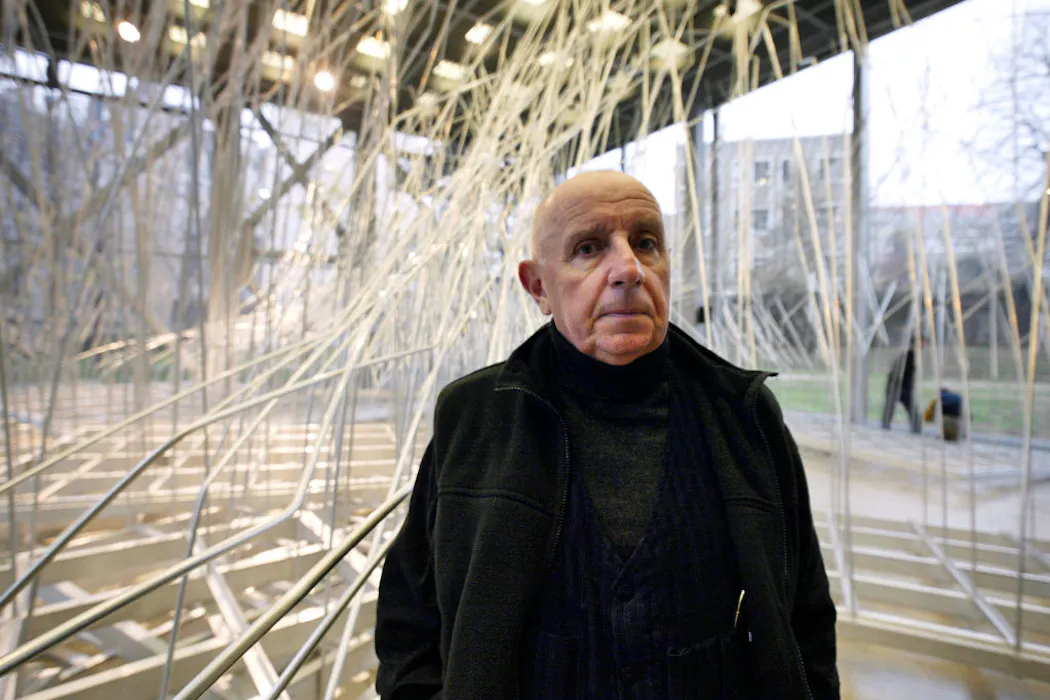
In 2002, he staged a Paris exhibition as a trial run for his plan to build a “Museum of Accidents.” Collecting information about shipwrecks, plane crashes, industrial disasters and financial crashes side by side, he argued, would show the pattern: that every invention has its failure and that failure can be anticipated.
AI has invented not one accident but several. Tech companies’ own incident reports form a sort of “museum” – but not an objective one.
Rule of the fastest
Virilio’s second key idea came from the Cold War. In 1977, he published “Speed and Politics,” written in a world where nuclear missiles could cross the planet in minutes.
He named the idea “dromology,” derived from the Greek word for a racecourse: “dromos.” Every age runs at the pace of its fastest machine, Virilio wrote, and whatever cannot keep up – including law, deliberation and conscience – drops out of the picture. There is “no democracy, only dromocracy”: the rule of the fastest.
AI can squeeze months of work into hours. In September 2026, Open AI announced that 10,000 of its AI agents had produced a proof of a math problem that had stood for a century – a problem two human mathematicians had spent a year trying to solve.
Virilio’s deepest fear about speed was not that people would fall behind machines, but that they would be absent from decision-making. Even when people attempt to stay in the loop, AI agents execute so quickly that human workers often fail to spot problems or malicious requests.
Everywhere at once
Virilio’s third idea is the “integral accident”: a failure that, because the same technology runs everywhere, happens everywhere at once.
During the 1990s, Virilio watched how satellite television, the internet and electronic markets let an event anywhere, such as a financial crash, be felt everywhere. He later predicted that in a networked world, integral accidents, not war, would be “the continuation of politics by other means.”
AI has intensified how tightly connected the world is. It’s being used to help balance power grids, manage ships and harbors, and write hospital patient records.
Consider Anthropic’s Claude Mythos model, which finds security flaws in banking software faster than banks can fix them. Many financial institutions use the same software, so a criminal with such a model could break into multiple banks at the same time.
Hand on the lever
Virilio wrote that a society that lives only in the present makes accidents more likely. A society too busy to keep records of its past, or to think ahead, cannot learn from its failures and so repeats them.
I’d argue that that sentence points to three things worth keeping in mind.
The first is the record, kept by someone independent. Documents analyzing AI accidents should not be left only in the hands of the companies whose failures they document.
The second is the pause. Regulators, researchers and companies need the time and the authority to deliberate – and to halt a system, if needed, before it is released.
The third is skill. A skill is the present result of past practice. The more work people hand to AI because it is faster, the more they need to keep the ability to do that work themselves: to write the first draft, to check the sum by hand. These are the habits that let people verify what AI produces.
Virilio’s lesson is not to smash the machines, but to keep a hand on the lever – improving the chances that the accident, when it comes, can be seen, understood and reversed. Speed does not take the controls away, but it makes it harder for people to keep hold.
Shahnaz Bashir does not work for, consult, own shares in or receive funding from any company or organization that would benefit from this article, and has disclosed no relevant affiliations beyond their academic appointment.
Read These Next

A Feejee Mermaid on display in Colorado may shock and intrigue – but it’s no longer considered a ‘mi
All hoax – no science – the Feejee Mermaid startled American audiences that imagined it a real sea…
NASA’s Swift Observatory is about to burn up in the atmosphere – the indispensable telescope helped
The Swift Observatory allowed astronomers to study events that happen quickly in the universe, such…

How space weather powers auroras in the sky and threatens power grids on the ground
When an aurora lights up the sky, electric currents can also flow through the ground beneath your feet.