‘Let nothing be forgotten’: Holocaust survivors’ memorial books honored lives lost and vibrant homet
After the Holocaust, Eastern European survivors collaborated on memorial books called ‘yizker bikher’ – one way to reclaim their neighbors’ lives and memories.

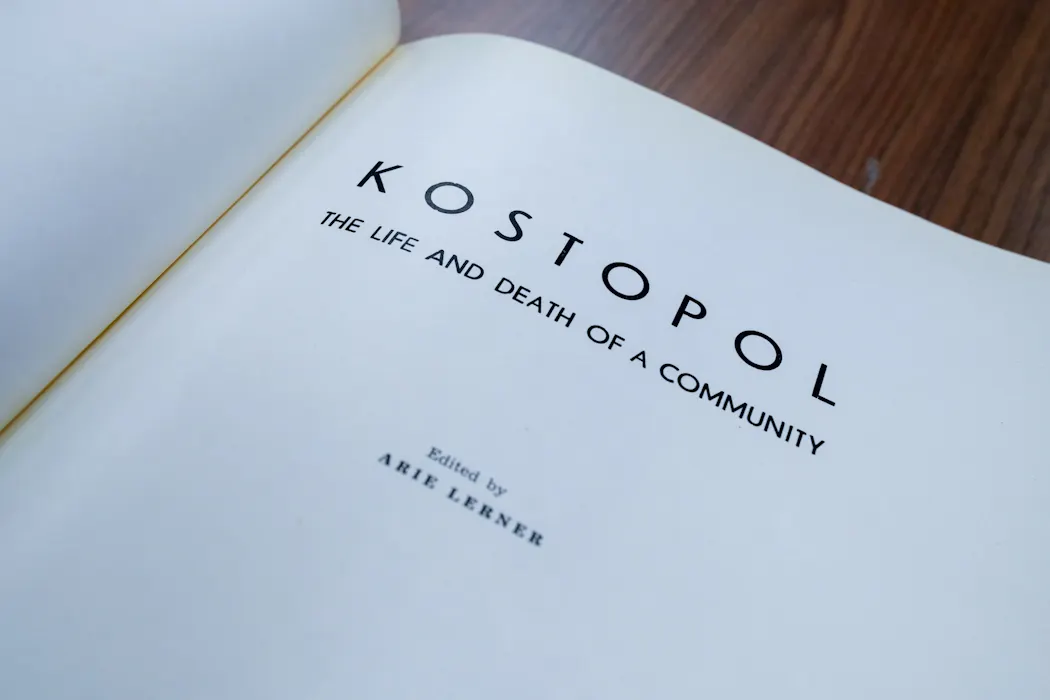
My grandmother was a Holocaust survivor from Kostopol, Ukraine. Years after she passed away, I was trying to learn more about her life before the war – something I knew very little about. When I found a book called “Sefer Kostopol” – Hebrew for “Book of Kostopol” – I hoped to find her among its pages.
It was a memorial book for her hometown, but beyond that, I wasn’t sure what to make of it. I’m a scholar of Holocaust memory, but I had never come across anything quite like it. It was a bit like a scrapbook, with varied types of images, essays written by different residents and lists of survivors – where I found my grandmother’s name – and of their murdered families, including her mother and sister.
My questions led me to investigate exactly what “Sefer Kostopol” was – and to learn that communities of survivors created over 1,000 such memorial books, called “yizker bikher” in Yiddish.
Everyday life
After the Holocaust, Eastern European survivors and Jews who had left before the war created these memorial books to honor their destroyed towns and murdered loved ones. Devoted to their neighbors, these collaboratively written volumes were one way for survivors to reclaim their lives and memories.

Yizker bikher were created not only to document the destruction of the Nazi genocide, but also to preserve the everyday lives that came before it. The volumes insist that Jewish communities be remembered not solely as sites of death but as places where people lived, argued, worked and celebrated. In general, around two-thirds of a given volume is devoted to describing prewar life; the remaining third includes first-person accounts of the Nazi occupation of the town and a long list of the dead.
Each book had anywhere from 20 to 50, even 75, contributors, who wrote in a warm, colloquial style. The visuals, too, feel personal. Photos portray the particulars of prewar life, with images of sports teams, school groups, bustling market squares and busy, modern streets.
Another common feature are maps, almost always drawn and labeled from memory by a survivor: the details of the forests and the rivers, the nicknames that locals used for the streets and stories of the homes and shops.
Beyond the photographs and maps, most volumes contain sketches by amateur artists to convey information about life under Nazi occupation. Some include art by well-known artists at the time, like Arthur Szyk, a Polish-Jewish illustrator and political cartoonist. There are also ephemera like posters, budgets, song lyrics, book covers, event flyers and elementary school report cards.

Link in a chain
The earliest volume that I studied came from Volkovisk, Belarus, and was published in 1946, just a year after the liberation of Auschwitz. It’s hard to imagine survivors finding one another and putting books together so soon after the war.
The editors, publication committees and contributors, though, reached for a familiar model: the “pinkes,” the community register found in every Eastern European Jewish town. These books contained everything from meeting minutes to school budgets and lists of political candidates.

Like the community registers, yizker bikher have a somewhat chaotic, idiosyncratic organization to them. Both were written by many hands, and they became treasured objects.
The relationship was so strong that many yizker bikher include the word “pinkes” in their title. In the introductions, some editors made explicit connections between the prewar pinkes and those created in the wake of the Holocaust. One of them was Eliezer Yerushalmi, who compiled the memorial book from Navaredok, Belarus.
Each pinkes is a link in a timeless chain recording the history of Jewish communities, he wrote: “The present pinkes, the Navaredok pinkes, is here to tell the orphaned generation and the generations to come all that the community experienced from its very beginning hundreds of years ago to its terrible destruction.”

Just like Jewish communities in Eastern Europe were interconnected, so too were survivor communities in places like the United States, Canada, Israel and Argentina. Some yizker bikher committees relied on the same editors and adopted features of other memorial books, making the process easier.
The first step was for members of the book committee to circulate a prospectus to their fellow survivors to explain the memorial project. A prospectus for the “Wielun Memorial Book,” commemorating a community in Poland, was circulated in 1961, 10 years before the volume was published. The editor wrote that,
The Wielun memorial book must be a reflection of a former home, which was so brutally destroyed and erased. In the book of remembrance, all moments, events, adventures, and experiences need to be expressed. Different facts, good deeds, memories, figures, and types. Let nothing be forgotten: days of sadness, days of joy, and hope for a better tomorrow.
That goal – “let nothing be forgotten” – sits at the very heart of each memorial book.
How they lived
Despite this, yizker bikher were mostly overlooked by scholars for many years. Perhaps this was because they defy easy categories: They are too nostalgic to be histories and too historical to be literature. They are too secular to be religious and too religious to be secular. And the range of visual material complicates things even further – for example, they aren’t photo albums per se, but they certainly include hundreds of photographs.

In the past few years, however, there has been a surge of academic and popular interest. Scholars are exploring the books and the archives that created them to learn more about all aspects of prewar Jewish life. They have also used yizker bikher to understand the intimate nature of the violence wrought by the Nazis and their local collaborators, and the beautiful, profound ways survivors found to honor their loved ones.
When we take yizker bikher seriously, it allows us to expand our focus beyond how 6 million Jews were murdered and highlight the way they once lived. Ultimately, these books remember individuals and communities as they wanted to be remembered.
Jennifer Rich does not work for, consult, own shares in or receive funding from any company or organization that would benefit from this article, and has disclosed no relevant affiliations beyond their academic appointment.
Read These Next

Some states are stepping up after federal childcare cuts – and now offer lessons for the future
Improving both supply and quality of childcare has been the focus of several states trying to find solutions…

Why over two-thirds of Americans say their country is in decline
A recent national survey reveals a US electorate that is unsettled, gloomy and likely looking for political…

I’ve been talking to MAGA supporters for years, and here’s why some are sticking with Trump — and ot
Despite the headwinds that have cratered support for Donald Trump – high prices, the Iran war, corruption…