Embryo personhood, once on the margins of abortion debates, is moving closer to the center
In vitro fertilization has become a bigger part of reproductive rights debates as a once-fringe movement to recognize embryos as people grows louder.

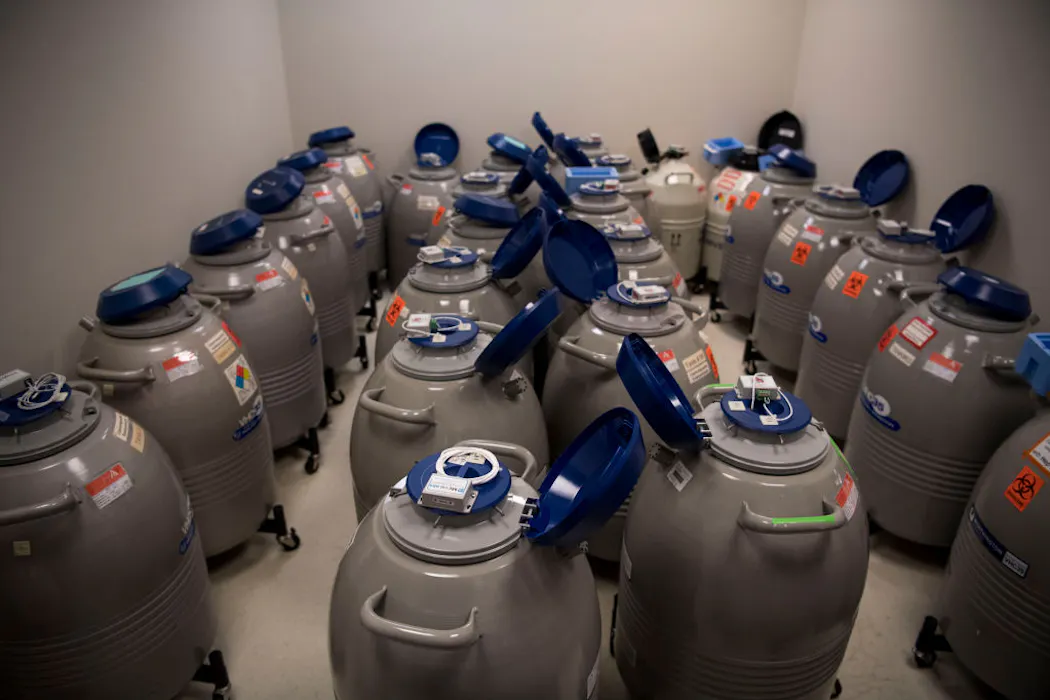
About 100,000 babies were born through in vitro fertilization in 2024, according to the most recent U.S. data. But IVF commonly involves trying to create multiple embryos, because success is never guaranteed. If unused, those embryos can be frozen, discarded, donated to research or donated to another fertility patient.
In the eyes of some anti-abortion activists, those frozen IVF embryos are already children – children who need to be “adopted” into families. And that idea now appears in a federal document: grant guidelines announced by the Department of Health and Human Services in June 2026.
The department’s Embryo Adoption Awareness and Services program has existed since 2002. But this year’s funding notice describes IVF embryos as “children who already exist and are in need of a family.” Rather than presenting “embryo adoption” as one option among many for patients with remaining embryos, the document describes the practice as centered on embryos’ “rights” and “best interests.”
This language draws from a decades-long movement to give personhood status to fetuses and embryos, including those made in fertility clinics. The personhood movement is rooted in a belief embraced by many conservative Christians: that human life begins at fertilization and should receive legal protection from that moment.
Embryo adoption occupies a niche corner of U.S. fertility care. But the notice brings far-reaching questions about reproductive politics into sharper focus, including the future of IVF – a fertility treatment that many of those same conservative Christians support.
In my 2023 book, “Conceiving Christian America: Embryo Adoption and Reproductive Politics,” I show how embryo adoption developed as a Christian pro-life response to the accumulation of embryos remaining after IVF, recasting embryos as vulnerable children requiring rescue. Once a fringe view even among anti-abortion activists, that claim is now moving closer to the mainstream of reproductive politics.
Donation vs. adoption
Some fertility patients who no longer plan to use their frozen embryos donate them to other patients in the United States. An embryo is transferred through contracts and clinic consent forms, after which it can be transferred into a recipient’s uterus.
The small network of agencies, nonprofits and churches that offer embryo “adoption,” on the other hand, recast the donation process as one that saves “pre-born children.” Modeled on domestic adoption, many programs require home studies that assess prospective parents and their households. Many also allow donors to select who receives their embryos and encourage families to get to know each other rather than remain anonymous.
Legally, though, embryos in the U.S. generally are not adopted, because states do not classify them as children under adoption law. Instead, they are often transferred by contract as personal property.
The distinction between donation and adoption is not merely semantic, however, but part of a larger political project. Advocates seek to change how the public understands embryos and, ultimately, how the law classifies them.
As one advocate for embryo personhood told me in 2008, “What we call things matters.” Adoption language gives the process “some meaning and some dignity,” he said, by recasting IVF embryos as children deserving protection rather than as surplus tissue or research material.

Pushing for personhood
The world’s first embryo adoption program was launched in 1997 by Nightlight Christian Adoptions, which also facilitates traditional domestic and international adoptions. But the idea emerged from a longer effort that began taking shape in the 1960s, led largely by conservative Christian organizations, to establish legal personhood from the moment of fertilization onward.
In 1973, the Supreme Court’s Roe v. Wade ruling found that the Constitution protected the right to have an abortion – a decision grounded in the right to privacy, stemming from the 14th Amendment’s due process clause. But the majority’s opinion also observed that the case for abortion rights would “collapse” if a fetus were recognized as a person under the 14th Amendment, with a constitutional right to life.
It was a watershed moment for personhood politics, and anti-abortion strategists responded quickly. One week later, Maryland Rep. Lawrence Hogan proposed the Human Life Amendment, which sought to extend constitutional personhood to “the moment of conception.” Similar efforts repeatedly failed in Congress and at the ballot box, including a prominent 2011 measure that Mississippi voters rejected.

As IVF advanced, the treatment raised new questions about when and where personhood begins. Some anti-abortion advocates extended claims about life beginning at fertilization to embryos created outside the body, but IVF was not one of the movement’s main targets.
In the late 1990s and early 2000s, debates over human embryonic stem cell research drew national attention to what happens to embryos that remain after IVF. Scientists and patient advocates viewed embryos remaining after IVF as valuable materials for research that might lead to treatments for serious diseases.
To anti-abortion activists, however, using embryos in research destroyed human life. Embryo adoption entered the debate as a “life-affirming alternative” to discarding them or donating them to research.
President George W. Bush brought families from Nightlight’s embryo adoption program to White House press conferences opposing expanded federal funding for embryonic stem cell research. These children helped convey Bush’s message that “there is no such thing as a spare embryo.”
From margins to mainstream
Embryo politics changed dramatically in 2022, when a new Supreme Court ruling, Dobbs v. Jackson Women’s Health Organization, overturned the constitutional protection for abortion.
Before Dobbs, persuading courts to recognize embryos and fetuses as persons had been a potent but divisive goal among anti-abortion groups. Some embraced it, while others favored a different strategy – in part because public support for IVF is so strong.
After Dobbs, however, activists intensified efforts to extend legal rights to embryos and fetuses. Personhood arguments now surface in not only abortion restrictions but also disputes involving pregnancy loss, child support and taxes. Fertility care, in particular, has moved toward the center of anti-abortion politics.
Alabama became a bellwether in 2024 when its Supreme Court ruled that frozen embryos created during IVF treatment qualified as “children” under the state’s wrongful death law, which allows parents to sue over the death of a child. The case arose after a patient entered a fertility clinic’s cryogenic storage area and dropped a container holding frozen embryos. Concerned about liability, clinics paused services, and the state quickly passed a law giving providers immunity for embryo damage or death during IVF services.

New territory
Today, the Health and Human Services funding notice signals a shift toward the personhood movement’s central premise: that embryos are children.
To be sure, embryo adoption occupies a small corner of U.S. fertility medicine. Few people choose to donate remaining embryos for procreative use. Nor is embryonic personhood a popular idea: Only 39% of Americans support laws declaring that human life begins at fertilization. A majority of white evangelical Protestants, Hispanic Protestants and Latter-day Saints support that view, yet majorities of these religious groups also oppose banning IVF.
But embryo adoption’s political power has never depended on widespread participation or public support. It lies in the story the movement tells about what embryos are, and advocates’ efforts to embed that story in institutions, policies and law.
I would argue the funding notice is one sign that the personhood movement is gaining force after the Dobbs decision. The question it raises is what legally recognizing embryos as children would mean for reproductive health and rights.
Risa Cromer has received research funding from the Wenner-Gren Foundation for Anthropological Research and served as a Public Religion Research Institute Fellow in 2025-2026.
Read These Next
Using light to control brain cells – neuroscientist Karl Deisseroth explains how he made his Nobel-w
Optogenetics, a field that started with an algae gene, is shedding light on new treatments for eye and…

Do you think teachers are similar to coaches, pastors or something else? It depends on where you liv
Across three countries, people agree that teaching is centered on the teacher-student relationship.…
Young voters fear mass shootings but are divided on gun control
Research on the ‘massacre generation’ reveals that shared fear over mass shootings doesn’t lead…