How enslaved African Muslims resisted bondage through their faith and writing
As the US approaches the 250th anniversary of the signing of the Declaration of Independence, two scholars revisit the rich legacy of American Muslims.

Muslims in the United States often face negative stereotyping and suspicion. Especially in the years following 9/11, Muslims have been frequently cast as outsiders.
What many may not know is that Muslims have been part of the American story since its founding. Scholars estimate that as many as 30% of Africans who were enslaved and brought to the Americas between the 16th and 19th centuries were Muslim.
The rise of Islam in West Africa, from as early as the eighth century, brought with it the spread of literacy as Muslims learned to read and write in Arabic, the language of the Quran.
Historian Sylviane A. Diouf, in her 1998 book “Servants of Allah,” delves into the history of enslaved Muslims. She writes that among the hundreds of thousands of enslaved African Muslims, there were “clerics, teachers, students, rulers, and traders.”
Some of those enslaved people were able to create their own written records, in a language that their slave masters could not understand. Diouf also argues that these African Muslims held on to their Islamic faith as a source of “hope, moral comfort, and mental escape” from the grueling circumstances forced on them.
As scholars of Islam in America, we have studied the writings of many of these enslaved African Muslims. These accounts offer glimpses into their lives, as well as the cultural traditions they carried with them across the Atlantic. At times, their ability to read and write played an important role in their freedom.
Writings of Omar ibn Said
One of the most famous enslaved African Muslims in American history was Omar ibn Said. Born in West Africa – modern-day Senegal – in 1770, ibn Said spent 25 years studying Arabic, the Quran, Islamic theology and law.
In 1807, at the age of 37, he was captured, enslaved and sold at a slave market in Charleston, South Carolina.
In 1831, ibn Said wrote an autobiography in Arabic that has survived. He wrote that he was enslaved by a man who “did not fear God” and treated him very harshly. Ibn Said ran away, only to be captured and jailed. While imprisoned, he wrote in Arabic on the walls of his prison cell.
He captured the attention of John Owen, who would later become the governor of North Carolina. Owen bought ibn Said and gifted him to his brother. Ibn Said’s literacy got him out of jail but not out of bondage.
He began his 15-page autobiography with a chapter from the Quran, “Surah al-Mulk,” which starts with the verse, “Blessed is the One in Whose Hands rests all authority. And He is Most Capable of everything.” Historian Ala Alryyes argues that starting the autobiography with these verses signaled ibn Said’s direct challenge to the institution of slavery: Only God is the owner and creator of all things.
Ibn Said died in 1864 after almost 60 years of enslavement, nearly 100 years after the signing of the Declaration of Independence. Slavery was abolished a year after his death.
One who ran away in search of freedom
Ayuba Suleiman Diallo, or Job Ben Solomon, was born to a wealthy family in West Africa in 1701. His father was a well-established Muslim scholar who helped Diallo memorize the entire Quran when he was a teenager. Diallo was 30 years old when he was captured and shipped across the Atlantic.
The biography of his life, “Some Memoirs of the Life of Job Ben Solomon,” by British judge and minister Thomas Bluett, written in 1734, is the first biography of an African American.
In the biography, Bluett marvels at Diallo’s devotion to his faith, especially his memorization of the Quran. Bluett writes, “His Memory was extraordinary; for when he was fifteen Years old he could say the whole Alcoran [Quran] by heart.”
As Bluett documents, even in bondage, Diallo continued to carry out the five daily prayers. He would leave his work and retreat to the woods to pray. White children often followed him to the woods, mocking him and throwing dirt in his face.
It was after one of these encounters, a year into his enslavement, that Diallo ran away in search of freedom. Like ibn Said, Diallo was jailed; while in jail, he met Bluett, who took an interest in him. Bluett found someone who spoke Diallo’s language, Wolof, which is commonly spoken in Senegal and other West African countries. Moved by his story, Bluett wrote an account of Diallo’s life and helped secure his freedom.
After the publication of his biography in 1734, which Bluett addressed to the nobility of England, Diallo gained his freedom and eventually lived out the rest of his life in Senegal. He died in 1773.
A Prince in bondage
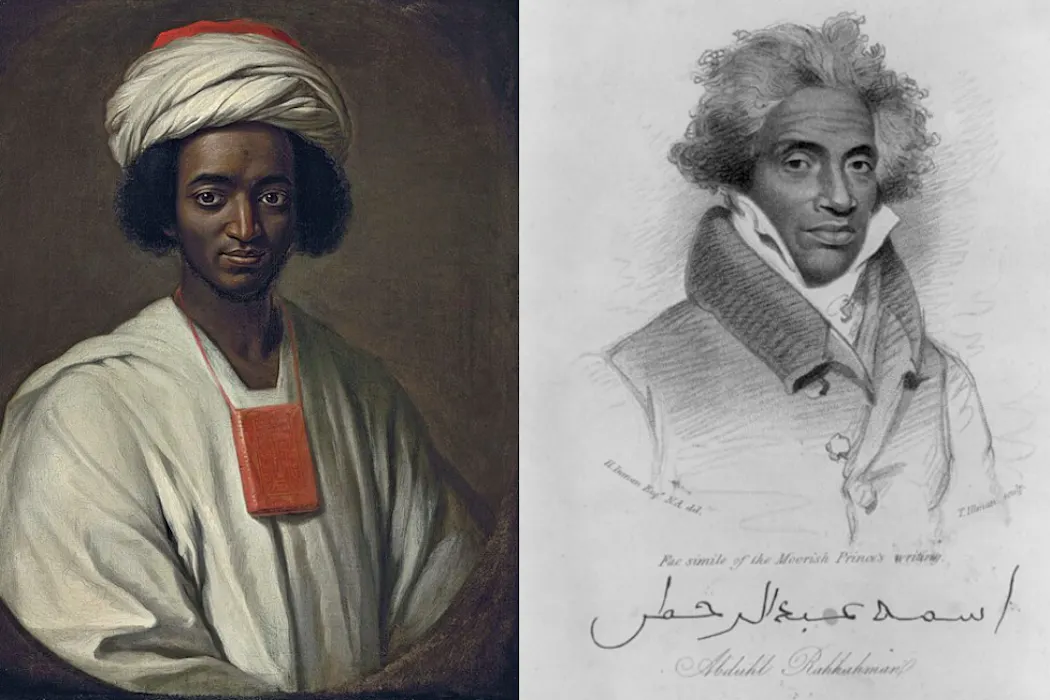
One of the most striking stories of early Muslims in America is that of Abdul Rahman Ibrahima ibn Sori. A prince from West Africa, ibn Sori was enslaved in 1788, when he was 26 years old, 12 years after the signing of the Declaration of Independence. He would remain enslaved for the next 40 years.
Working as a field hand, without access to a Quran, ibn Sori took to tracing Arabic letters in the sand – a link to his home, faith and culture.
Newspaper publisher and editor Andrew Marschalk, intrigued by ibn Sori’s royal lineage and ability to read and write in Arabic, agreed to help him send a letter to his African homeland. In 1826, ibn Sori penned what was actually Quranic verses from memory.
Marschalk sent ibn Sori’s letter to U.S. Sen. Thomas Buck Reed along with a cover letter in which he mistakenly refers to ibn Sori – who grew up in the Futa Jallon region in modern-day Guinea – as a member of the Moroccan royal family. The letter caught the attention of various politicians and eventually landed in the hands of the Moroccan Sultan Abd al-Rahman ibn Hisham, who petitioned President John Quincy Adams for ibn Sori’s freedom.
Thomas H. Gallaudet, an educator who founded the first American school for the deaf, ultimately documented ibn Sori’s story in a pamphlet, “A Statement with Regard to the Moorish Prince, Abduhl Rahhahman,” that was sold to raise funds for his and his family’s freedom and return to their homeland.
While the funds raised allowed for ibn Sori and his wife Isabella’s freedom, neither would return to Africa. Ibn Sori died of cholera shortly after gaining his freedom, and at least seven of his children remained enslaved in Mississippi.
Female Muslim slaves and why so little is known
Unfortunately, fewer women’s stories have been documented.
Diouf has attempted to piece together what their lives might have looked like by searching historical records, including runaway notices for Muslim-sounding names, such as Fatu, Jenaba and Safiyata.
Diouf found that women were essential in preserving the Islamic identity of their people, even if their stories did not garner the same attention as some of the learned enslaved men whose stories we highlight here. They kept their Muslim-sounding names when possible. They were also charitable, giving to others what little they had, and did their best to share their Islamic faith and practices with their children.
Today, Muslim Americans hail from all parts of the globe. The largest demographic of Muslims in the U.S., almost 30%, consists of African Americans, some of whom trace their roots to these enslaved African Muslims.
Turning to America’s early history highlights the long-standing presence of Muslims in America, many of whom helped build the nation and continue to do so today.
The authors do not work for, consult, own shares in or receive funding from any company or organization that would benefit from this article, and have disclosed no relevant affiliations beyond their academic appointment.
Read These Next
What the failed attack on an Illinois temple reveals about anti-Hindu hate in the United States
Hostility toward Hindu worship practices draws on a long history of prejudice portraying the faith’s…
Who should have a say in which species are saved? The California condor offers lessons for a global
When conservation affects local people, the question of who pays and who has a voice in decisions can…
A pregnant mom let her 5-year-old stay outside to collect goose feathers – and was placed on the chi
Child neglect statutes are intended to protect children. But some of them are so broadly written that…