Cincinnati, where Vance converted, gives a glimpse of Catholicism’s history in America’s heartland
For more than a century, anti-Catholicism was a powerful force in the region’s culture and politics. But religious pluralism ultimately triumphed in the ‘Queen City.’

Ten years after “Hillbilly Elegy” catapulted its author into public view, JD Vance is publishing a new memoir, “Communion: Finding My Way Back to Faith.” The vice president explains the book as a sort of self-help guide for the spiritually lost: “… by sharing my journey I might be helpful to others – Catholic, Protestant, or otherwise – who are seeking reconciliation with God.”
Scheduled for publication in June 2026, “Communion” promises “an intimate account” of its author’s religious journey. But the Catholicism to which Vance converted in Cincinnati in 2019 is quite unlike the evangelism he encountered in his childhood, famously described in “Hillbilly Elegy.”
As a historian of religion in Appalachia and the Midwest, I find America’s religious mosaic endlessly fascinating. Vance’s journey from Protestantism, to atheism, to Catholicism, not to mention his marriage to a Hindu woman, reflects the diversity of the United States.
My own experiences teaching in Vance’s hometown of Middletown, Ohio, suggest that America’s Midwestern communities, tarnished by “Rust Belt” stereotypes, are as dynamic and as changing as everywhere else – including in matters of faith.
Nearby Cincinnati, where Vance was confirmed at a Dominican priory, is a case in point and a window into Catholicism’s history in the American heartland. For more than a century, anti-Catholicism was a powerful force in culture and politics – yet, time and again, religious pluralism triumphed.

Scots-Irish settlers
“To understand me, you must understand that I am a Scots-Irish hillbilly at heart,” Vance declared in his first memoir.
The Scots-Irish played an outsized role in history. Initially, these Protestants were from Scotland, but they moved to Ireland in the 17th century. “Planted” by the British Crown as a form of colonization, these immigrants riled the Catholic majority whose lands they occupied.
Later, many crossed the Atlantic and settled the Colonial American backcountry. Their distinctive influence shaped the “hillbilly” culture of Appalachia.
The faith of these settlers kindled a fervent Protestant piety, found in the Great Revival of the Ohio Valley frontier. In this early 19th-century rebirth of backcountry religion, traveling ministers preached a fiery gospel of grace, stirring large crowds with their open-air sermons.
Queen City
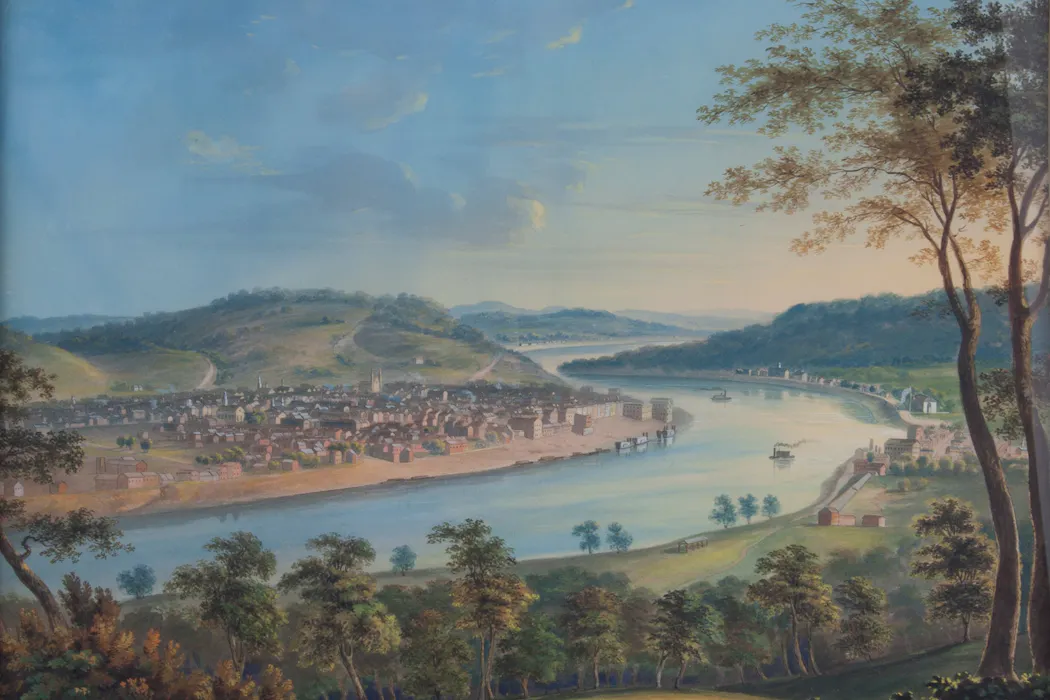
Boundaries between urban and rural America were always porous. By 1830 a quarter of Ohio’s 1 million inhabitants clustered in the state’s southwestern corner. Cincinnati was the heart of this region: the “Queen City” of the United States’ expanding Western frontier.
It had become a hub of Catholic immigrants from Germany and Ireland – and a center for anti-Catholic preaching and anti-immigrant politics. In 1835, leading Protestant evangelist Lyman Beecher infamously denounced immigrants “rushing in like the waters of the flood” and argued the Vatican and Catholic schools posed dangers for America.

Amid such prejudice, Protestant Irish Americans embraced the term Scots-Irish to distinguish their more established population from recent Catholic arrivals. Many of these Catholic newcomers, fleeing famine and persecution, were disparaged as poor, illiterate and superstitious.
Yet despite alarmism and periodic violence, including ethnic riots in 1855, Cincinnati’s sectarian relations were surprisingly pragmatic, shaped by a sense of shared civic endeavor. Protestants welcomed the city’s first Catholic church, for example, and often sent their children to the Catholic parochial schools. Many converted to Catholicism, including wealthy philanthropists.
In 1837, Cincinnati’s Catholic Bishop, John Baptist Purcell debated Protestant preacher Alexander Campbell on the merits of Catholic religion for several days before a crowded audience. Both debaters claimed victory, and proceeds from the published debates were evenly split between Catholic and Protestant charities in Cincinnati.
Changing country
By the mid-19th century, the city’s Catholics, while still a minority, were larger than any single Protestant denomination and central to the cultural landscape.

At the time, Catholics represented only 5% of the U.S. population. That percentage would triple by the turn of the century, due to immigration from southern and eastern Europe.
Anti-Catholic backlash continued into the 20th century, along with other forms of religious prejudice. For example, the U.S. Immigration Act of 1924 restricted immigration from parts of Europe heavily populated by Jews and Catholics. Animosity once focused on immigrants from Germany and Ireland shifted to those from Italy and Russia.
Bias against Catholics remained a robust force in Appalachian politics, too. Leading up to the 1960 Democratic primary, John F. Kennedy campaigned tirelessly in West Virginia, considered a tough arena for a Harvard-educated Catholic but critical to his electoral strategy. His success in the Mountain State defied the myth that a Catholic candidate could never win the White House.

Turn toward ‘Communion’
Southern Ohio, where Vance grew up and converted to Catholicism, is deeply Midwestern. But its heritage has been influenced by the wave of workers who left Appalachia in the mid-20th century looking for jobs, including Vance’s family.
As Vance wrote in a 2020 essay for Lamp magazine, which addresses Catholic issues, his early ideas of Catholicism were negative ones – assuming, for example, that the church “rejected the legitimacy of Scripture.”
As a young man, he drifted away from faith altogether. During his days at Yale Law School, however, Vance discovered a curiosity that drew him toward Catholicism, inspired by thinkers from Silicon Valley mogul Peter Thiel and French philosopher René Girard to the fourth-century theologian St. Augustine.
Vance wrote in his essay, “I often wonder what my grandmother” – a woman with Christian beliefs, but skepticism of institutional religion – “would have thought about her grandson becoming a Catholic.”
Today, 1 in 5 U.S. adults is Catholic, and another 9% consider themselves “cultural Catholics.” America’s prejudice toward their tradition has eroded. Six out of nine Supreme Court justices are Catholic, along with 28% of Congress.
In fact, Vance’s new faith highlights a growing alliance between culturally conservative elements of American Catholicism and America’s religious right, dominated by conservative Protestants since its emergence in the 1970s.
Lately, this alignment has come under strain, in part reflecting American-born Pope Leo XIV’s wariness toward U.S. policies, such as the war in Iran. Nowhere have such spats been more ironic than in Vance’s rebuke of the pope. After Leo remarked that Jesus’ followers are “never on the side of those who once wielded the sword and today drop bombs,” the vice president warned, “If you’re going to opine on matters of theology, you’ve got to be careful.”
It will be interesting to see how such tensions play out in years to come.
Matthew Smith does not work for, consult, own shares in or receive funding from any company or organization that would benefit from this article, and has disclosed no relevant affiliations beyond their academic appointment.
Read These Next

Chiricahua is the nation’s newest national park – what does that mean?
What comes next for Chiricahua, now that is has been officially redesignated as America’s 64th national…

Offering cash for votes is quite common – but here’s why it doesn’t work
Money or other material benefits are often not enough to override a voter’s preferences and partisanship.

El Niño is threatening California’s fragile coast again – the 1982-83 El Niño opened eyes to the ser
The destructive 1982-83 El Niño, then the strongest on record, eroded cliffs, leaving homes hanging…