America’s musical founding father: ‘Liberty songs’ by a self-taught singer and tanner helped fuel th
William Billings has been largely forgotten, except among music historians. But he was the country’s first notable composer, penning protest songs against Great Britain.

As July 4, 2026, approaches, Americans will be paying more attention than usual to events of 1776: the year the American Colonies declared their independence from Great Britain. Public historians, including filmmaker Ken Burns, have tried to offer a more inclusive view of the American Revolution, highlighting lesser-known patriots. But figures such as Thomas Jefferson, John Adams, George Washington and Benjamin Franklin will undoubtedly get the lion’s share of attention on the 250th anniversary.
One important character who rarely makes it into the limelight is the pioneering composer William Billings, who lived in Boston at the time of the Revolution. Billings is widely considered America’s first noteworthy composer, publishing six tune books and writing some 340 choral works – some of which are still sung today.
Apprenticed at 14 as a leather tanner, he learned music in his spare time and became a renowned teacher of singing schools, which taught basic elements of music so people could sing hymns more confidently. He also became a staunch supporter of independence, one of the Boston “Whigs” who spearheaded the American Revolution.

I have been studying Billings for 25 years now and always find more of interest about him – so interesting, in fact, that I wrote a historical novel about him. He was a colorful character with a voracious appetite for snuff and an unforgettable appearance. As music historian Nathaniel Gould wrote in 1853, Billings was “blind with one eye, one leg shorter than the other, one arm somewhat withered, with a mind as eccentric as his person was deformed.”
‘Liberty songs’
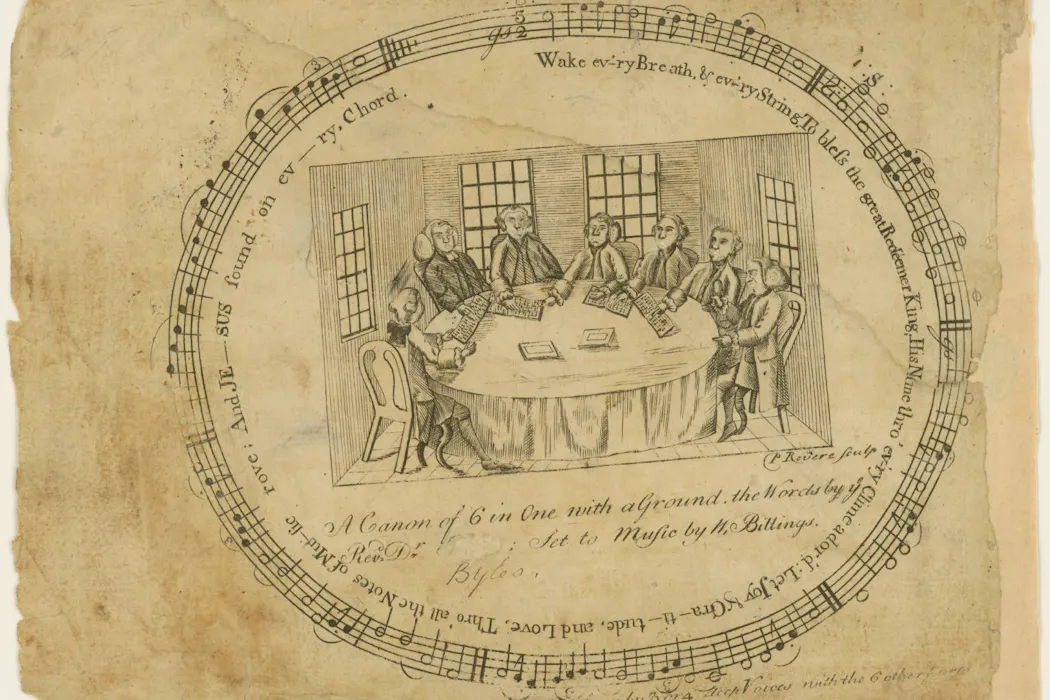
Billings was a friend of Samuel Adams, the revolution’s great agent provocateur, and sang regularly with him. He likely knew Paul Revere, who is credited with engraving the frontispiece to Billings’ first tune book, “The New-England Psalm-Singer,” published in 1770.
That was the year of the Boston Massacre, when British soldiers fatally shot five civilians. The event was one of several incidents that eventually triggered the conflict later known as the Revolutionary War. Billings did not serve in the military, probably because of his disabilities. His contribution to the independence movement was his music.
A tune from his first collection, “Chester,” is one of Billings’ best known, for which he also wrote words:
The Foe comes on with haughty Stride;
Our troops advance with martial noise,
Their Vet’rans flee before our Youth
And Gen’rals yield to beardless Boys.
That was not the only Billings song with a revolutionary message.
“Lamentation Over Boston” adapted a Hebrew psalm about the Judeans’ exile in Babylon: “By the Rivers of Watertown we sat down & wept,” he wrote, referring to a town a few miles west, “when we remember’d thee O Boston.” Billings’ lyrics cast Britain as the oppressive Babylon: “For they that held them in Bondage/ Requir’d of them to take up Arms against their Brethren.” It may be the very first American protest song.
In 1778 Billings published “Independence: The States, O Lord”, again writing music and words:
The States, O Lord, with Songs of Praise shall in thy Strength rejoice,
And Blest with thy Salvation raise To Heav’n their cheerful voice….
And all the Continent shall sing: Down with this earthly King, No King but God.
There’s some evidence these songs had national reach.
“The words stirred the patriotic heart, and with their striking melodies were sung at home and by the choirs, and especially in the military camps,” Louis F. Benson wrote about Billings’ music in his 1915 study “The English Hymn.” “The New England soldiers learned the words by heart, and every fifer the tunes, and carried them to whatever part of the country duty called them.”
Billings’ pieces were only a handful of the hundreds of what John Adams called “liberty songs” circulating in the Colonies. Most of them were less pious than what Billings composed. “Some of the outrageously ribald songs would have horrified polite society,” according to historian Bruce C. Daniels, author of “Puritans at Play.” “Dozens of them made metaphorical reference to England as a whore.”
Struggle after Independence
The peak of Billings’ career was during the 10 years after the Declaration of Independence. Two years before, he had met Lucy Swan while leading a singing school in Stoughton, Massachusetts. They got married the same year and went on to have a large family. In 1780, they moved into a nice house on Boston’s fashionable Newbury Street.
In the late 1770s and 1780s Billings published four tune books, including arguably his most important, “The Singing Master’s Assistant.” He also tried his hand at writing prose and even served briefly as editor of The Boston Magazine before being fired, apparently for his poor taste. He published a grisly tale about a clan of incestuous cannibals from Scotland.
At some point, he seems to have given up leather tanning. But by the 1790s Billings was reduced to working as a street cleaner and hog wrangler. He had to mortgage his house. Lucy died in 1795, leaving William to single-parent their six children – including a daughter, also named Lucy, born three years earlier.

American musical tastes had changed. Billings’ rough-hewn “fuguing” songs, a style with vigorous counterpoint between the different voice parts, were no longer in fashion. Formally trained singing instructors competed for students in Boston.
And Billings was unable to secure copyright for his compositions. Before the Revolution, he succeeded in having a bill to protect his first tune book passed by the Massachusetts legislature. The Tory governor refused to sign it, however, perhaps due to Billings’ associations with patriots like Samuel Adams. In any event, several of his pieces were reprinted in other collections, and he was paid nothing.
When Billings died in 1800, he was buried on Boston Common in an unmarked grave. But his music was kept alive by shape-note singers, a style of musical notation that caught on in the 1800s and helped preserve older, sacred songs. Billings’ music played at least a small part in uniting American colonists well enough to defeat the powerful British military.
David W. Stowe does not work for, consult, own shares in or receive funding from any company or organization that would benefit from this article, and has disclosed no relevant affiliations beyond their academic appointment.
Read These Next

Yemen’s Houthis are bringing their war to Saudi Arabia – and reframing the narrative of being an Ira
A deadly bombing at Riyadh’s international airport is the latest in a tit-for-tat retaliation campaign…
Republicans can confirm a Supreme Court justice if Democrats take the Senate, but at what cost?
If Republicans attempt to confirm a nominee, they will trigger a historic fight and hand Democrats the…
In newly independent US, Americans debated whether public executions taught a lesson or just showed
The conflict over the wisdom of Nidal Hasan’s public execution is not a new one. Americans at the…