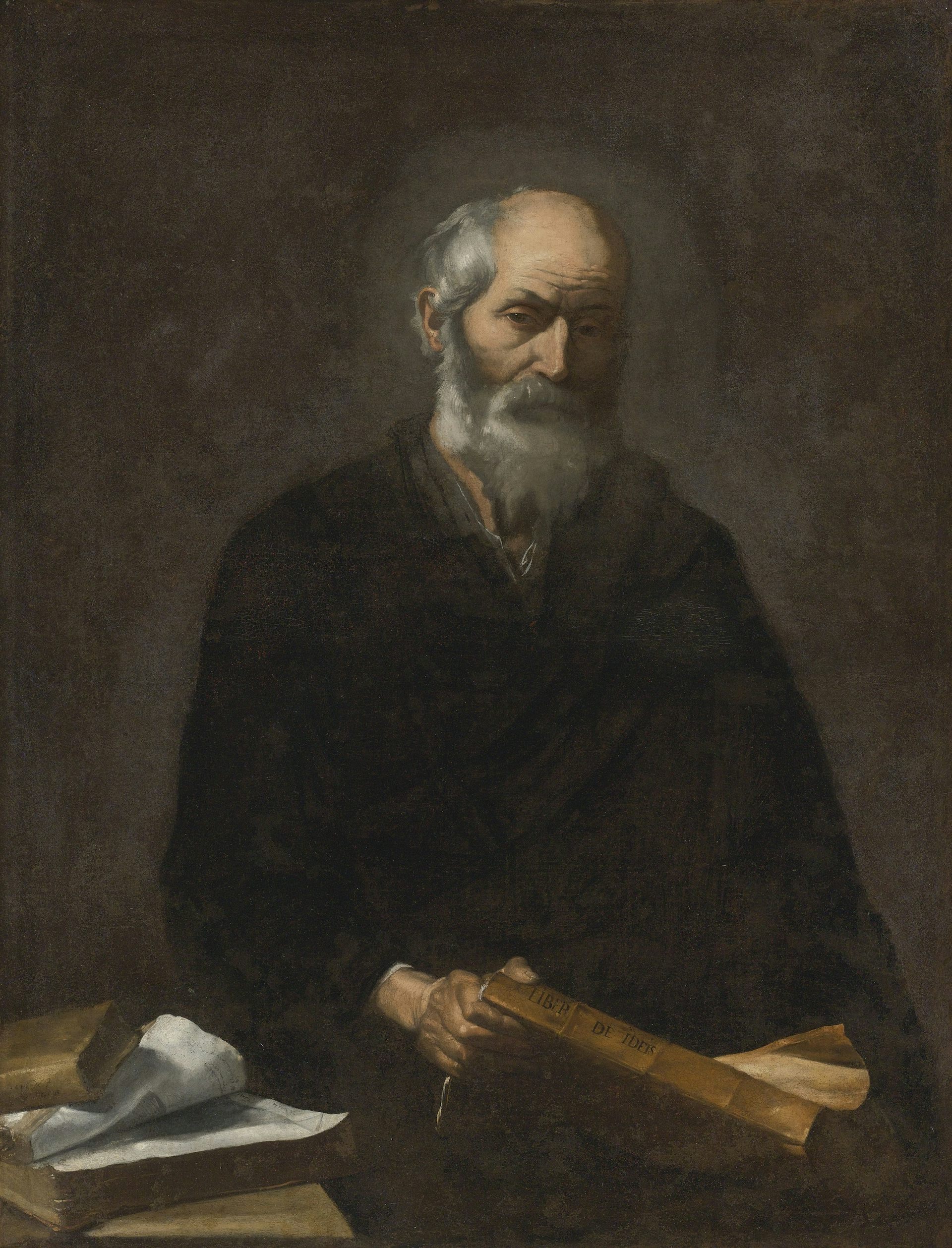
The Cherokee Bible, one of the language’s first books, is a window between worldviews
Cherokees across the US are working to revitalize their language.

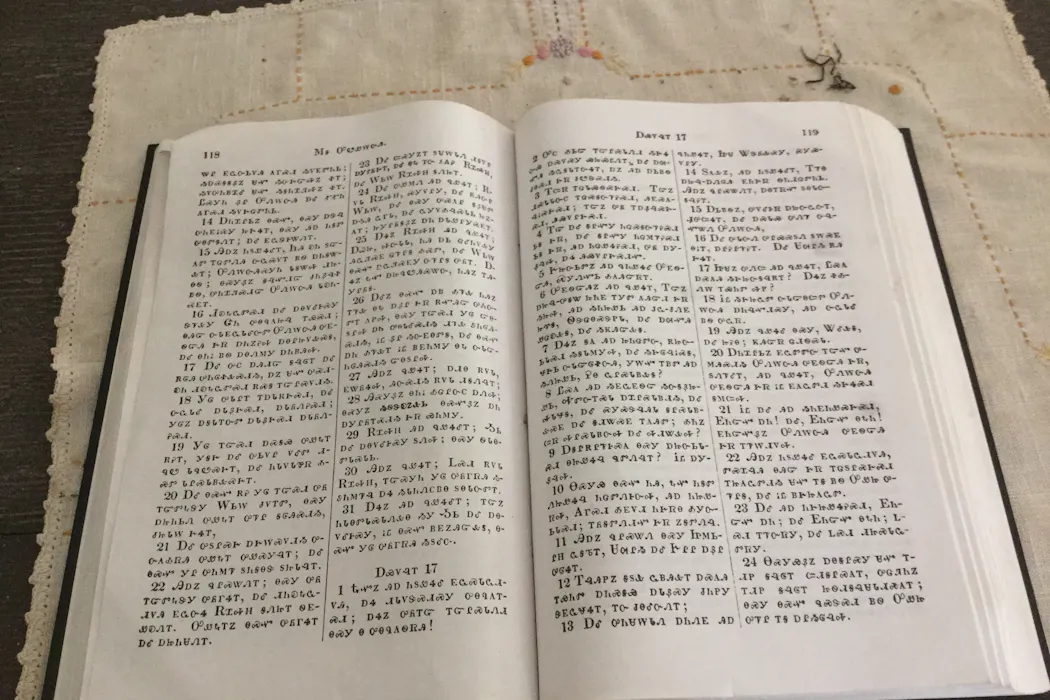
If you wanted to learn the Cherokee language in the 1990s, there weren’t many written resources: three dissertations from the 1970s and ’80s, one textbook and a handful of college classes in North Carolina and Oklahoma. Even on most Cherokee land, it was unusual to see street or building signs in this endangered Indigenous language.
There are nearly 500,000 enrolled members in the three federally recognized Cherokee Tribes: the Cherokee Nation and United Keetoowah Band, both based in Oklahoma, and the Eastern Band of Cherokee Indians, based in North Carolina. Only about 2,000 of those members speak Cherokee as a first language.
But over the past few decades, opportunities for learners of all ages have exploded. One of the authors of this article, Thomas Belt – a first-language speaker from Oklahoma – has been honored to play a role in that resurgence, working as a teacher, curriculum developer and language consultant. Today there is bilingual signage throughout the Eastern Cherokee reservation, in the Cherokee Nation capital of Tahlequah, Oklahoma, and on tribal buildings and some private businesses throughout Cherokee country.
Cherokees of all ages and in communities across the U.S. are working to revitalize the language in new ways, from apps, games and videos to social media, music and immersion schools.
Amid all this innovation, there is also a 200-year-old resource that language learners turn to: the Cherokee translation of the Christian Bible.
New writing system
Translating the Bible into Cherokee began early in the 19th century, shortly after Protestant missionaries arrived in the Cherokee Nation – centered mainly in what are now western North Carolina, north Georgia and eastern Tennessee.

In 1821, the brilliant Cherokee Sequoyah invented a writing system for the Cherokee language. First, he identified all the vowels, consonants and combinations of them used in the Cherokee language. He then invented and taught characters for every syllable – making his writing system a syllabary rather than an alphabet that assigns a character to each individual consonant or vowel.
The elegance of the system made it easy for speakers to learn, and Cherokee literacy rates were reportedly high soon after its invention. The 1828 launch of the bilingual Cherokee Phoenix, the first Native American newspaper in the U.S., is testimony to the writing system’s popularity.
It also made it easy for the Cherokee to read the Bible, once it had been translated. Teams of Euro-American missionaries and Cherokee converts produced a Cherokee version of the Book of John in 1824. A complete Cherokee New Testament and most of the Old Testament emerged in the following decades.
3 options
For language learners today, the Cherokee Bible is much more than a source of words. In our 2025 book “The New Voice of God,” we found that the text captures the cross-cultural encounter that produced it. The translation does more than show how the Cherokee interpreted Christian theology; it is a window into the Cherokee worldview.
At the time, Cherokee did not have words for many of the concepts found in the Bible – hypocrisy, poverty, power and king, to name just a few. In such situations, translators have three options.
One is to use loan words, borrowed from the foreign language. Texts heavy with loan words, though, often require special training or guides in order for the general public to read them. We did not find any true loan words in the parts of the Bible we studied.
A second option is semantic extension: using a word whose meaning is similar in some way, creating a kind of cross-cultural metaphor. This happens frequently in the Cherokee translation. For example, sheep and shepherds appear frequently in the Bible, but sheep are not indigenous to the Americas. Instead, the translation uses the word for deer, “ahwi,” to translate sheep and represents a shepherd as “ahwi diktiya,” or deer-watcher.
The third option is to create a new descriptive word, a process also seen throughout the translation. For example, the Cherokee word for idols is “unehlanvhi diyelvhi,” meaning imaginary gods.
Cultural differences
In some cases, translators’ challenges suggested deep differences between a Western worldview and their own.
Christian missionaries’ culture drew a clear distinction between the sacred and the secular. In Cherokee culture, however, science, ritual and belief are tightly intertwined.
Specialized Christian terms such as resurrection, repentance, sin, purity, baptism, salvation and blessing didn’t translate well into that worldview. The expression of those concepts in Cherokee thus reads as more ordinary and accessible than in English.
‘Child’ of God
Major differences between the grammars of Cherokee and English also shaped how Cherokee Christians reframed biblical concepts. For example, Cherokee has no gendered pronouns: no equivalents of he, she, him, her, his or hers. This means that beings who are not clearly recognizable as human men or women, such as angels, devils and God, come across as gender-neutral in the Cherokee translation.
God becomes masculine only when referred to as a father, as in “ogidoda,” “our father.” Instead, the Cherokee Bible most commonly translates God as “unehlanvhi,” which is usually interpreted as meaning a gender-neutral creator. Jesus is described as the “uwetsi,” or child, of God – even though there is a fuller Cherokee phrase, “uwetsi atsusa,” boy child, that could have clearly identified Jesus as the son of God.
In English, some speakers consider “mankind” to refer to both men and women. But in Cherokee, the word for man, “asgaya,” is not interpreted that way. Whenever the word man appears in English translations of the Bible, the Cherokee word “yvwi,” person, is used, or occasionally “kilo,” someone. This inclusivity would have resonated much better with traditional Cherokee culture, which was more egalitarian and matrilineal, with ancestry and property passed down through mothers.
Learning today

The Bible plays various roles in today’s Cherokee language learning, including as a source of vocabulary. For example, the most widely used online Cherokee dictionary gives Genesis 28:18 as its sample text for the word “go’i,” oil. But it also models how to form fluent phrases and sentences, mark transitions, narrate events and correctly use Cherokee’s complex grammar.
Perhaps even more importantly, the Cherokee Bible offers invaluable insight into Cherokee-specific meanings, interpretations of social and spiritual concepts, and a benchmark for understanding how the language has changed. Though the history of the relationship between Christian missionaries and Indigenous people is complex, this historic text is supporting an impressive contemporary wave of cultural and linguistic renewal.
The authors do not work for, consult, own shares in or receive funding from any company or organization that would benefit from this article, and have disclosed no relevant affiliations beyond their academic appointment.
Read These Next

Yemen’s Houthis are bringing their war to Saudi Arabia – and reframing the narrative of being an Ira
A deadly bombing at Riyadh’s international airport is the latest in a tit-for-tat retaliation campaign…
In newly independent US, Americans debated whether public executions taught a lesson or just showed
The conflict over the wisdom of Nidal Hasan’s public execution is not a new one. Americans at the…

From ‘A Little Princess’ to ‘Black Panther,’ how Hollywood films have reimagined the South Asian epi
There is no single way to tell the story of the ‘Ramayana.’ People from different religious traditions…