
What courage is, how to build it and why you should take a risk
Courage is widely considered a fundamental human virtue. A professor of psychology and a university president break down the components of courageous action.

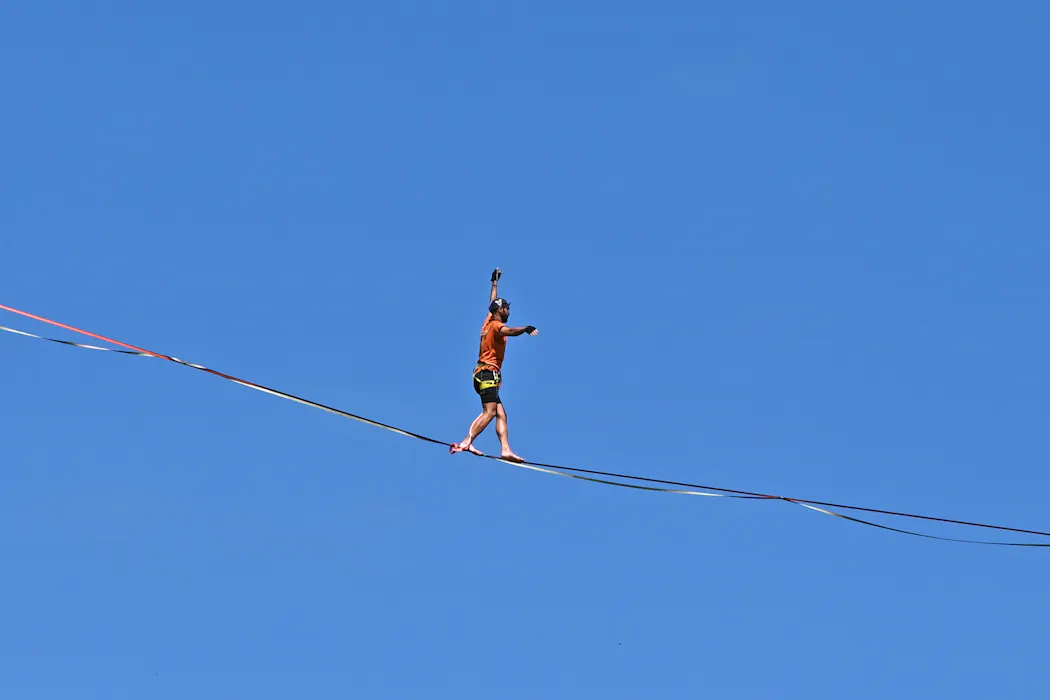
From ancient epics to contemporary headlines, humans have spent centuries canonizing courage as a rare and admirable virtue. Aristotle writes, “You will never do anything in this world without courage.” But what does it really mean to be courageous, and what does it look like in a classroom or a checkout line?
On April 1, 2026, The Conversation hosted a webinar examining the virtue of courage. Panelists Greg Crawford, president of Miami University, and Cynthia Pury, professor of psychology at Clemson University, discussed the different ways we understand courage, how it can be built and why it is a worthwhile risk to take.
Crawford has leveraged his academic role to elevate entrepreneurship education, innovative research and entrepreneurial startups at Brown University, the University of Notre Dame and Miami University. Pury has consulted on courage with numerous national and international organizations. The webinar has been edited and condensed for print.
Beth Daley: What are the ingredients of courage?
Greg Crawford: I would break courage down into three areas: taking calculated risks, accepting the possibility of failure and taking action. That sometimes means choosing principles that you’re going to uphold no matter what because it’s a matter of purpose or mission. To quote Maya Angelou: “Courage is the most important of all the virtues, because without courage you can’t practice any other virtue consistently.”
I think the first component or ingredient of courage would be clarity of purpose. Courage isn’t just about action, it’s about a directive action. The second ingredient would be realistic awareness of that risk. You’re not trying to minimize risk nor exaggerate the danger; you’re trying to be balanced so as to understand the consequences of that decision. Finally, courage includes the willingness to act despite fear. We make these decisions, and it’s more about resolve. Fear is never absent in the face of courage.
BD: Are you born with courage, or is it a muscle one can build and teach and learn?
Cynthia Pury: Both yes and no. Even in animals, you see evidence of boldness or exploration despite risk. When we moved houses a few years ago, I watched our cats explore. It was clear that they were afraid, but they were still going to check it out. It’s hard for me to think that my cats learned how to do that. You see that in other animal species, too.
The longer I do this, the more I’m convinced that it all comes down to people’s evaluations of the goals and risks of a given situation. So, there are some goals that I would find very easy to be courageous for, like saving someone’s life. Other goals I might not share with others, like my love of doing theater.
Similarly, there are also some risks that we all agree are universal. Fire is dangerous for every human, and we all are susceptible to being burned. I think that’s one of the reasons firefighters are often the least controversial helper people who are seen as heroic and are part of this “monumental courage,” as professor Robin Kowalski and I call it.

We also have situations where people have particular fears or vulnerabilities that aren’t necessarily apparent to others. One of the bravest things I’ve ever seen is a former patient of mine wrapping a gift for his child. This person had experienced horrific wartime trauma at Christmastime and had never given his child a Christmas present and he really wanted to. Wrapping the Christmas present brought back all the terrible things that had happened, and in the context of that – and really understanding PTSD – it was quite courageous.
In a day-to-day setting, a lot of the things people report doing that they say are courageous in their everyday life are things that are particular to them or a form of personal courage.
BD: How do you develop courage as an individual?
GC: At Notre Dame I was involved in raising money for Niemann-Pick Type C, a rare disease. The research center reported to me, but I was a physicist, so I couldn’t do genomics and proteomics and those kinds of things, but I wanted to be involved with it. So I decided to ride my bicycle across the country and raise funds for the Ara Parseghian Medical Research Foundation. People would ask me how I got in shape to bike cross-country, and the fact of the matter is I never did. I just had the courage to start and get in shape along the way.
I would tell people today, you’ll take these leadership positions and jobs, and you’ll never be ready because everything changes and comes at you quicker than ever before. You need to have the courage to get in shape along the way, be flexible and have confidence.
At one point, earlier in my career, I was talking about how my hit rate on grants was 20% or 30%. A lay person had asked me if that means I waste 70% of my time. I think my answer today is absolutely not, because I spend 100% of my time developing courage. Sometimes you have to try things over and over again. You keep pushing, and a failure or a misstep often results in a great answer later down the road. So there’s an element of courage when you do fail, but you keep learning, progressing and advancing, and then it comes full circle and you finally get there.
BD: How does failure relate to courage?
CP: Failure is really tied, more than people think it is, to how courageous action is perceived. If you decide to move to the other side of the country to take your dream job, but then the company folds when you get there, you’re not as likely to think that the move was courageous in retrospect.
The Carnegie Medal for heroism, for example, has rewarded people’s acts of physical bravery mostly in instances where the would-be rescuer dies and the would-be victim lives. Not a single time was it rewarded when the would-be rescuer lived and the would-be victim died. And I find that kind of startling.
In my research, people say that a courageous thing they did was something that made a situation better and didn’t make it worse. When they try to do something and fail, people don’t report their action to be courageous. And even people who say that it doesn’t matter if you succeed or fail still end up rating the courageousness of failed things the same way as everybody else does. So that’s definitely something to be aware of and look out for.

BD: What does a courageous conversation actually look like in practice, especially when delivering difficult feedback or talking to people who don’t agree with us?
GC: It’s important to normalize dissent as part of the process. When you can control and manage dissent, you can advance ideas in a much better way. I would say sometimes when you get criticism and so forth, it’s a good thing. Some people would call it a gift that you’re able to have the courage to either push back or to be open to influence and change your mind.
In today’s world, criticism comes nonstop and all the time in these leadership roles. So there’s courage in accepting it and not being defensive about it, and there’s also courage in trying to find a solution and an answer to it, and in some cases acknowledging it and moving forward.
BD: In terms of political courage, when there seems to be a collective consensus about what the right thing to do is, why don’t people act when they want to or others feel like they should?
CP: I wonder how much of what we see with political courage is people having different views about what the right thing is to do in this situation. Is it the right thing to take a stand here? Is this the thing to have your political career die on? Or is it more courageous to just let this go and be there for whatever the next thing is?
I also wonder how much of the courage talk in politics is people signaling, “I value this, I don’t value this.” Having the humility to listen to another side seems to be an important and missing virtue.
Cynthia Pury has received funding from the American Psychological Association and the Department of Defense. She is affiliated with Alchemy Comedy Theater, Greenville, SC.
Gregory Crawford does not work for, consult, own shares in or receive funding from any company or organization that would benefit from this article, and has disclosed no relevant affiliations beyond their academic appointment.
Read These Next
Cornell 7 case puts a spotlight on fraternity misconduct – and the limits of universities’ power to
While universities can suspend and expel students for committing sexual violence and other kinds of…

US regulators want to make corporate earnings reports less frequent, but investors have doubts
No federal rule proposal has ever generated so much opposition.

Want to use AI to improve your work? Have it disagree with you
Prompting AI models to contradict your ideas can improve your thinking about a problem.