
The enduring legacy of medieval Christian depictions of Islam in today’s political discourse
Long-standing Christian narratives about Islam continue to inform political language, argues a sociologist of Islam.

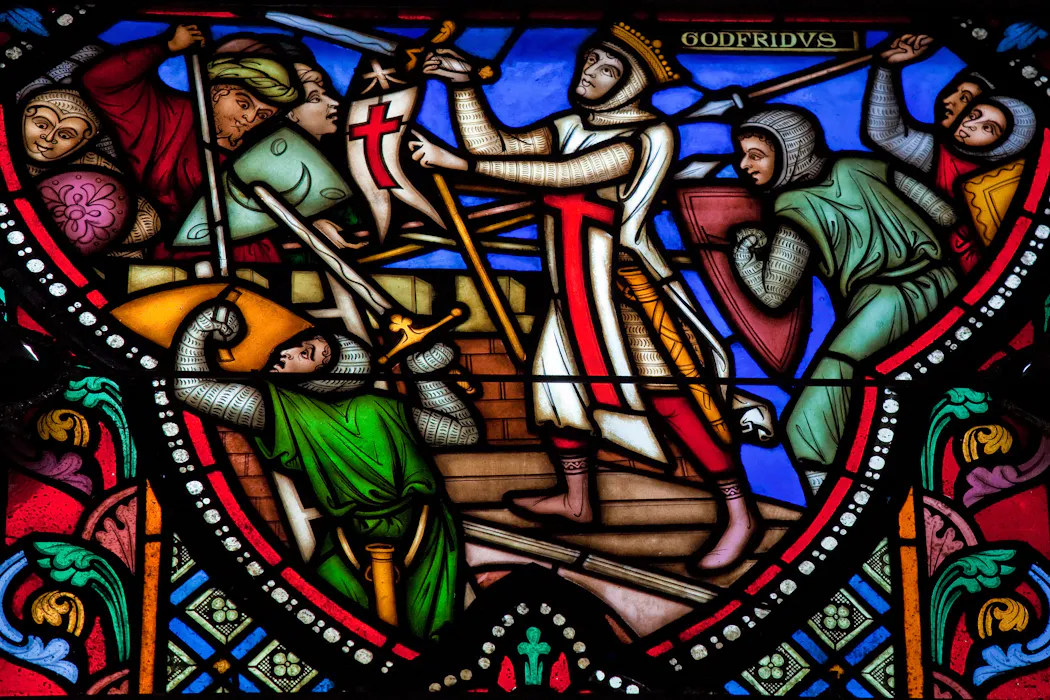
The war with Iran is not just a geopolitical conflict. We see religious rhetoric used to cast strategic interests as a moral or sacred matter.
U.S. House Speaker Mike Johnson described Iran’s majority faith tradition, Shiite Islam, as a “misguided religion” while discussing the ongoing U.S. strikes against Iran on March 4, 2026. A complaint made to the Military Religious Freedom Foundation alleged that same month that an unnamed military commander had said that “President Trump has been anointed by Jesus to light the signal fire in Iran to cause Armageddon and mark his return to Earth.” In the Book of Revelation, Armageddon represents the final battle between good and evil, associated with the second coming of Jesus Christ.
Soon after the U.S. attack on Iran, right-wing pastor Andrew Sedra commented that “Trump is going after the head of the snake, which is Islam.” He added that “God is using President Trump in a prophetic moment of time to execute judgment on evil and wicked civilizations.”
In part, such religious rhetoric draws on older narratives about Islam in Christian thought. In medieval times, Islam was often portrayed as a violent and extremist faith. Over the past few decades, many American politicians and Christian clergy have disparaged Islam and its believers. My research shows that these earlier portrayals remain recognizable in the rhetoric today.
Hostile depictions
Early Christian theologians began to designate Islam as a theological rival soon after its emergence in 610 C.E. In the eighth century, the monk John of Damascus described Islam as a “heresy” in his work “The ‘Heresy of the Ishmaelites.’” This is widely considered the earliest documented critique of Islamic doctrine.
In his 2002 book, “Saracens: Islam in the Medieval European Imagination,” historian John Tolan writes that medieval Christian writers disseminated “crude insults to the Prophet, gross caricatures of Muslim ritual [and] deliberate deformation of passages of the Koran.” They portrayed Muslims as “libidinous, gluttonous semi-human barbarians,” he adds.
Tolan and other historians show how these hostile depictions developed in time in monasteries and royal courts. In popular culture, epic poems called “chansons de geste” glorified Christian heroes vanquishing Muslim foes.
Notably, medieval Muslim theologians also produced cutting critiques of Christian doctrines such as the Trinity, which they viewed as polytheistic. However, these writings circulated largely within scholarly circles. In Christian Europe, however, anti-Muslim writings were often used to justify the Crusades. Pope Urban II urged in 1095 that Holy Land be wrested from those who inhabited it and brought under Christian control.

Similarly, the Second, Third and Fourth Crusades were preceded by papal letters that depicted Muslims as enemies of the faith and called on Christians to reclaim Palestine.
The eventual military failure of the Crusades posed a new theological problem to Christian thinkers.
Medieval Christians believed history reflected God’s judgment. As a result, they struggled to explain the military success of Muslim armies in theological terms, since such victories in the Holy Land would imply divine favor for Muslims. In order to reconcile this, some medieval Christians developed the idea that the defeats were a punishment for Christian sin.
Accordingly, medieval epic poems and art often depicted Muslims as near-demonic, bloodthirsty figures wearing turbans and strange robes.
Christian missionary narratives
In later centuries, these anti-Muslim depictions were reworked to justify colonialism. Scholar Edward Said famously critiqued early modern narratives about people and cultures from the Middle East and Arab world in his foundational 1978 work, “Orientalism.”
He argued that Orientalist stereotypes reduced diverse peoples to a set of mostly negative traits: barbaric, violent, incomprehensible, but also lazy, gullible and mysterious. While not held by all Christians, these ideas circulated broadly within Christian and Western intellectual traditions, shaping durable representations of Muslims in literature, art, theology and politics.
Scholar Deepa Kumar, who recognized this tension, wrote that “while ordinary people can and do resist dominant ideas, those who rule the society tend to set the terms of discussion.”
Anti-Muslim tropes were reflected in Christian missionary narratives. In the 19th century, figures such as David Livingstone promoted what later came to be known as the “three C’s” of colonial expansion: Christianity, commerce and civilization, all portrayed as benefiting the colonized peoples.
Over time, these ideas became part of a broader moral justification for European imperial expansion, framing colonial rule as a civilizing mission. As part of this effort, missionaries often contrasted the moral authority of Christianity with Islam, which they portrayed as a morally stagnant and simplistic.
Islamophobia today
While these hostile themes have been adapted over centuries to fit new contexts, they are recognizable in political and media rhetoric today. This rhetoric shapes popular understandings of Islam in troubling ways.

In a survey of American Baptist clergy conducted for my 2026 book, “Confronting Islamophobia in the Church,” with co-author and Baptist pastor Michael Woolf, I found that many pastors describe Islam and Muslims as inherently violent, blasphemous, oppressive toward women, or incompatible with Western society. These pastors have adapted old Christian tropes to contemporary moral language. Theological accusations of Islamic “heresy” have morphed into concerns about apparent Muslim violence and women’s oppression.
A 2019 study found that 9 in 10 pastors believe that they influence what their congregants think about social issues, suggesting that religious prejudice, including Islamophobia, can be reinforced in church contexts. Indeed, historians of American evangelicalism such as Kristin Kobez du Mez note that Islam has been often portrayed in evangelical church contexts as violent and opposed to Christian values. In her 2020 bestselling book, “Jesus and John Wayne,” she cites a 2002 poll that found that 77% of evangelical leaders held an overall unfavorable view of Islam, and 70% agreed that Islam was “a religion of violence.”
At the same time, Muslim groups like Council on American-Islamic Relations and national interfaith coalitions such as Shoulder to Shoulder Campaign have worked with Christians to challenge these portrayals and promote more nuanced understandings of Islam. For example, Shoulder to Shoulder Campaign delivers anti-Islamophobia training to pastors and congregations – Faith over Fear – around the country.
Researchers have linked incendiary rhetoric about Muslims to spikes in discrimination and hate crimes in Europe and North America. A study by the Center for the Study of Organized Hate found a significant surge in anti-Muslim hate speech in the first week of the war in Iran. When politicians describe Islam as the enemy and the West as a civilizing force, they risk turning distant wars into everyday hostility toward American Muslim communities.
Anna Piela previously received funding from the National Science Center in Poland, the American Academy of Religion, and the Interfaith Alliance. Currently she is not receiving any funding.
Read These Next
Hunter-gatherer societies are often put on a pedestal as paragons of equality – but the reality is m
Hunter-gatherers do not always seek total equality, but that doesn’t mean they aren’t egalitarian.
US regulators want to make corporate earnings reports less frequent, but investors have doubts
No federal rule proposal has ever generated so much opposition.
White nationalism’s appeal runs deeper than partisan politics
Nearly 1 in 7 white men under 30 in the US support white nationalism, and partisanship alone doesn’t…