
Notions of ‘Christendom’ often miss the mark – medieval Europe’s ideas about faith and power were no
There has never been a singular Christian perspective on how religion, power and politics ought to relate to each other – not even in medieval ‘Christendom.’

During the National Prayer Breakfast on Feb. 5, 2026, Paula White-Cain, senior adviser to the White House Office of Faith, introduced President Donald Trump as “the greatest champion of faith that we have ever had in the executive branch.” Taking the podium after her, Trump declared, “I’ve done more for religion than any other president.”
Should an earthly leader be promoting a heavenly cause? Some of the Americans who say “yes” – by no means all – are likely sympathetic to the ideas and values of Christian nationalism. A blanket term, Christian nationalism ranges in meaning. Some citizens might see themselves as Christian nationalists simply because they are Christian and patriotic. Others, however, assert that the United States is rightfully a Christian nation that ought to be governed by Christian leaders, ethics and laws.
As a historian, I’m aware that Christian nationalism relies upon a selective and often distorted view of American history. As a historian of the European Middle Ages, in particular, I’m interested in another myth of a shared Christian past that seems to lie beneath the surface of some Christian nationalist claims. That’s the idea of the medieval Christian West, also known as “Christendom”: a time before the modern separation of church and state.
1,000 years
What was Christendom? Similar to Christian nationalism, the term can mean different things to different people.
It generally recalls a long period of time – 1,000 years, give or take – between the “fall” of Rome around 500 C.E. and the beginning of the modern era around 1500. Christianity dominated European politics, society and culture. The Middle Ages really were an era when kings ruled in Christ’s name, when the popes of Rome commanded obedience from believers around Europe, and when monasteries played a crucial role in the shaping of values and education.

In recent years, though, I’ve observed puzzling and ahistorical ways that the concept of Christendom has started to appear in certain corners of conservative political thought. That era of Christian dominion is sometimes remembered as a lost age of Christian unity, a time when religion and politics were “properly” aligned.
Such views don’t map neatly onto any partisan position or religious affiliation. The Catholic-inspired website The Josias, for example, a guide “for those who wish to bring their faith into the public square and resist the tides of liberalism, modernism, and ignorance of tradition,” is filled with works by medieval thinkers.
In some conservative Protestant circles, one finds yearnings for the creation of a “new Christendom,” an “American Christendom,” or, as pastor Doug Wilson calls it, “mere Christendom.”
Wilson is the founder of the Communion of Reformed Evangelical Churches – one of which Defense Secretary Pete Hegseth attends. Wilson says that his vision of “mere” Christendom does not entail a return to theocracy but “a network of nations bound together by a formal, public, civic acknowledgment of the Lordship of Jesus Christ, and the fundamental truth of the Apostles’ Creed.”
In his 2023 book “The Boniface Option,” minister Andrew Isker calls for Christians to fight for the creation of “new Christendom.” He also co-authored 2022’s “Christian Nationalism: A Biblical Guide for Taking Dominion and Disciplining Nations.”
From a historical perspective, there are numerous problems with such views of Christendom. For starters, they erase the reality that, while Christian authorities governed Christian-majority kingdoms during the Middle Ages, Europe was also home to Jewish and Muslims communities. They also paper over the fact that medieval Christians themselves never reached a consensus over the proper relationship between worldly and spiritual powers – or, as we might call them today, church and state.
Faith and empire
When I teach on religion and politics, I compare two late ancient thinkers whose works left profound legacies on the medieval world: the first historian of the church, Eusebius of Caesarea; and the immensely influential theologian, Saint Augustine.

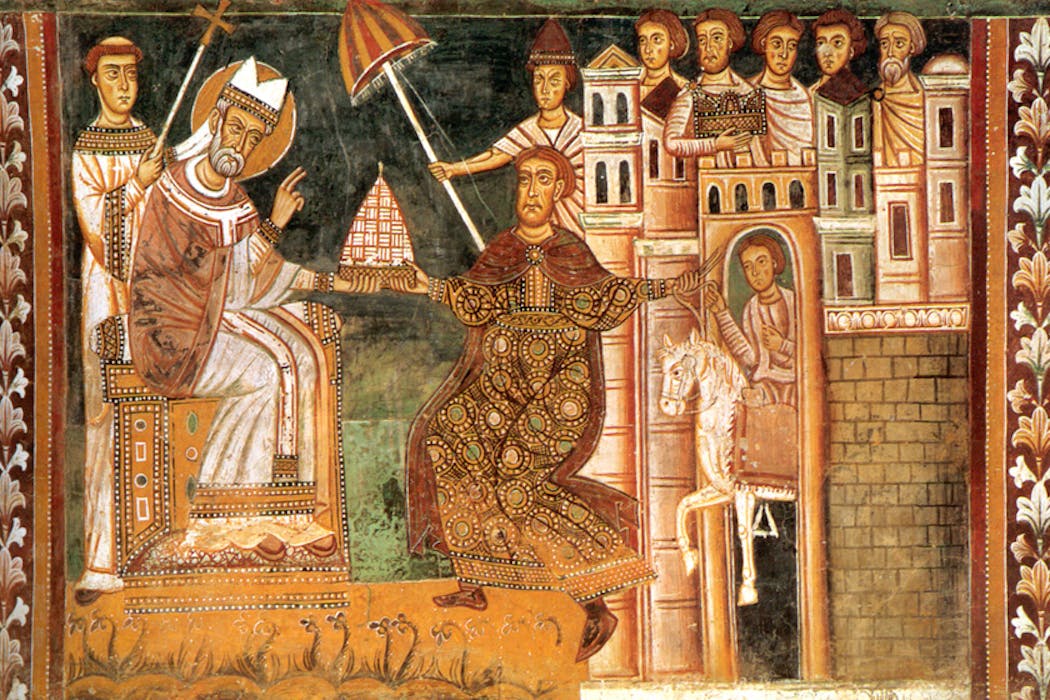
Writing in the fourth century, Eusebius celebrated the reign of the first Christian Roman emperor, Constantine, who ruled from 306-337. The story of Constantine’s conversion is famous. As Eusebius told it, the emperor was marching toward Rome during a civil war when he saw a radiant “cross-shaped” vision in the sky, accompanied by the words “by this conquer.” That night, the “Christ of God” appeared to the emperor in a dream and told him to march to war under that sign, which he did with victory.
From Eusebius’ perspective, there was a lot to celebrate about Constantine’s reign. Constantine ended the persecution of Christians unleashed by his predecessors. Under his direction, imperial money flooded into clerical hands, followed by a wave of church building around the empire. The emperor granted bishops legal privileges and tax exemptions, and he called church councils to resolve disputes over Christian doctrine and organization.
In Eusebius’ eyes, this was all part of the divine plan. As he wrote, God had intended since the beginning for the “two shoots” of the “empire” and the “gospel of Christ” to intertwine, grafted together in harmony. Pagan Rome, Eusebius claimed, had subdued the peoples of the world. Under Constantine, its rule was bringing the “good news” of Christianity to all those conquered nations.
This kind of boosterism for Christian monarchs, hailed as “champions of the faith,” would endure throughout the Middle Ages and beyond. The Byzantine Empire, the Carolingian Empire, the Holy Roman Empire, Christian kingdoms from England to Armenia: Supporters saw their worldly power as representing the heavenly power of Christ, the “King of kings.” This was, in effect, a kind of Christian nationalism before the rise of modern nations.
‘Not of this world’
Yet medieval Christian thinkers also maintained skepticism about the ability of temporal princes to realize God’s kingdom here on Earth.
This is where Augustine, who wrote “The City of God” in the early fifth century, comes into the picture. Augustine was a prolific writer and immensely complicated thinker whose views changed across the course of his lifetime. Similar to Eusebius, he believed that God determined the fate of all empires and kingdoms, whether Christian or not.

Augustine supported the right of rulers to wage “just wars” and use force to maintain public order. Still, the bishop of Hippo hit the brakes on unbridled enthusiasm for the divinely appointed role of earthly empires and kingdoms, even if their rulers were Christian.
Living through the aftermath of Rome’s plundering in 410 by the Visigoths, Augustine keenly appreciated the fact that empires come and go. True happiness for Christian princes didn’t come from seeking their own personal ends: winning battles, gaining the most territory, leaving their thrones to their heirs, and conquering their enemies. It came from putting their “power at the service of God’s mercy” and the greater good. “Remove justice,” Augustine asked in “The City of God,” “and what are kingdoms but gangs of criminals on a large scale?”
In Augustine’s view, which profoundly influenced medieval theologians and political thinkers, this world was the transitory “City of Man,” filled with love of self and lust for domination. What really mattered was the eternal “City of God.” There was nothing wrong with Christian kingdoms, empires and nations, he thought, but there was nothing especially blessed about them, either. After all, hadn’t Jesus said in the Gospels, “My kingdom is not of this world”?
There has never been a singular Christian perspective on the relationship between faith, power and political identities. There certainly wasn’t in the world of medieval Christendom. To suggest otherwise is a fantasy that misrepresents the sophistication of Christian political thought during the Middle Ages – and in the present.
Brett Whalen does not work for, consult, own shares in or receive funding from any company or organization that would benefit from this article, and has disclosed no relevant affiliations beyond their academic appointment.
Read These Next
Today’s irreverent politics ignore ancient wisdom: The need to know your limits
Many Americans have decried today’s politics as ‘shameless.’ The antidote, a political philosopher…

Across the US, people don’t want data centers coming to their communities
Opposition to data centers is widespread across the US, uniting people despite other differences on…

Why the Paramount-Warner merger is a problem for democracy
The Paramount merger may make good business sense, but research shows putting more media power in fewer…