What ‘hope’ has represented in Christian history – and what it might mean now
From ancient Greek myths to Scripture and papal teachings, Christianity has long wrestled with hope.

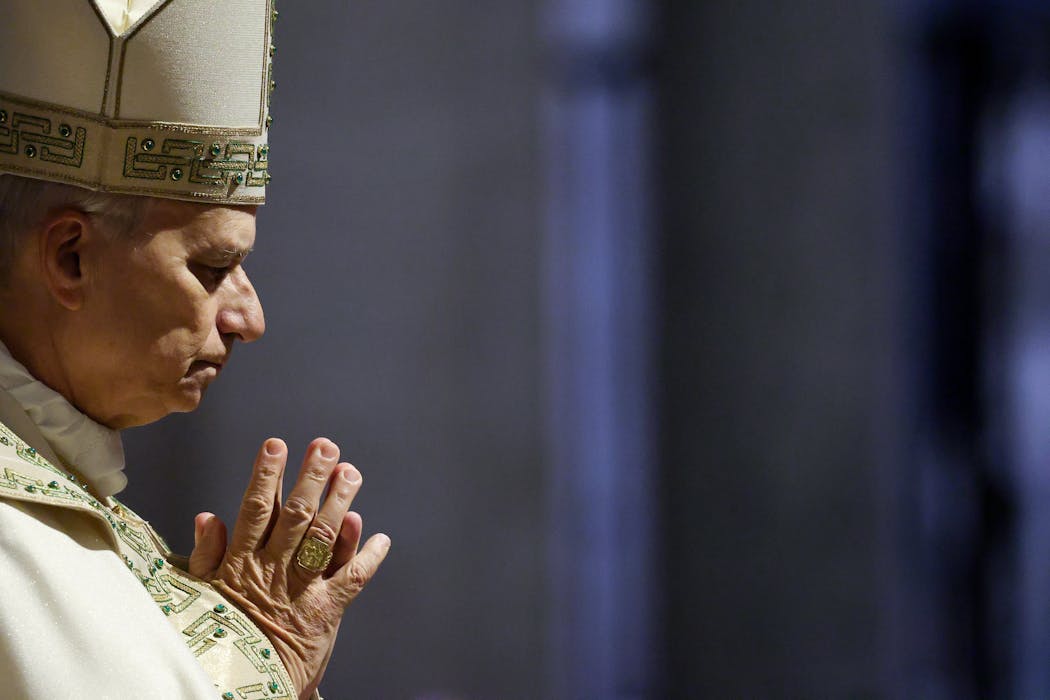
Pope Leo XIV closed the door at St. Peter’s Basilica on Jan. 6, 2026, just days into the new year. The act formally brought the Vatican’s Holy Year 2025 – designated as “Pilgrims of Hope” – to an end.
In 2022, after the COVID-19 pandemic ended, Pope Francis announced his intention to proclaim a Jubilee year, urging the faithful to look to the future “with an open spirit, a trusting heart and far-sighted vision.” That is why, as Francis explained, he chose the motto of the Jubilee: “Pilgrims of Hope.”
Ironically, 2025 was a turbulent year the world over. After so much military aggression in Ukraine, rampant starvation in Gaza and increasing violence of all kinds within the United States, people in many parts of the world were left much more despairing than hopeful for 2026.
Religions typically try to offer hope in the face of despair. As a scholar of Catholicism, I know that even amid violent persecutions, devastating wars and staggering death tolls from epidemics, Christians have repeatedly turned to their holy texts for hope.
So what is the meaning of hope in the Christian tradition?
Western antiquity
Christianity was shaped by its roots in Judaism, but also its rejection of Greco-Roman religious culture, especially its polytheism.
Many ancient Greek authors wrote about a divine spirit of hope – Elpis. As early as the late eighth century B.C.E., the poet Hesiod composed a mythic poem, “Works and Days,” about Pandora and her box of woes. The god Zeus warned that Pandora was not to open the box, given to her as a gift. But in the end, she did – and released all of the entrapped evils to trouble the world. But Elpis – that is, Hope – had also been placed in the box and was kept inside when Pandora closed the lid quickly. The moral of the story is that hope still remains with humanity.
In ancient Rome, hope was venerated as a minor goddess, Spes, but usually on a communal, national level. Politically, Spes represented the collective hope for the Roman Republic or support for the semi-divine emperors of the later empire; temples were erected in her honor, and her image could be found on coins.
Hebrew Scriptures
But for monotheistic Judaism, hope was not an external divine spirit or goddess to be invoked in times of personal or communal need.
In the ancient Near East, the authors of books of the Hebrew Bible spoke frequently about hope. Often expressed with the word “tikvah,” hope is presented in the Bible as a human reaction to God’s promises, “an inner attitude of inner expectation”: a confident trust based on God’s past works.
Early in the Book of Job, the reader meets Job, a righteous man whose faith is tested through the sudden loss of his children, wealth and health. His friend Eliphaz urges him not to give up hope in the midst of Job’s terrible sufferings. He asks: “Is your fear of God not your confidence, and the integrity of your ways your hope?” Job is already living a life of faith and obedience; his reaction should not be to collapse in despair, but to carry on in hope, trusting in God’s wisdom and mercy.
The Psalms were composed as poems or hymns used in worship. In Psalm 62, the psalmist reminds himself and all God’s people of this hope: “My soul, wait in silence for God alone, for my hope is from Him. … Trust in Him at all times, you people.”
The prophets were understood to have been sent by God to chastise the people of Israel for falling into idolatry and other evils and to urge repentance. And some of them stress hope in God as the source for strength in rejecting these worldly temptations and turning back to following the teachings of the Scriptures. The prophet Jeremiah, for example, addresses God as “the hope of Israel” as they repent.
Christian Scriptures
The New Testament, compiled in the first century C.E. contains frequent references to the Old Testament as interpreted through the lens of Jesus’ teaching.
The Gospels rarely use the word hope itself, but imply it obliquely in connection with other elements of faith, such as belief and trust. The Epistles, or letters, by early Christian apostles and their followers, contain frequent references to hope.
For example, in several Epistles, the apostle Paul speaks often about the Christian hope in God through Jesus Christ. In the “Letter to the Romans,” Paul states that, even among difficulties, “hope does not disappoint us, because God’s love has been poured into our hearts.” He praises the Christians in Thessalonika for “your work of faith and labor of love and endurance in hope of our Lord Jesus Christ, before our God and Father.”
But in his first “Letter to the Corinthians,” Paul addresses different kinds of spiritual gifts – some very striking, such as speaking in tongues or healing others. But he then writes a section specifically exploring the most important gift of all, love – in Greek, “agape” – and refers to its relationship with both faith and hope. He closes with a frequently quoted text about what he described as the three greatest Christian virtues: faith, hope and love.
Contemporary hope
Throughout the next centuries, Christian theologians and popes reflected on the nature of hope – either in itself, or within the framework of all three of these virtues.
And so, on Dec. 24, 2025, Francis opened the door of St. Peter’s Basilica to declare the beginning of the Catholic Church’s celebration of the Holy Year, with hope as the special theme.
He would not live to close it. But Leo XIV did, with the following words at the final Jubilee Mass:
“Has the Jubilee taught us to flee from (the) type of efficiency that reduces everything to a product and human beings to consumers? After this year, will we be better able to recognize a pilgrim in the visitor, a seeker in the stranger, a neighbor in the foreigner, and fellow travelers in those who are different?”
From his very first speech after being elected pope, Leo called Christians to reach out to others, build bridges, engage in dialogue and be present to one another.
Perhaps this is what continuing to hope means for the world in 2026.
Joanne M. Pierce does not work for, consult, own shares in or receive funding from any company or organization that would benefit from this article, and has disclosed no relevant affiliations beyond their academic appointment.
Read These Next
Cornell 7 case puts a spotlight on fraternity misconduct – and the limits of universities’ power to
While universities can suspend and expel students for committing sexual violence and other kinds of…

Physicists who uncovered the first particle accelerator were honored with a Nobel Prize 75 years ago
Particle accelerators aren’t just for testing the Standard Model. They’re also used to diagnose…

Christa Pike survived a lethal injection attempt – the latest person to endure a failed execution
The constitutional prohibition of cruel and unusual punishment has shaped legal discourse around failed…