
The hidden power of grief rituals
Grief can inspire concrete acts of loyalty and generosity.

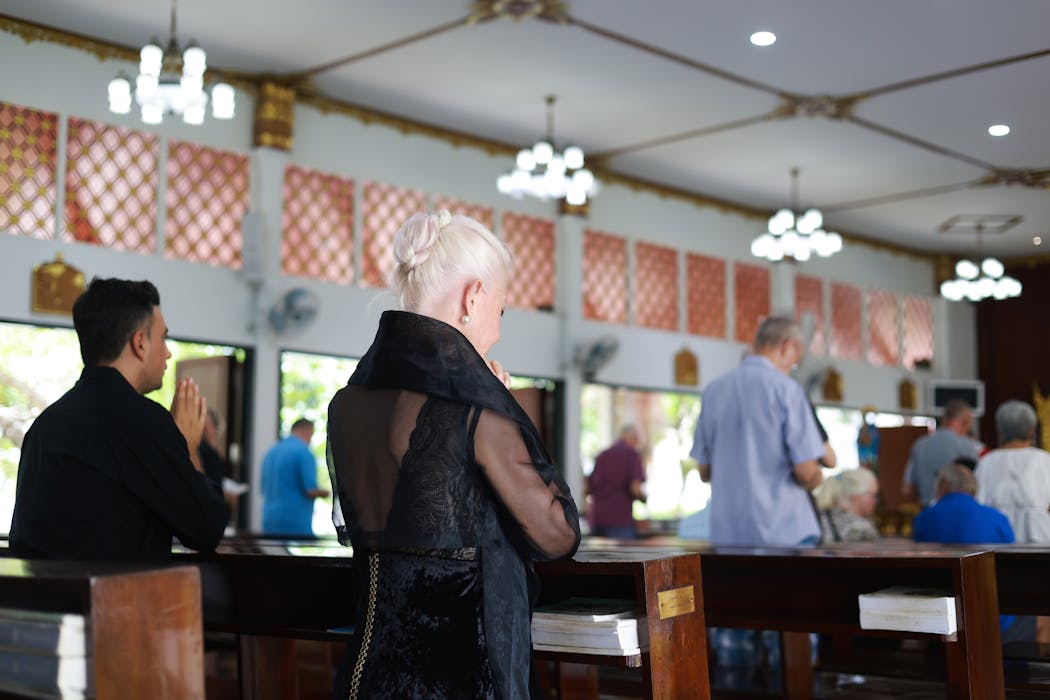
In Tana Toraja, a mountainous region of Sulawesi, Indonesia, villagers pour massive resources into funeral rituals: lavish feasts, ornate effigies and prized water buffaloes for sacrifice.
I witnessed this funeral ritual in 2024 while accompanying scholar Melanie Nyhof on her fieldwork. Families were expected to stage funerals that matched the social standing of the dead, even if it meant selling land, taking out loans or calling on distant kin for help.
In my own work of studying communal mourning rituals, I take part in ceremonies to see how they unfold. At one of the ceremonies I attended in Tana Toraja, hundreds gathered as gongs echoed through the valley. Guests were served meals over several days, dancers in bright headdresses performed for the crowd, and water buffalo – the most valuable gift a family can give – were led into the courtyard for sacrifice. Mourners described these acts as ways of honoring the deceased.
It wasn’t just in the villages of Tana Toraja that families and clans used rituals to express loyalty for people they knew personally. I saw the same dynamics in cities, where national funerals can draw millions of strangers into a shared experience of unity and loss for a person they never met.
As a scholar who also studies the psychology of rituals, I found that rituals can be one of the most powerful ways humans bond with one other.
How rituals unite
In 2022, my colleagues and I surveyed more than 1,600 members of the British public a few days after Queen Elizabeth II’s funeral – both those who had traveled to London to be part of the crowds, and others who had watched the ceremony live on television.
Spectators reported intense grief and a connection with fellow mourners when they viewed the ceremony. On average, they described their sadness as intense. Most also said they felt a strong sense of unity – not only with people standing alongside them, but even with strangers across the nation who shared in the moment.
The effects were especially pronounced for those who had attended in person.
To see whether that sense of unity translated into action, we also used a behavioral measure using a mild deception task. All participants would receive a digital £15 (US$20) voucher for completing the survey, which would be emailed to them 48 hours later.
Toward the end of the survey, however, participants were asked whether they would be willing to donate money from their voucher for taking part in the survey. They indicated this via a sliding scale, from £0-£15 ($0 to $20.25) in £1 ($1.35) increments. Participants were led to believe that the funds would go to a new U.K. charity designed to educate future generations about the importance of the monarchy.
At the end of the study, participants were debriefed: The charity was fictional, and no money was actually taken; so regardless of how much they thought they were donating, all participants received the full compensation.
The results were striking. Those who felt the strongest grief also reported greater connection to both fellow mourners and fellow citizens; they were more likely to pledge to the monarchist cause. We later tested whether these effects fade quickly or leave a lasting imprint.
In a forthcoming study, we followed British spectators for up to eight months after Queen Elizabeth II’s funeral. Those who experienced the most sadness during the ceremony formed especially vivid emotional memories, which prompted months of reflection. That reflection, in turn, reshaped how people saw themselves – a personal identity shift that predicted enduring feelings of unity with others who had shared the experience.
Crucially, this sense of “we-ness” was strongest among those who had been physically present together and continued to predict willingness to volunteer long after the funeral ended.
In other words, grief didn’t just wash over people passively; it mobilized them toward concrete acts of loyalty and generosity. And importantly, this wasn’t limited to those who had traveled to London. Even people who only watched the funeral on television still showed some of the same effects, though less strongly.
Anthropologists have long reported that funerals and other rituals can create a profound sense of bonding that can outlive the ceremony itself. Our research suggests that shared rituals of mourning can foster unity at scale, reaching far beyond those physically present.
Furthermore, shared suffering forges identity and binds people together long after the ritual itself has passed.
Anthropologist Harvey Whitehouse’s research shows that when people endure intense suffering together, they don’t just feel closer – they come to see one another as if they were family. This kinlike bond helps explain why groups who undergo hardship together often display extreme loyalty and self-sacrifice. This is true even for strangers.
When rituals divide
But are those bonds always open-ended? Or do they sometimes channel generosity inward, toward one’s own group?
At Pope Francis’ funeral in 2025, we surveyed 146 people immediately after they had viewed his body lying in state in St. Peter’s Basilica. We asked them to rate the extent of their discomfort waiting in line.

Some had waited overnight without food or water, and all had queued for hours in the unrelenting Roman sun. At the end of the survey, participants were invited to donate to one of two charities: a new Catholic aid organization or the International Red Cross.
As we predicted, the people who rated their experience waiting in line as the most uncomfortable also pledged the most money. But there was a twist. Almost all of that generosity flowed to the Catholic charity. Donations to the Red Cross were strikingly low, even though Red Cross volunteers had been circulating through the crowd, offering water and assistance. The difference in giving was not due to a difference in awareness or salience. What mattered was whether the cause felt part of the shared experience people had just endured.
This finding aligns with the work of my collaborator, anthropologist Dimitris Xygalatas, who has demonstrated that group rituals both “bind and blind.” These ceremonial rituals blind by narrowing generosity, channeling it mainly toward one’s own group, such as through the funerary ritual studies we conducted.
When shared suffering bridges divides
But shared suffering can sometimes do the opposite – not narrowing solidarity, but expanding it.
In other research I conducted after the catastrophic earthquakes in Turkey in 2023, with my colleague, anthropologist Sevgi Demiroglu, we surveyed 120 survivors across some of the most heavily impacted regions. Nearly half had lost a loved one, a third had lost their homes, and the vast majority showed signs of post-traumatic stress.
Participants were asked how intensely they had felt negative emotions such as fear and anxiety during the quakes; crucially, how much they believed those emotions were shared by others – whether family members, other Turkish survivors or Syrian refugees who were also affected.
Survivors who felt their suffering was shared reported a stronger sense of oneness, with those groups. And that sense of bonding predicted action. Even after losing nearly everything, many said they were just as willing to volunteer time to help fellow Turkish survivors as if they were their own families. Strikingly, this willingness extended even to ethnic communities often regarded with suspicion, suggesting that shared suffering can temporarily override social and political divides.
In this case, there were no collective grief rituals to help process loss. Yet the same underlying mechanism was visible: Shared suffering brought people together like kin. Grief rituals can take this raw bond and stabilize it – giving shared loss a durable social form.
Perhaps, grief rituals remind us that in grief, as in life, we are not alone.
Claire White receives funding from Templeton Religion Trust TRT-2021-10490.
Read These Next
Hunter-gatherer societies are often put on a pedestal as paragons of equality – but the reality is m
Hunter-gatherers do not always seek total equality, but that doesn’t mean they aren’t egalitarian.
Cornell 7 case puts a spotlight on fraternity misconduct – and the limits of universities’ power to
While universities can suspend and expel students for committing sexual violence and other kinds of…
US regulators want to make corporate earnings reports less frequent, but investors have doubts
No federal rule proposal has ever generated so much opposition.