Outside the West, the Kundalini tradition presents a model of the ‘divine feminine’ beyond binary ge
Drawn from tantric traditions, Kundalini points to spiritual practices that go beyond traditionally understood concepts of the masculine and feminine.

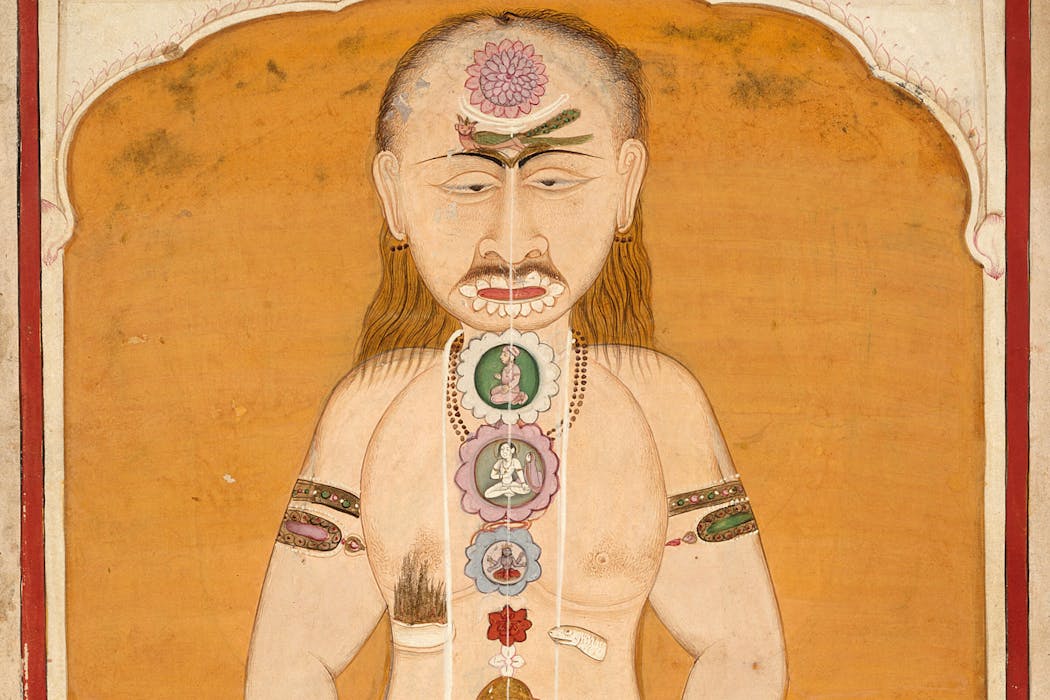
The notion of the divine feminine is a recurring motif in American pop culture, playing with the assumptions people make when referring to God – often the deity described in the Bible – as “He.”
Whether it’s Alanis Morissette’s iconic portrayal of God in the 1999 comedy “Dogma” or Ariana Grande’s titular declaration in her 2018 track “God is a Woman,” the effect is the same: a mixture of irreverence and empowerment. It dovetails, moreover, with a ubiquitous political slogan: “The future is female.”
But in a historical moment when society is bitterly contesting ideas about gender, we’d note that these notions still rely on a simplistic binary.
As two scholars who study the entangled history of spirituality and gender, we often observe an especially fraught version of this dynamic playing out among “spiritual but not religious” practitioners, often called spiritual seekers. To many such people, the divine feminine represents an escape from oppressive gender norms, and yet many stumble in trying to reconcile the idea with the embodied realities of biological sex.
An approach that escapes this dilemma is the centuries-old Kundalini tradition, which paints a model of the divine feminine beyond gender altogether.
The feminine Shakti
There are certainly examples of the feminine divine to be drawn from Christian and other Abrahamic religious traditions. Yet many seekers quickly find themselves reaching beyond these borders.
When they do, one of the first concepts they come across is Shakti, a divine feminine energy that manifests in the human body as the electrifying force of Kundalini. Both terms originate in South Asian religions – especially Hinduism – that fall under the broad umbrella of tantra.
Tantric cultural and spiritual traditions, which began to emerge in the early centuries of the Common Era, take a positive perspective on the material world in general and the human body in particular, as opposed to traditions that regard both as inherently illusory or sinful. In tantra, the material world and physical body are suffused by divine energy. This energy is called Shakti, and it is feminine.
Another key idea common to tantric traditions is that the universe is composed of two fundamental principles – or rather that it has two poles: a dynamic energy, which is female, balanced by an unchanging consciousness, which is male. As the great Goddess, Shakti goes by many names, including Durga, Kali and myriad others. The masculine principle is usually called Shiva, though this can vary as well.
Divinity beyond binaries
Tantric traditions span over a millennium in time and a subcontinent in space, so it should come as no surprise that they are incredibly diverse. However, most practices that enjoy global popularity today, especially those centered on the divine feminine energy of Kundalini, can be traced to a specific tradition called Kaula Tantra, which developed in the northeast of modern-day India near Kashmir.
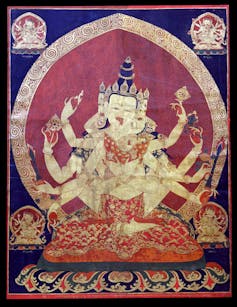
This tradition is distinctive by maintaining that while the cosmos is polar, it is also nondual, meaning that there is only one ultimate reality. So, the pairing of Shakti and Shiva, feminine and masculine, energy and consciousness, is best understood not as a binary but as the two sides of a Mobiüs strip, where one seamlessly flows into the other.
Take a strip of paper, twist it into a figure eight – also the symbol we use for infinity – and glue the back to the front. That’s the Kaula model of the universe.
In such a world, Shiva is Shakti. The masculine is the feminine. Both are divine, but even more than this, both are ultimate, because there is no difference between them. God is goddess, and both are nonbinary.
Awakening Kundalini
Kundalini yoga is a centuries-old practice quite different from the branded version popularized more recently by Yogi Bhajan. It involves using complex meditative and physical techniques to awaken and raise this energy from its usual resting place in the bottom of the torso.
In doing this, tradition says the practitioner experiences a radical transformation both of the body and of consciousness. Premodern texts describe Kundalini’s fiery energy burning through the tissues of the body, shooting up to the crown of the head, where the feminine Shakti unites with her masculine counterpart and all dissolves into oneness.
While some texts treat this ascent as equivalent to a sort of voluntary death, others describe how, once she has ascended, Kundalini returns to bathe the body in a cooling nectar of immortality, resulting in an embodied state of enlightenment and liberation.
According to this tradition, the body may appear the same but is now enlivened with a new consciousness that has transcended all dualities – including male and female.
Is the divine feminine female?
Human gender norms often prove difficult to shake, however. Though the energy of Kundalini is understood as feminine, Kundalini yoga in South Asia has been traditionally practiced by men. The reasons for this are perhaps almost entirely social, and yet they remain a powerful force.
Ironically, the very fact that Kundalini is often believed to be associated with womanhood has resulted in women being excluded – or at least deprioritized – from cultivating their own practice. Instead, they have historically become assistants or accessories to the enlightenment of men.
The fieldwork we present in our recent book on the topic bears this out. Among South Asian practitioners, the common attitude is that women embody the maternal principle, and this makes them extremely powerful. In them, the energy of Kundalini operates naturally. Men, on the other hand, need to be purified by a woman through ritual in order to effectively engage in Kundalini practice.

Such ideas are also common among Western practitioners, who tend to believe women have a more natural aptitude for Kundalini awakening. One of our subjects said this is because women have less ego. Another attributed it to female sexual fluids.
However, cultural difference plays a role, too. Western notions of the divine feminine are much more inclined to cling to the binary, resisting the idea that male and female bodies alike are ultimately woven from the same nondual reality.
Most striking, perhaps, one man who had spent a lifetime among seekers at spiritual retreats in the U.S. and South America told us of a long-held and common belief that only women were capable of Kundalini experience. It was, to him, an energy exclusive to the female body. He recounted having been shocked, only months prior, at encountering a copy of the 1967 classic “Kundalini: The Evolutionary Energy in Man,” authored by the decidedly male Gopi Krishna.
The broader point, however, is that the historical core of Kundalini practice has always been about transcending all dualities.
Thus, even as a goddess representing the ultimate “She,” Kundalini is best understood as nonbinary. Perhaps if we can wrap our heads around this idea, we can cultivate a more inclusive empowerment.
The authors do not work for, consult, own shares in or receive funding from any company or organization that would benefit from this article, and have disclosed no relevant affiliations beyond their academic appointment.
Read These Next

Americans want electric cars – they just can’t find them
Sales reveal how many cars people actually bought, but not how many they actually wanted. Prices, on…
Using light to control brain cells – neuroscientist Karl Deisseroth explains how he made his Nobel-w
Optogenetics, a field that started with an algae gene, is shedding light on new treatments for eye and…

Americans who go to church and trust science are also more likely to believe in ghosts and curses, n
Belief in science and belief in magic can coexist.