Meditating on the connectedness of life could help reunite a divided country – here’s how ‘interbein
Meditation can change our perceptions about things we encounter in our daily lives − revealing the interconnectedness of reality.

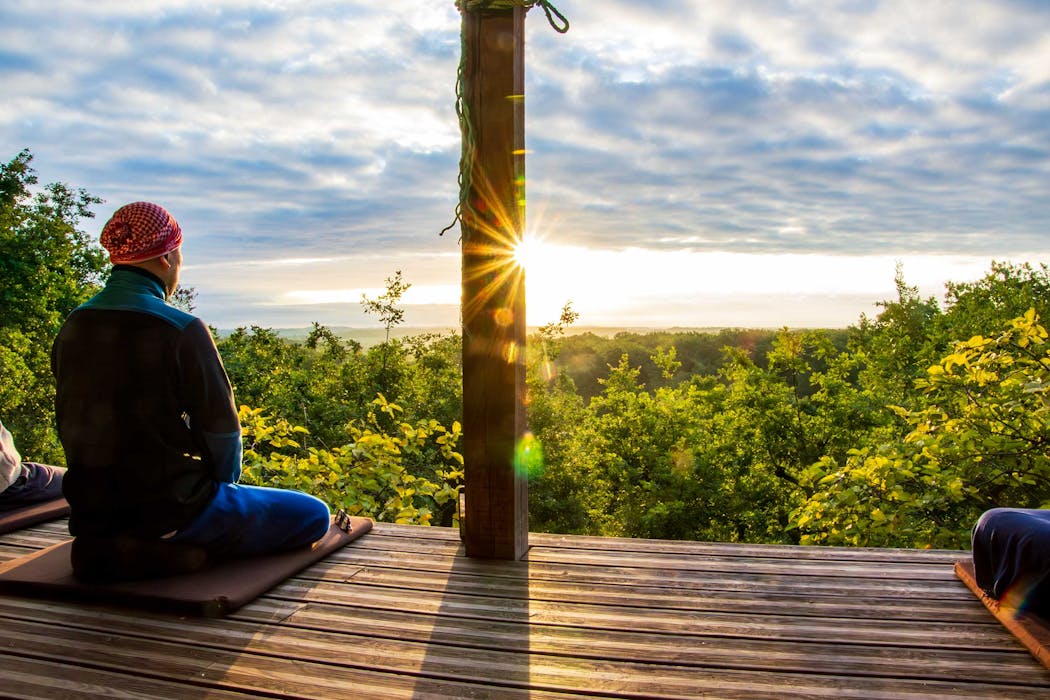
The late Vietnamese Zen master Thich Nhat Hanh often emphasized the interconnectedness of everything in this world. He explained how meditation can change our perceptions about the things we encounter in our daily lives by revealing this interdependence.
Take the example of an apple: Before meditation, an apple is just a piece of fruit. During meditation, the meditator sees how deeply the apple is interconnected with the world – the apple would not exist without the rain, the sunshine, the soil and the farmer who planted the seed. These are just a few of the causes and conditions that allow the apple to exist.
The apple is because of all these other things. An apple is not just a piece of fruit. The apple is also part rain, part sunlight, part soil, part farmer.
After meditation, an apple goes back to being an apple again. The meditator continues to call it an “apple,” but they understand its true nature. Hanh calls this sense of connection “interbeing.”
The apple insight applies to any object: a mountain, a river, a tree, a person.
In my research, I explore how the insights gained by practicing meditation can change how we live our daily lives. Inspired by Hanh, in my forthcoming book “On Mindful Democracy: A Declaration of Interdependence to Mend a Fractured World,” I explore what happens when we make “interbeing” – or interdependence – the foundation of democracy.
The essence of interbeing
In his book “The Other Shore,” Hanh recounts how he coined the term “interbeing” during a retreat in California in the 1980s, while guiding a mindfulness meditation on the nature of a chair.
He asked his students to look at the chair and notice the trees, sunshine, rain and clouds in it. He then wondered aloud if there was a word in English or French that could capture the reality that a chair is made up of things other than a chair: “I asked if the word ‘togetherness’ would do. Somebody said that it sounded strange, so I suggested the word ‘interbeing.’”
Hanh explains that interbeing means “this is because that is.” No rain means no tree, and no tree means no apple and no chair.
According to Hanh, this knowledge can help us to live a happier life because it reveals the miracle of existence.
Consider all the causes and conditions that had to happen exactly as they did for an apple to exist. Had there been a drought that killed the tree when it was young, or a late spring freeze that stunted the apple flower, or had a person chopped the tree down to make space for a housing development, this particular apple would not exist. The apple is a small miracle composed of many other small miracles.
From what I noticed staying at the Plum Village monastery Hanh established in southern France, people who practice mindfulness meditation in Hanh’s tradition are able to see miracles everywhere, because they recognize interbeing in daily life. Even commonplace activities can become special.
When drinking tea at Plum Village, for example, meditators are encouraged to “drink your cloud,” because the water in the tea was once a cloud that was once a river that will one day again fall from the sky as raindrops nourishing the apple trees.
A person is not (just) a person
The knowledge gained in meditation applies to people, too.
We as human beings are also interbeing. We are not separate from the world or each other. We are mutually interdependent. None of us would exist without rain, sunshine, food, a planet Earth – and the efforts of other people, including parents, neighbors, teachers, scientists, farmers and doctors.

A person is more than a single, solitary individual. We contain multitudes.
Seen from this perspective, being a human is miraculous. Think of how the stars had to align so that each of us could be here today. Had the Earth been a little farther from the Sun, or one of our ancestors slipped and fallen down a cliff before their children were conceived, we wouldn’t be here at all.
“People usually consider walking on water or in thin air a miracle. But I think the real miracle is to walk on earth,” Hanh wrote in his book “The Miracle of Mindfulness.” Each breath, each step, becomes a miracle in this practice of meditation.
Mindful democracy
Many of Hanh’s writings and talks were focused on drawing out the civic and ethical implications of interbeing. He believed that a better, more just world is possible if people are committed to cultivating an awareness of “the interconnectedness of all things.”
Everything is interdependent, so it’s not enough to focus on individual well-being while ignoring the well-being of others or the world.
“With the insight of interbeing – that we are inherently interconnected with all other beings – we know that when other people suffer less, we suffer less. And when we suffer less, other people suffer less,” Hanh observed.
As I explain in my new book, “On Mindful Democracy,” to foreground interbeing changes democracy.
It’s common today to talk about democracy as a partisan conflict and to interpret events through the lens of which party will win.
From the perspective of interbeing, we are interdependent, so we all win, or we all lose, together. To practice meditation is to see that underneath our partisan disagreements, we are interconnected. I therefore define mindful democracy as the practice of caring for each other and for the miraculous life we share.
Concretely, this means building welcoming, vibrant communities where people can meditate on interbeing together. It means learning to disagree – and still work together to reduce suffering – without turning each other into enemies.
Life is a shared project, and all of us benefit when we cooperate to ensure that there is less suffering, and more joy, in the world.
Jeremy David Engels does not work for, consult, own shares in or receive funding from any company or organization that would benefit from this article, and has disclosed no relevant affiliations beyond their academic appointment.
Read These Next

Why the assault weapons debate is a culture debate
The Supreme Court’s decision to hear two assault weapons cases caps a multi-decade dispute over restricting…

Leap seconds have helped keep clocks synchronized with Earth’s rotation, but their time may be over
If you think about leap years, it may seem like humans have a very odd way of measuring time. Sometimes,…
AI is changing pilgrims’ journeys, but sacred journeys have always adapted to new technology
From the printing press to smartphone apps, technology has continually transformed the experience of…