Why one theologian’s advice for a bitterly divided nation holds true today
Sebastian Castellio penned one of the first arguments for religious freedom – but it went unheeded for centuries.

Ideological division was tearing the country apart. Factions denounced each other as unpatriotic and evil. There were attempted kidnappings and assassinations of political figures. Public monuments and art were desecrated all over the country.
This was France in the middle of the 16th century. The divisions were rooted in religion.
The Protestant minority denounced Catholics as “superstitious idolaters,” while the Catholics condemned Protestants as “seditious heretics.” In 1560, Protestant conspirators attempted to kidnap the young King Francis II, hoping to replace his zealous Catholic regents with ones more sympathetic to the Protestant cause.
Two years later, the country collapsed into civil war. The French Wars of Religion had begun – and would convulse the country for the next 36 years.
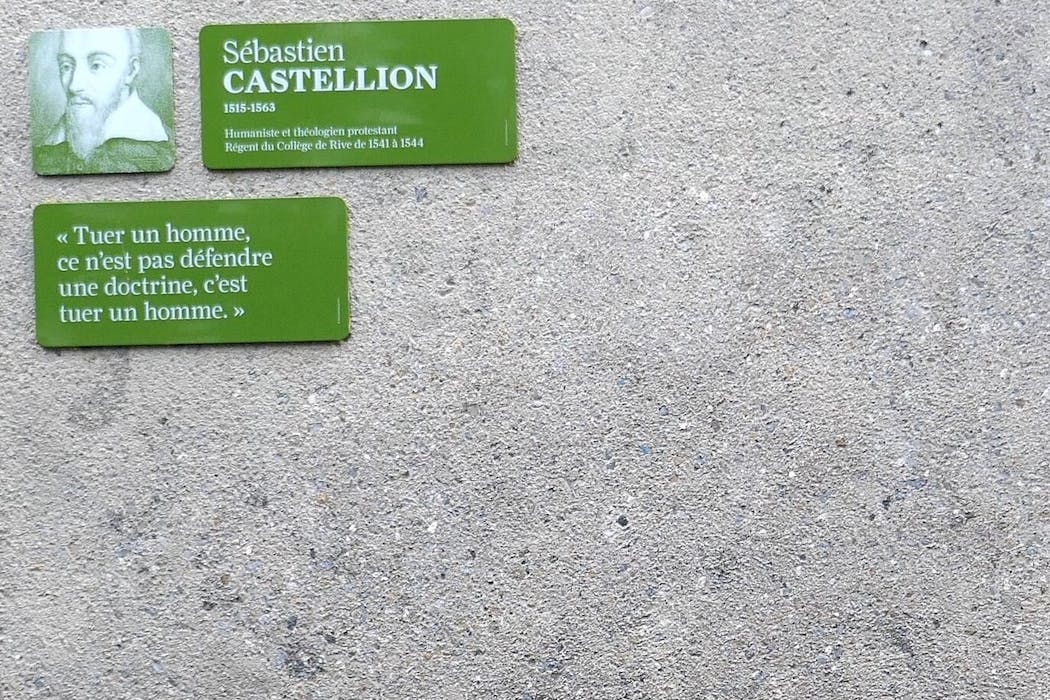
I am a historian of the Reformation who writes about the opponents of John Calvin, a leading Protestant theologian who influenced Reformed Christians, Presbyterians, Puritans and other denominations for centuries. One of the most significant of Calvin’s rivals was the humanist Sebastian Castellio, whom he had worked with in Geneva before a bitter falling out over theology.
Soon after the first war in France broke out, Castellio penned a treatise that was far ahead of its time. Rather than join in the bitter denunciations raging between Protestants and Catholics, Castellio condemned intolerance itself.
He identified the main problem as both sides’ efforts to “force consciences” – to compel people to believe things they did not believe. In my view, that advice from nearly five centuries ago has much to say to the world today.
Foreseeing the carnage
Castellio rose to prominence in 1554 when he condemned the execution of Michael Servetus, a medical doctor and theologian convicted of heresy. Servetus had rejected the standard Christian belief in the Trinity, which holds that the Father, Son and Holy Spirit are three persons in one God.

Already condemned by the Catholic Inquisition in France, Servetus was passing through Geneva when Calvin urged his arrest and advocated for his execution. Servetus was burned alive at the stake.
Castellio condemned the execution in a remarkable book titled “Concerning Heretics: Whether They are to be Persecuted and How They are to be Treated.” In it, Castellio questioned the very notion of heresy: “After a careful investigation into the meaning of the term heretic, I can discover no more than this, that we regard those as heretics with whom we disagree.”
In the process, he laid the intellectual foundations for religious toleration that would come to dominate Western political philosophy during the Enlightenment.
But it took centuries for religious toleration to take hold.
In the meantime, Europe became embroiled in a series of religious wars. Most were civil wars between Protestants and Catholics, including the French Wars of Religion, a series of conflicts from 1562 to 1598. These included one of the most horrific events of the 16th century: the St. Bartholomew’s Day Massacre of 1572, when thousands of Protestants were slain in a nationwide bloodbath.
Castellio had seen the carnage coming: “So much blood will flow,” he had warned in a treatise 10 years earlier, “that its loss will be irremediable.”

Remembering the Golden Rule
Castellio’s 1562 book, “Advice to a Desolate France,” was a rarity in the 16th century, for it sought compromise and the middle ground rather than the religious extremes.
With an extraordinarily modern sensibility, he decided to use the terms each side preferred for themselves, rather than the negative epithets used by their opponents.
“I shall call them what they call themselves,” he explained, “in order not to offend them.” Hence, he used “Catholics” rather than “Papists” and “evangelicals” rather than “Huguenots.”
Castellio pulled no punches. To the Catholics, referring to decades of Protestant persecution in France, he said: “Recall how you have treated the evangelicals. You have pursued and imprisoned them … and then you have roasted them alive at a slow fire to prolong their torture. And for what crime? Because they did not believe in the pope, the Mass, and purgatory. … Is that a good and just cause for burning men alive?”
To the Protestants, he complained, “You are forcing them against their consciences to attend your sermons, and what is worse, you are forcing some to take up arms against their own brothers.” He noted that they were using three “remedies” for healing the church, “namely bloodshed, the forcing of consciences, and the condemning and regarding as unfaithful of those who are not entirely in agreement with your doctrine.”

In short, Castellio accused both sides of ignoring the Golden Rule: “Do not do unto others what you would not want them to do unto you,” he wrote. “This is a rule so true, so just, so natural, and so written by the finger of God in the hearts of all,” he asserted, that none can deny it.
Both sides were trying to promote their vision of true religion, Castellio said, but both were going about it the wrong way. In particular, he warned against trying to justify evil behavior by appealing to its possible effects: “One should not do wrong in order that good may result from it.”
In another essay, he made the same point to argue against torture, writing that “Evil must not be done in order to pursue the good.” Castellio was the anti-Machiavelli; for him, the ends did not justify the means.
Force doesn’t work
Finally, “Advice to a Desolate France” argued that forcing people to your own way of thinking never works: “We manifestly see that those who are forced to accept the Christian religion, whether they are a people or individuals, never make good Christians.”
Americans, I believe, would do well to bear Castellio’s words in mind today. The country’s two dominant political parties have become increasingly polarized. Students are reluctant to speak out on controversial topics for fear of “saying the wrong thing.” Americans increasingly think in binary terms of good and evil, friends and enemies.
In the 16th century, Christians failed to heed Castellio’s advice and continued to kill each other over differences of belief for another hundred years. It would be wise to apply his ideas to today’s bitter divisions.
Michael Bruening does not work for, consult, own shares in or receive funding from any company or organization that would benefit from this article, and has disclosed no relevant affiliations beyond their academic appointment.
Read These Next

Why the assault weapons debate is a culture debate
The Supreme Court’s decision to hear two assault weapons cases caps a multi-decade dispute over restricting…

What the law says about armed officers at polling places
What does the law say about armed officials at the polls? That’s one of four questions that a legal…

Meet the ‘independent voters’ who will likely decide which party triumphs in the 2026 midterm electi
Republicans and Democrats need to make inroads with independent voters. But the themes that motivate…