Using thunderquakes to X-ray Earth – a new study shows urban seismology in action
With the help of thunderstorms and everyday fiber-optic cables, these scientists are revealing a hidden world underground.

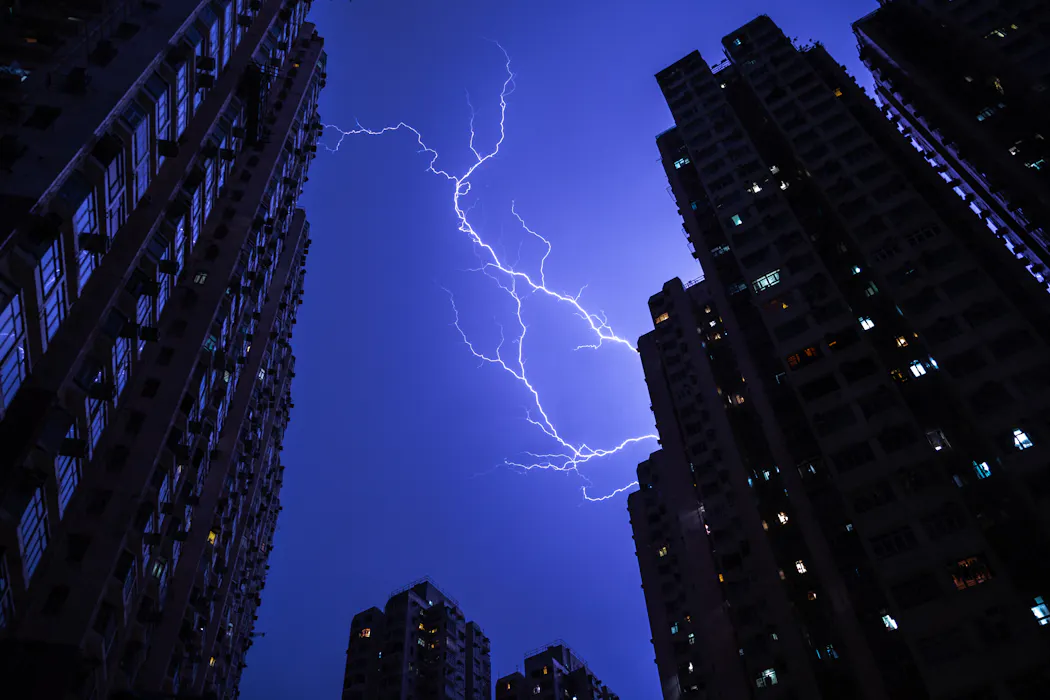
When lightning strikes, it superheats the air around it and creates a shock wave that we hear as thunder. But thunder doesn’t just travel through the atmosphere to our ears.
When that energy reaches the ground, some of it is converted into seismic waves that ripple through the soil and rock beneath. The resulting vibrations are known as “thunderquakes.”
Until now, scientists haven’t understood these signals well enough to make practical use of them. Our team’s research shows that thunderquakes can be used to map the structure beneath the Earth’s subsurface – such as groundwater movement, environmental contamination, sinkholes, or for evaluating building sites and foundations – just like X-rays image inside the human body.
We discovered this by listening to thunder with something found in communities around the world but unusual as a seismic measuring instrument: fiber-optic cable.
Turning fiber optics into vibration sensors
Using a technique called distributed acoustic sensing, we turned an ordinary fiber-optic cable, the kind used for internet or phone service, into a string of thousands of vibration sensors.
A laser-pulsing computer, called an interrogator, sends light through the cable and measures tiny changes caused by vibrations along its length. In our experiment, part of the Penn State FORESEE project, we used a cable that is over 2 miles (more than 4 kilometers) long. That gave us more than 2,100 sensors, spaced only a few feet apart, all listening to the ground at once.
Over two years, we used an old telecom fiber to record and identify 458 clear, high-quality thunderquakes.
The enormous amount of detail captured by this process has allowed us to see something that had been difficult to observe before: specific types of seismic waves produced when sound from the atmosphere interacts with the ground.
The most important of these seismic waves are what we call air-coupled Rayleigh waves. They are measurable at the surface but can be used to study the subsurface far below, even down 300 feet (around 100 meters).
How a thunderquake ‘X-rays’ the ground below
The trick to this technique is known as seismic dispersion: Waves of different frequencies travel at different depths. By measuring how the thunderquake’s wave speeds changed with frequency, we could reconstruct the seismic wave speed at different depths, which allows us to interpret the properties of the ground beneath the fiber.
The result was the equivalent of an X-ray of the subsurface extending roughly 300 feet underground, without drilling a single hole.

Imaging the subsurface typically requires specialized equipment, such as truck-mounted vibration sources or arrays of sensors that have to be installed for surveys. These approaches can be expensive and difficult to deploy over large areas.
Thunderstorms offer a naturally occurring source of seismic energy that is already spread across the landscape. And fiber-optic cables are buried beneath cities and towns around the world.
Instead of bringing a seismic source to the ground, we can listen to the storms passing overhead. That could eventually make it possible to monitor the shallow subsurface continuously, using infrastructure that is already in the ground and seismic energy that is already coming from the sky.
What we found at our test site
In State College, Pennsylvania, where we conducted the tests, the geology is mostly limestone and dolomite, rocks that can slowly dissolve as groundwater moves through them. Over time, this process creates fractures, caves and sinkholes.
Our thunderquake study revealed four distinct areas where seismic waves traveled much more slowly than through the surrounding rock. These “weak zones” could be caused by fractured or weathered rock or the presence of water or air. Two of them coincide with areas where satellite radar shows that the ground is actively subsiding. The depths of all four are consistent with fractures and voids documented at nearby sites.

These results matter because karst landscapes like the one beneath State College are widespread. They cover roughly 20% of the world’s continental land area and affect nearly a quarter of the global population. Sinkholes, groundwater contamination and other hazards associated with these landscapes can threaten buildings, infrastructure and public safety. Knowing where these hazards are allows for better construction and planning.
Not just for thunder, and not just on Earth
Our results demonstrate a fundamental process: Sound waves in the atmosphere can be converted into useful seismic waves in the solid Earth. But thunder is only one example.
Sonic booms, volcanic eruptions and meteor airbursts can produce similar atmospheric shock waves, potentially creating other natural seismic sources.
The idea may even extend beyond Earth. Earth-like tectonic earthquakes are not expected to be common on some other planets and moons, but atmospheric disturbances may still be present.
Titan, Saturn’s largest moon and the destination of NASA’s upcoming Dragonfly mission, is one intriguing possibility. If lightning and thunder occur there as models predict, atmospheric energy could potentially provide another way to investigate its subsurface.
Back on Earth, the atmosphere is constantly interacting with the ground beneath our feet. Our work suggests that this interaction could be a source of information about the hidden world below us.
The authors do not work for, consult, own shares in or receive funding from any company or organization that would benefit from this article, and have disclosed no relevant affiliations beyond their academic appointment.
Read These Next

These state supreme court races could decide abortion access and trans rights
Ohio, North Carolina and Michigan have open seats on their state supreme court, and these hotly contested…

Why your boss matters more than remote or hybrid work when it comes to burnout and job satisfaction
A return to the office can mean very different things to different workers, which is why this debate…

AI can help with academic research but doesn’t always get it right – here are some tips to check the
AI is quickly changing. These tips from university librarians can help people keep pace with the shifts…