Puerto Rico is rationing water, but many residents stopped trusting the tap long before the drought
Drought and a ruptured pipeline have forced Puerto Rico into revolving water shut-offs. For many people, the disruption started years earlier, as did loss of faith in the utility.

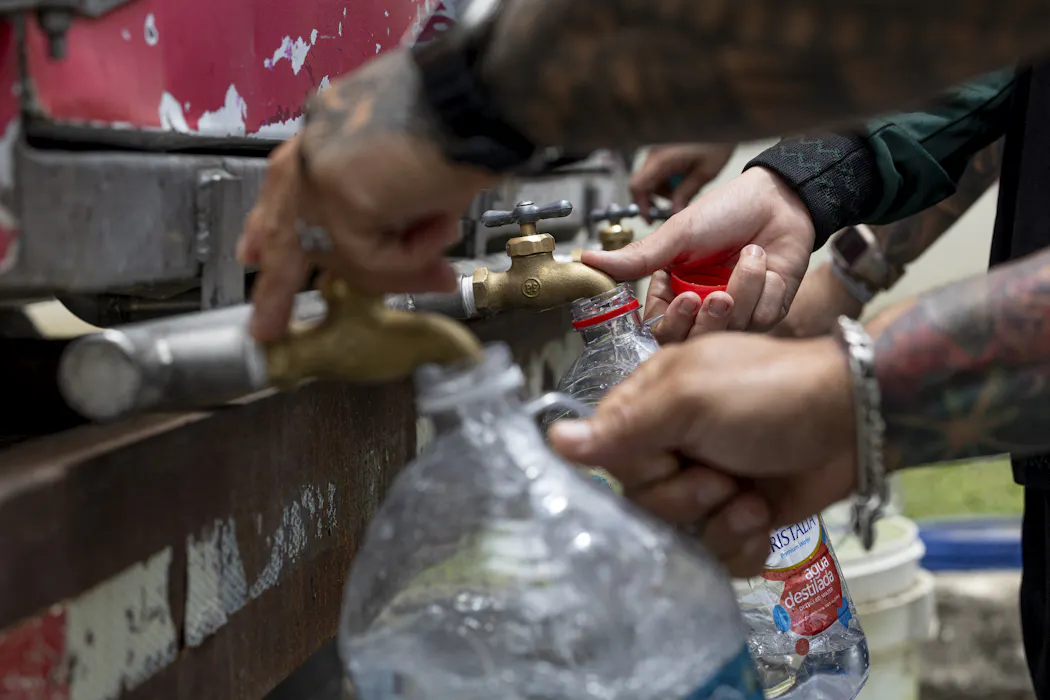
Imagine turning on your kitchen faucet and nothing comes out. Not for an hour, but for two full days. Then the water returns, only to stop again two days later.
That is what more than 180,000 customers in San Juan, Puerto Rico, and six nearby municipalities have been dealing with since Aug. 7, 2026, and officials expect 48-hour rotating outages to continue at least through August.
The official explanation is drought that has depleted the island’s reservoirs. July was the driest month San Juan has recorded in more than 120 years. The Superaqueduct, a large, aging pipe system that carries water to the metro area, also ruptured in June, severely reducing water supplies.
“This situation is out of our hands,” Gov. Jenniffer González said in early August as water rationing began.
But as a professor of urban planning who has spent years studying water in Puerto Rico, I know that a great deal of the problem Puerto Rico is facing has been in someone’s hands. And for many households I’ve spoken with, the announcement changed less for their daily lives than you might expect.
People were already living without water
Puerto Ricans have dealt with water-rationing before, including during a drought in 2015 that left 400,000 customers receiving water service every third day, and again in 2020. After Hurricane Maria in 2017, parts of the island went nearly five months without dependable service. The water interruptions never really stopped for many Puerto Ricans after that.
Residents of one San Juan neighborhood counted 123 days of water outages over the 13 months before the latest rolling outages began. Some brought their unwashed laundry to a protest in the capital in August 2026. A community leader in another town told The Associated Press the rolling outages schedule did not mean much, because her neighborhood had been experiencing water outages for several months.
Filling buckets, keeping jugs by the door, checking the faucet each morning – for many Puerto Ricans, that routine was in place long before now.

The government-owned water company, Puerto Rico Aqueduct and Sewer Authority, or PRASA, is responsible for the water system. But no agency publishes how often households lose service, and Puerto Rico has no independent water regulator. Past engineers’ reports for PRASA have counted reported leaks and overflows, but not how many homes were affected. Much of the information about the latest outages has come instead from residents and investigations by the Puerto Rico House and Senate into repeated water interruptions.
Losing half its water to leaks
Part of Puerto Rico’s water problem is the large amount of water lost between water treatment facilities and customers.
Two aging systems are failing at once: large transmission mains like the Superaqueduct, where a break can cut off an entire city, and roughly 15,000 miles of distribution lines that leak continuously.
This is not a new problem. PRASA lost 267 million of the 513 million gallons it produced each day, close to half, to leaks from pipes before it reached anyone in fiscal year 2024, according to Puerto Rico’s federally appointed Financial Oversight and Management Board, which certifies the utility’s budget. The utility’s fiscal plan includes investing in leak detection, but shows only a 6% reduction in water losses since 2019.
Overall, the costs have been estimated at nearly US$100 million annually in wasted water production and over $200 million in lost revenue.

The island, which has been battered by severe storms and earthquakes in recent years, relies heavily on disaster recovery funds from the Federal Emergency Management Agency and funding from other federal and state agencies for its water system repair work. To secure those funds, it prioritizes projects that FEMA will reimburse – treatment plants, meters and hurricane reconstruction – rather than the thousands of miles of small pipes where most of the water is lost.
The U.S. Environmental Protection Agency has put Puerto Rico’s need for distribution and transmission pipe work at $2.2 billion, far more than the funding it receives for water systems or the amount it gets from customers.
Mistrust of the system
In addition to the outages, water quality problems over the years have created widespread mistrust of Puerto Rico’s water system.
An analysis of U.S. Environmental Protection Agency data found that in 2015, water systems serving the island had more health and other violations than in any other U.S. state or territory.
In 2021, researchers analyzing EPA compliance data found that 17 of Puerto Rico’s 78 municipalities had systems the agency classifies as serious violators. However, that label does not tell a household whether the problem is contamination or paperwork, which is part of why people stop trusting what comes out of the tap.

I worked on a research team led by engineers at Iowa State University that studied how Puerto Rican households get their drinking water. In 2022, we surveyed and interviewed 154 residents in the Loíza, Comerío and Aguas Buenas regions.
Sixty-four percent said they mistrusted their tap water. They talked about taste, color and smell, and their own history with the utility. One said the water tasted like the ocean. Another said that, after Hurricane Maria, the pipes smelled of dead animals. A third boiled the water as recommended, got sick anyway, and didn’t go back to using tap water.
Some residents said they rely on bottled water when they can, even when the taps are running. One told us she uses municipal water when her bottled water runs out because she has no car and will not keep asking her children to bring more. A few said relatives shamed them if they used water from the faucet.
These households are paying for water whether it arrives or not. The published residential rate starts near $30 a month on top of the cost of the water actually used. But buying bottled water is more expensive than tap water, and the median household income in Puerto Rico is $26,297, compared to roughly $82,000 nationally. The poverty rate is 37.3%.
A separate survey our team ran with 208 older adults in Loíza found 86% using bottled water and 71% also drinking tap water.
Paying for repairs
A utility that cannot hold its customers will have an even harder time financing its repairs.
The system’s $1.1 billion in annual revenue can’t cover the roughly $1.3 billion in operating costs and $240 to $270 million a year in debt service on about $3.8 billion in long-term debt. That is why the capital program is mostly federally funded.
But that federal funding is paid as reimbursements, and the work has been slow. Puerto Rico’s most recent congressional status report found it slowed even more after FEMA added new procedural requirements in 2025.
In Puerto Rico, the money for repairs mostly exists on paper. Some is obligated but not disbursed, some is committed to court-ordered wastewater work instead, and almost none of it is aimed at the small pipes losing the water. A utility that has spent two decades under federal consent decrees for breaking Clean Water Act rules and releasing raw sewage into waterways still cannot cover the island’s water system’s actual needs.
Ivis García received funding from the U.S. Environmental Protection Agency, Assistance Agreement No. 84004001, and the National Science Foundation, Award 2302205. The research was conducted with colleagues at Iowa State University and Bradley University, with local field research assistants in Puerto Rico. The views are the author's and have not been reviewed by the EPA, NSF or the rest of the team at ISU.
Read These Next

These state supreme court races could decide abortion access and trans rights
Ohio, North Carolina and Michigan have open seats on their state supreme court, and these hotly contested…

Your cells keep a record of every workout you’ve ever done – and those gains persist even after a br
‘Use it or lose it’ isn’t quite true when it comes to the health benefits of exercise. Cells across…

I’m a physicist who worked on the Nobel-winning neutrino search – here’s how a cubic kilometer of An
The 2026 Nobel Prize in physics recognizes Francis Halzen’s vision in building an unusual telescope…