Sargassum, the smelly nemesis of beach vacations, has become a self-sustaining disaster that will ke
Communities and entrepreneurs are experimenting with ways to turn this nuisance into a valuable resource.

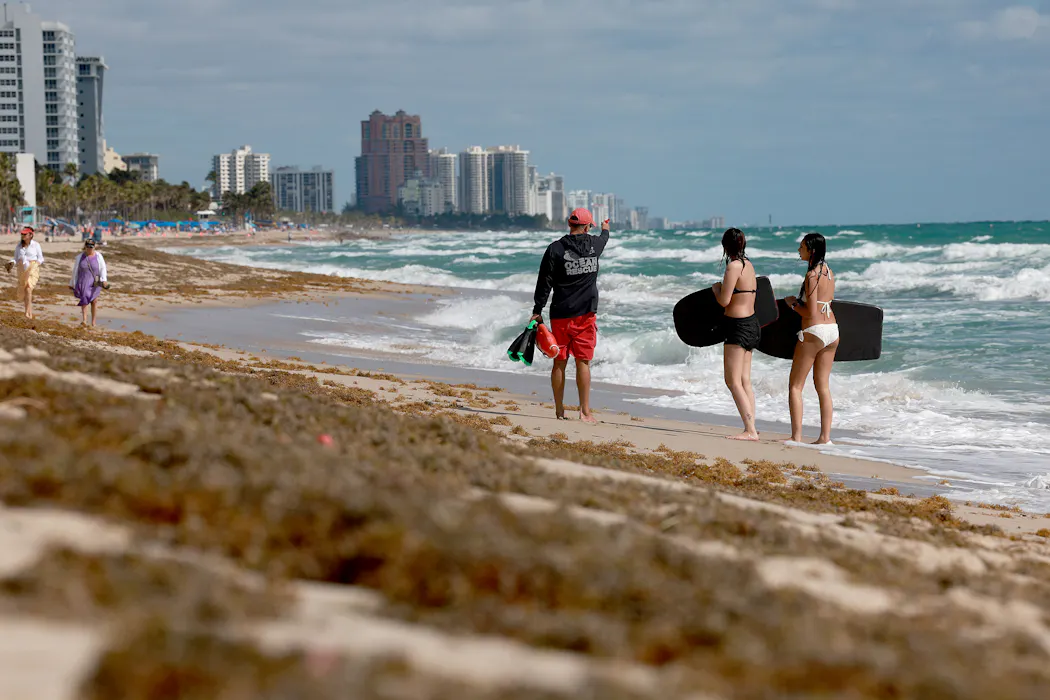
You’ve been planning your dream beach vacation for months, only to arrive and find the shoreline covered in large piles of smelly, brown seaweed, with even more floating offshore. It’s disappointing, for sure – and increasingly common.
Since 2011, summer scenes like this have played out on beaches in South Florida and throughout the Caribbean.
The consequences are even greater for people who live and work along the Caribbean and Gulf coasts and the coasts of the tropical Atlantic. Large masses of sargassum seaweed can clog harbors, interfering with fishing and boating, and in some cases harm marine life. As the seaweed begins to decompose it releases gases, including hydrogen sulfide, ammonia and methane, raising concerns for both public health and the environment.
To reduce the impact of these sargassum blooms, a crucial first step is understanding why the seaweed started growing in the first place and what’s sustaining it now.
We study the oceans, marine life, and algae blooms, such as sargassum. Our research suggests that these vast mats of smelly seaweed may have entered a self-sustaining cycle, effectively feeding their own expansion. It’s creating a chronic disaster for the affected coasts, with little sign of ending.
Columbus and the great Sargasso Sea
Pelagic sargassum is a type of brown seaweed that floats on the ocean surface and is naturally abundant in the Sargasso Sea, a region of the subtropical North Atlantic.
The seaweed takes its name from sargaço, the Portuguese word for grape. When Portuguese navigators reached the region, they noticed its small, grapelike, air-filled bladders that keep the seaweed afloat. Christopher Columbus later wrote about encountering vast mats of it during his voyage to the Americas.
However, in 2011, people began noticing unusually large mats of sargassum in the tropical Atlantic, between the coasts of Africa and Brazil. In the years since, these blooms have become more frequent, lasted longer, and grown much larger, with vast amounts of sargassum washing ashore across Central America, the Caribbean and the Gulf of Mexico.

In this new area, now called the Great Atlantic Sargassum Belt, the amount of sargassum surpassed an estimated 37,500 million tons in 2025. Forecasts suggest summer 2026 could break records again.
Sargassum’s drivers changed over time
For years, scientists have searched for the causes of the Great Atlantic Sargassum Belt.
They explored changes in ocean nitrogen and phosphorus from fertilizer and other human activities in the Amazon and Congo river basins, increasing amounts of Saharan dust blowing in the wind, and changes in ocean temperatures, winds and currents. None of the hypotheses could fully explain year-to-year variations in the sargassum belt.
Our research suggests something else is also going on – the main cause has changed.
In the winter of 2010, strong winds brought some sargassum southward from the Sargasso Sea to the tropical Atlantic. For a few years, winds stayed strong in winter and spring, acting like a giant spoon and mixing deeper, nutrient-rich water up to the sunlit surface, giving the algae the resources it needed to bloom and grow.
A floating sargassum mat is much more than just seaweed. It is like a floating city, home to fish, shrimp, crabs and countless tiny living organisms, all food for larger fish. Together, they form an ecosystem that we call the sargassumsphere. It’s much like a mobile reef or forest.
These animals collect food around the floating mats and recycle nutrients through their waste and the breakdown of older sargassum. In this way, nutrients are gathered from a much larger area and concentrated around the seaweed, helping the next bloom to grow.
This process can make sargassum blooms very likely to persist in the years ahead.
To test this theory, we created a mathematical model that accounts for the mechanisms controlling the blooms. With the measurements of nitrogen content and isotopic composition in argassum collected around the U.S. Virgin Islands, our model not only reproduced the blooms from 2011 to 2022 but also predicted ahead of time the size and evolution of blooms that occurred in 2023 and 2024, suggesting the theory is correct.
Better forecasts, better solutions
Our work shows that the Great Atlantic Sargassum Belt is likely here to stay.
Predicting when blooms will occur, and understanding what drives them, can help create early warning systems that give coastal communities time to prepare for their unwanted arrival. It can also support long-term efforts to turn sargassum from a costly nuisance into a valuable resource.
Sargassum biomass has attracted growing interest as a renewable feedstock for biofuel production. Unlike bioenergy crops grown on land, sargassum does not need land, freshwater or fertilizers, reducing competition with food production. The seaweed is rich in carbohydrates that can be converted into bioethanol, biogas, bio-oil, or hydrogen through processes such as fermentation, anaerobic digestion, hydrothermal liquefaction and gasification.
Scientists at a university in Barbados, for example, developed a way to produce biofuel from a combination of the excessive sargassum on the island’s shores and wastewater from the local rum industry.
The island is also encouraging farms to use sargassum as a fertilizer and soil amendment, providing a sustainable alternative to synthetic fertilizers. Sargassum is rich in organic matter, potassium, calcium, magnesium and trace elements. After careful processing to remove the salt and excessive metals, it can be used to improve soil structure, enhance water retention and stimulate plant growth.

Sargassum is increasingly also being explored as a sustainable construction material, particularly in Mexico and Brazil. The biomass can be incorporated into building products, such as compressed panels similar to drywall that were developed by researchers at the National Autonomous University of Mexico, and low-cost bricks developed by entrepreneur Omar Vázquez Sánchez in Mexico using about 40% sargassum with limestone and other organic materials. Using sargassum as a mortar additive also helps reduce dependence on conventional, carbon-intensive materials.
By learning to live with and make use of sargassum, affected regions may be able to transform a growing challenge into a new opportunity.
Annalisa Bracco receives funding from The Tides Foundation to explore the causes of the Sargassum blooms.
Joseph Montoya receives funding from The Tides Foundation to explore the causes of the Sargassum blooms.
Xing Zhou does not work for, consult, own shares in or receive funding from any company or organization that would benefit from this article, and has disclosed no relevant affiliations beyond their academic appointment.
Read These Next

Why your boss matters more than remote or hybrid work when it comes to burnout and job satisfaction
A return to the office can mean very different things to different workers, which is why this debate…

Missing ambassadors, inexperienced appointees – is Washington dropping the diplomatic ball?
Almost half of US ambassador jobs remain vacant. Meanwhile, political appointees are outnumbering career…

I’m a physicist who worked on the Nobel-winning neutrino search – here’s how a cubic kilometer of An
The 2026 Nobel Prize in physics recognizes Francis Halzen’s vision in building an unusual telescope…