Efforts to combat climate change often exclude Indigenous people – and they may not have any recours
Efforts to protect land and environmental resources, including fighting climate change, often end up displacing people who have lived in those places for generations.

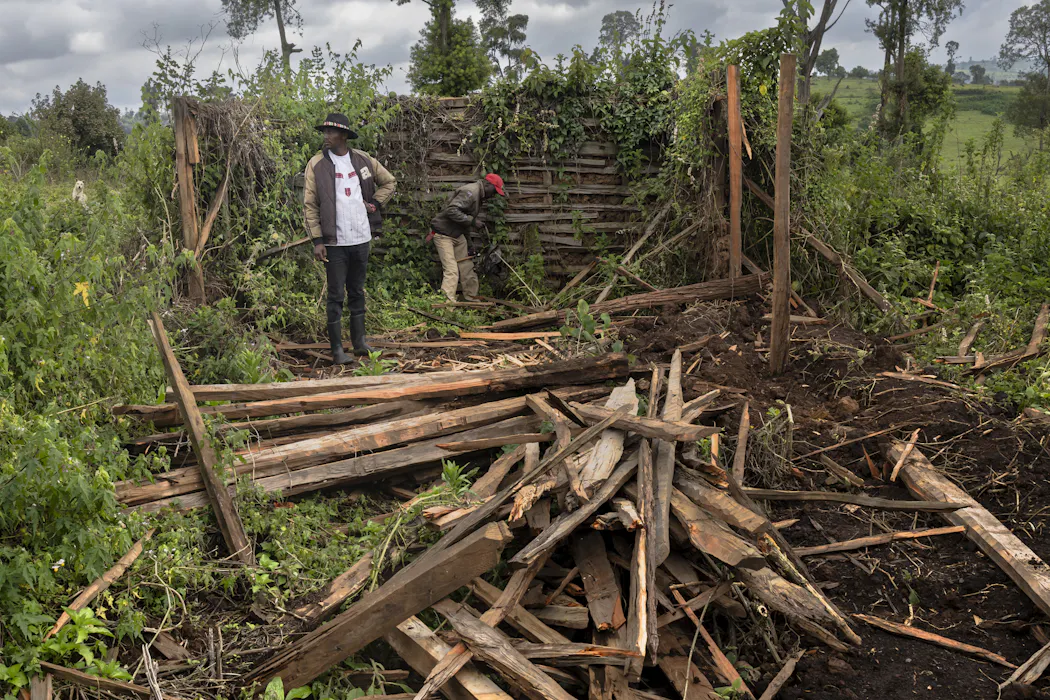
Imagine living in the same forest as your parents, grandparents, great-grandparents and all your ancestors as far back in time as stories can tell, and depending on the forest for food, shelter, recreation and education. Imagine, then, that the forest depends on you, too, because you and your people have protected it for generations.
Then, along come government officials who tell you what you already know: The forest is precious, an environmental and ecological gem that should be preserved. And then they tell you that to protect it, you all have to leave.
That’s the latest reason given in a series of efforts to evict the Ogiek people, an Indigenous group of hunter-gatherers in the Mau forest of East Africa. For more than a century, British colonial authorities and, later, Kenyan government officials, have all sought to evict the people who have lived there since time immemorial. And in 2017 the Ogieks won a landmark court case before the African Court on Human and Peoples’ Rights, which recognized their legal right to the land.
But in 2023, Kenya’s government began evicting them again, citing a new justification. The government wants to preserve the forest undisturbed, as a commercial resource in global markets for carbon credits, a system in which companies can claim they are doing no harm to the climate even while continuing to emit greenhouse gases that are raising global temperatures and changing the climate. Instead, they purchase credits to support the absorption from the atmosphere of an equivalent amount of carbon dioxide, such as by trees.
This story is still unfolding. And the Ogiek are not the only Indigenous group experiencing this type of pressure in a pattern that extends well beyond Kenya.
As countries, companies and nonprofit organizations around the world seek to protect land, conserving precious environmental resources and reducing the effects of climate change, the communities most likely to be displaced are the Indigenous people who have lived there for generations.
The Indigenous people involved often find they are left out of the planning process and have few legal options available to defend the homes they and their ancestors have cared for over thousands of years.
I am a researcher and consultant working on how Indigenous peoples and their land rights are affected, and often undermined, by outside interventions. I have seen that there is one principle designed to ensure Indigenous people are included in decisions about their land. From East Africa to Central Asia, the principle exists, but it is almost entirely unenforceable.
A right without teeth
Under the United Nations Declaration on the Rights of Indigenous Peoples adopted in 2007, Indigenous communities have a recognized right to be meaningfully consulted before anything is done to the lands where they live. This principle has a name: “free, prior and informed consent.”
This right means Indigenous groups must be told what governments or corporations want to happen on their lands and why, and must be given the chance to object or propose changes. And the final approval for whatever might happen must come voluntarily from those Indigenous people.
The principle of free, prior and informed consent was developed after decades of documented harm to Indigenous people by governments and companies that ignored their long-term presence on the land and their perspective on its use. But it is a principle, not an enforceable law or regulation in most countries.
So, many governments and corporations have interpreted the principle loosely, or even disregarded it entirely. Often they just tell a few representatives of an Indigenous group what’s about to happen, sharing key details too late for any opposition or revision. That’s what happened to the Ogieks in 2023: The Kenyan government decided it wanted to preserve the forest and told the people to leave, again.

Other decisions without consent
Something similar happened in the Arctic between 2008 and 2025. The Arctic Ice Project, initially called ICE911, was a nonprofit organization founded to find ways to reflect sunlight away from the Earth’s surface and slow the melting of Arctic ice. The effort decided to focus on spreading tiny reflective silica microspheres on the ice.
The project was ultimately discontinued because of concerns it could harm the algae and plankton that form the base of the Arctic food chain, which sustains both wildlife and Indigenous communities in the region. But since its beginning, the effort had been opposed by the local Indigenous people, who said they were excluded from discussions.
One Indigenous leader told me:
“Involvement doesn’t mean … a predetermined intervention, (with the organization) inviting us to a restaurant of their choosing, eating a meal they ordered to discuss our future. … We warned them about the potential impacts, and after all that, they want to hire us as consultants for a predetermined intervention. And they told us to set our price.”
The leader’s point was simple: What was being offered wasn’t consent and meaningful consultation. The proposal from the Arctic Ice Project was essentially a fee to sign off on a plan that had never really been open to change or input from the Indigenous people.
Some research also highlights that community-led conservation projects are more effective because Indigenous peoples are not relics of the past, but rather are active, present-day stewards with dynamic and sophisticated knowledge systems rooted in their relationship with their land.

Competing interests
What connects these cases is not malice. Governments, corporations and nongovernmental organizations all operate in competitive environments where financial pressures and inadequate regulations can push social and environmental considerations to the margins. That means the people with the most direct relationship to the land are often the last to be consulted about what happens to it.
The principle of free, prior and informed consent was designed specifically to break that pattern. But as long as it remains a principle rather than an enforceable obligation, I worry that meaningful consultation will continue to be replaced by the appearance of it, in the form of a meeting that’s held too late, a document signed by the wrong people, or a consulting fee offered to approve a decision that had already been made.
Some countries have ratified the International Labour Organization’s Indigenous and Tribal Peoples Convention, agreed in 1989, which contains this principle. Some countries, including the Philippines, Colombia and Peru, include the principle in their national laws. But other countries have not made so formal a commitment, and still others, including the U.S., have not ratified the international agreement in the first place.
In my view, not until the communities it was designed to protect are brought in at the beginning, as decision-makers with veto power, will the principle achieve its goal.
Buket Altınçelep does not work for, consult, own shares in or receive funding from any company or organization that would benefit from this article, and has disclosed no relevant affiliations beyond their academic appointment.
Read These Next
UN peacekeepers prepare to exit Lebanon after 70 years – leaving behind a worrying security vacuum
In August, the UN Security Council voted to end the decades-long peacekeeping mission in Lebanon. Blue…

Fear-based campaign ads can grab attention, but whether they win votes is less clear
Political campaigns often use fear to play on voters’ existing prejudices and stereotypes. What that…

Surviving cancer starts at diagnosis and continues after treatment – earlier survivorship care can h
Cancer survivorship is often thought to begin after a patient receives their last treatment. But planning…