Over 400 million barrels will be added to the oil market soon – what are strategic reserves and what
Nations’ stores of petroleum can dampen price shocks in the short term, but as reserve supplies dwindle, economic pain may continue.


In the second week of the Iran war – with the Strait of Hormuz effectively closed, cutting off shipping of 20% of the world’s oil supply – the International Energy Agency announced the largest release of strategic oil reserves in history. Thirty-two countries will sell a combined 412 million barrels from their reserves into the global market over four months, beginning in late March 2026.
Energy researchers like me know that the concept of a strategic oil stock goes back to the early 20th century, when the U.S. Navy first substituted oil for coal as a fuel for ships. Starting in 1912, Congress set aside several petroleum-rich areas in the U.S., including Elk Hills in California and Teapot Dome in Wyoming. In times of need, oil wells could be drilled in those regions to produce fuel for the Navy.
The current system involves oil that has already been produced and is stored so it can enter the market quickly. That approach was created by the International Energy Agency soon after its founding in the wake of the 1973-74 oil crisis. At that time, Arab nations in the Organization of the Petroleum Exporting Countries cut exports by as much as 25% to protest U.S. and other countries’ support for Israel in the Yom Kippur War. Global oil prices soared by over 350%, the equivalent today of US$70 – the price before Israel and the U.S. attacked Iran on Feb. 28, 2026 – jumping to $245.
Now, strategic reserves are a system of national oil stocks intended to replace at least 90 days of each country’s imports. In some cases, such as Japan, the reserve covers over 200 days. The 415 million barrels in the U.S. reserve as of March 13, 2026, covers only about 64 days.

What is the purpose of strategic oil reserves?
These reserves have a twofold purpose: to replace a portion of the disrupted supply and to moderate the resulting increase in prices.
In cases of a major loss to world supply, the International Energy Agency will propose a coordinated release from member countries. There have been five such releases, most recently in 2022, when Russia’s invasion of Ukraine caused oil prices to go above $120.
Together, members hold government stockpiles of about 1.2 billion barrels, with another 600 million barrels stored by private industry. The United States’ expected contribution of 172 million barrels is nearly half of the upcoming release.
To fill the U.S. reserve, the U.S. Department of Energy buys oil on the open market, using money funded by past sales and congressional appropriations. When releasing oil from the reserve, it sells to the highest bidder on the regular oil market, just like any other oil producer. Ideally, the reserve buys oil when the price is low and sells it at times of emergency when prices are high – though presidents of both parties have been accused of ordering oil releases for political gains rather than strictly economic reasons.
What can a major release from these reserves achieve?
Strategic releases are a short-term way to lessen the shock of an immediate supply loss.
A release provides a certain number of barrels – in the current case, perhaps 3 million to 4 million barrels per day – for a period of a few months.
But that amount is not enough to replace the roughly 10 million barrels per day or more now held back by the closed Strait of Hormuz.
My own study of the history of U.S. releases suggests, however, that a release can prevent prices from climbing to extreme levels at an early stage and staying there. That is because oil prices are mainly determined by futures contracts – legally binding agreements to buy or sell a quantity of oil at an agreed price for delivery one to three months in the future.
If oil buyers and sellers know additional oil will be released to the market in that period, they will likely agree to a lower price. So the strategic release temporarily moderates price increases.
What about the US reserve?
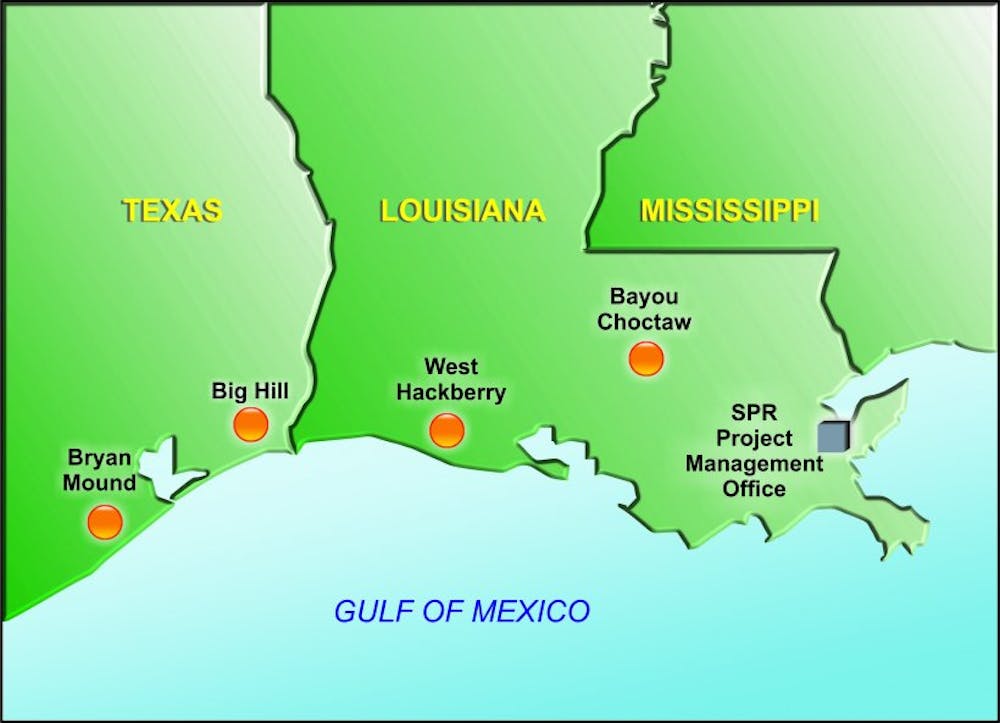
Congress created the Strategic Petroleum Reserve as part of the Energy Policy and Conservation Act of 1975. Its oil is stored underground in a series of large salt domes in four locations across the Gulf Coast, in Texas and Louisiana.
Congress originally said the reserve should hold up to 1 billion barrels of crude and refined petroleum products. Though it has never reached that size, the U.S. reserve was until 2025 the largest in the world, with a maximum volume of 713.5 million barrels.
Over the past decade, however, China has aggressively expanded its own stocks to an estimated 1.4 billion barrels. Such an enormous volume can be viewed as a sign of Beijing’s deep concern about oil security, as China relies on imports to supply more than 70% of its consumption.
In mid-March 2026, meanwhile, the U.S. reserve was only 60% full at 415 million barrels. In 2022, the Biden administration released 180 million barrels in response to the price jump caused by Russia’s invasion of Ukraine. An analysis by the U.S. Treasury Department concluded the release did reduce market volatility and lower prices at the pump by up to 30 to 40 cents per gallon. Nonetheless, it has not been a priority under the Biden or Trump administrations to refill the reserve.
As a result, the release of 172 million barrels recently ordered by the White House will temporarily shrink the U.S. reserve to 243 million barrels – only 34% of its capacity. That level is its lowest since the early 1980s.
U.S. Secretary of Energy Chris Wright has said plans are in place to add 200 million barrels back later in 2026. But doing so would return the reserve only to the pre-war stock level.
Risk or reward?
Nonetheless, the oil shock that has happened as a result of the Iran war has proven that the idea of strategic reserves is still relevant. Though the process of how it is utilized can be debated, having emergency stocks of a vital resource subject to supply crises can hardly be called irrational.
In the early days of the war, the White House said there was no reason for a release from the U.S. Strategic Petroleum Reserve.
But only days later, the administration changed its mind, reportedly because President Donald Trump saw oil prices soaring and remaining elevated.
But, as noted, this withdrawal will leave the U.S. and other nations in a highly vulnerable position. Additional price increases – like those that have occurred because of attacks on Gulf oil and gas facilities, production, and shipment locations – could well lead to a second call from the International Energy Agency to release oil from the world’s remaining reserves.
Scott L. Montgomery does not work for, consult, own shares in or receive funding from any company or organization that would benefit from this article, and has disclosed no relevant affiliations beyond their academic appointment.
Read These Next

Ancestors all around – millions of dead people linger in Americans’ memories
The shadow population of deceased relatives is more than three times as large as today’s living population.
Why ultra-Orthodox parties hold so much sway in Israeli politics
Ultra-Orthodox Jews, often called Haredim, make up a small but growing percentage of Israel’s population.…

Indian Gen Z ‘cockroach’ protesters aim to upend assumptions about democracy – and populism – in Mod
The protests challenge the government’s view of who “the people” are, what democracy means, and…