Abandoned Pennsylvania mines and waste-heat recycling could make the state’s massive new data center
In Pennsylvania, new data centers could require enough electricity to power 11 million homes.

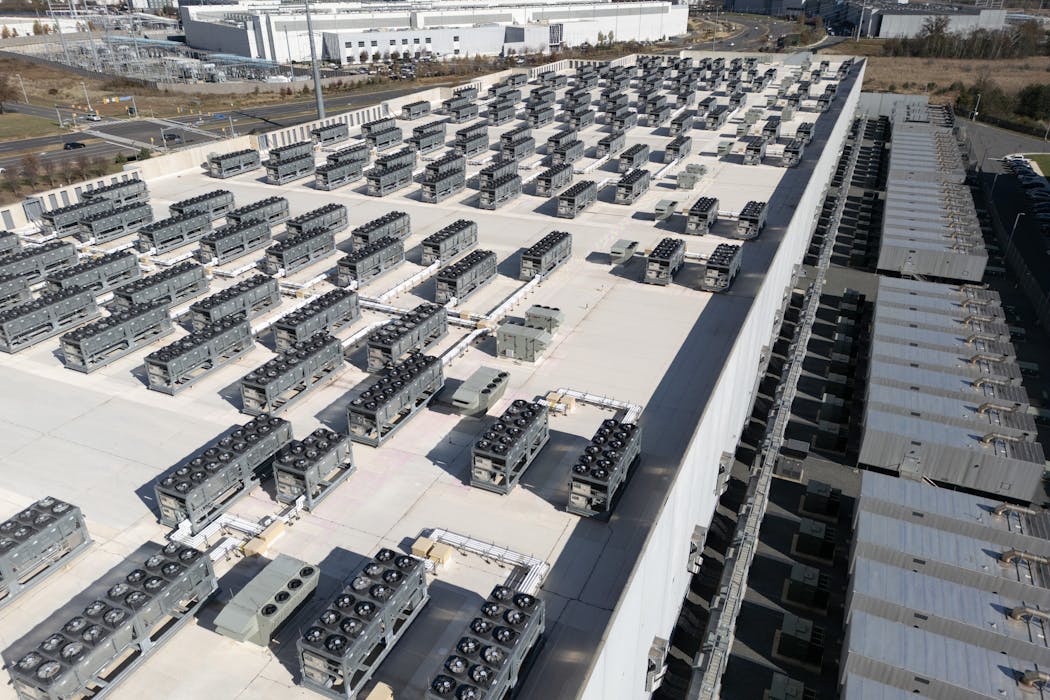
The electricity needed to power new Pennsylvania data centers already in advanced stages of planning could power 11 million homes – nearly twice the total number of households in the state.
Companies that want to build data centers to expand their cloud and artificial intelligence computing are drawn to Pennsylvania due to its proximity to major East Coast cities, relatively affordable land and electricity, and legacy industrial infrastructure. For instance, there is a plan to turn an abandoned steel mill in Pittsburgh into a high-density data center that can leverage the existing infrastructure for electricity and water supply.
If all data centers in advanced planning are built, it could total about 13 gigawatts of electrical capacity.
As more data centers are proposed across the state, residents and policymakers are asking important questions: How much energy and water will these data centers use? And what can be done to manage their environmental footprint?
As a professor of architectural engineering at Penn State, my research focuses on optimal design and control of data center cooling systems. I know that a key part of the answer to minimizing the negative effects of data centers lies in cooling.
Data centers generate a lot of heat
Every bit of electricity that a data center consumes is converted into heat that must be removed and released into the environment. Cooling systems, including chillers and cooling towers, are mission-critical infrastructure.
Without effective cooling, temperatures in computing devices would quickly rise to damaging levels, forcing systems to shut down. In November 2025, the Chicago Mercantile Exchange experienced a major outage when a data center’s cooling system failed. It halted trading for hours.
Data centers currently account for about 4.4% of total U.S. electricity consumption and are projected to rise to 6.7% to 12.0% in 2028, according to Lawrence Berkeley National Laboratory.
They also consumed nearly 211 billion gallons of water in 2023, most of it indirect and tied to electricity generation. Within individual facilities, cooling alone accounts for about 40% of total electricity use
How efficiently Pennsylvanians cool data centers has major implications for energy consumption, water demand and community impacts.
The challenges of cooling
AI workloads demand a lot of computing power and therefore generate more heat that must be removed.
Traditional air-cooled systems rely on powerful fans and mechanical chillers, both of which consume significant amounts of electricity.
During Pennsylvania’s hot and humid summers, cooling energy needs for data centers can rise sharply. This increased demand on electricity requires costly infrastructure upgrades, and the cost is often shared by all users including residents, which raises concerns of fairness.
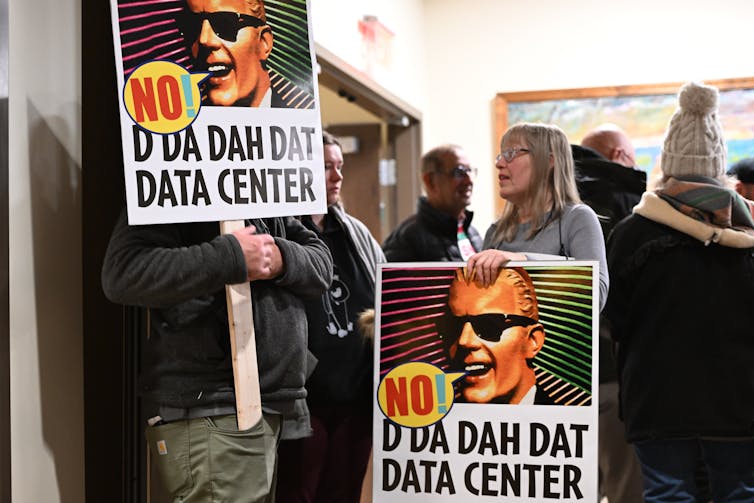
Water is another concern. Many large facilities use evaporative cooling towers that consume millions of gallons of water per day. In regions facing periodic droughts or stressed water supplies, this can frustrate local communities.
Noise is a third, often overlooked issue. Most complaints from people who live near data centers are not about servers but about cooling systems. Large cooling tower fans, rooftop air-handling units and dry coolers generate continuous low-frequency noise. Chillers and compressors add vibration and tonal hum. In quiet rural or suburban settings – especially at night – this steady sound can travel surprisingly far.
Pennsylvania’s climate presents both challenges and opportunities when it comes to cooling data centers. Cold winters can support energy-efficient cooling for part of the year. However, hot and humid summers limit the effectiveness of those free cooling strategies.
At the same time, many proposed sites sit near legacy industrial infrastructure, including abandoned coal mines, that could enable innovative approaches.
Turning heat into opportunity
Improving cooling efficiency is a straightforward way to minimize the negative impact of data centers.
In a U.S. Department of Energy project my team worked on, we demonstrated a 74% cooling energy reduction in a Massachusetts data center. This was achieved by using a digital twin of the data center. A digital twin is a virtual representation of a real system. Using this digital twin, we were able to identify and fix different faults in the cooling system. We also used the digital twin to optimize the control set points based on the data center workload and weather conditions to meet the cooling needs with much less energy.
In addition, more saving can be achieved by integrating the digital twins with AI, which can perform the optimal cooling control with minimal human interventions. This concept – I call it “AI for sustainable AI” – aims to reduce the environmental footprint of the very systems powering the AI revolution. We are currently working with the Alerify data center in Harrisburg to reduce its cooling energy consumption using this technology.
Pennsylvania also has potential for geothermal cooling from its abandoned mines across the state. An example is Iron Mountain’s underground data center in western Pennsylvania, about an hour north of Pittsburgh. The data center is located 220 feet below ground in a former limestone mine. The stable and naturally cool subterranean environment – around 52 degrees Fahrenheit (11 degrees Celsius) – and underground lake reduce reliance on conventional mechanical cooling.
Beyond efficiency, reusing waste heat can transform how we think about data centers. In Idaho, a startup is using server waste heat to support hydroponic greenhouses for year-round food production. In Paris, excess data center heat has warmed swimming pools used during the 2024 Olympics, and one of Meta’s data centers in Denmark supplies heat to a district heating network serving roughly 11,000 local homes. In Colorado, the National Laboratory of the Rockies recovers heat from its high-performance computing systems to warm building spaces and melt snow.
There are also opportunities in food processing and aquaculture. In Norway, waste heat from a data center is used to warm water for land-based fish farming. Studies suggest that the waste heat from data centers could also support food-drying processes for coffee beans, fruits and vegetables.
To be economically viable, these solutions often require a constant heating demand located adjacent to the data center, which may not be readily available in some cases.
Data centers will likely play a growing role in Pennsylvania’s economy. The question is not whether they will use energy and generate heat – they inevitably will. The question is whether we design them to simply release that heat into the air and water, or design cooling systems to harness it for more sustainable uses.
Read more of our stories about Philadelphia and Pennsylvania, or sign up for our Philadelphia newsletter on Substack.
Wangda Zuo receives funding from National Science Foundation, U.S. Department of Energy, and Penn State. He is a Fellow American Society of Heating, Refrigerating and Air-Conditioning Engineers. Besides his academic position at Penn State University, he is CTO and Co-founder of Glacian Technologies Inc, which is a Pen State spin-off company. He also holds a joint appointment at the U.S. Department of Energy's National Laboratory of the Rockies.
Read These Next

Ancestors all around – millions of dead people linger in Americans’ memories
The shadow population of deceased relatives is more than three times as large as today’s living population.

UN peacekeepers prepare to exit Lebanon after 70 years – leaving behind a worrying security vacuum
In August, the UN Security Council voted to end the decades-long peacekeeping mission in Lebanon. Blue…

PHP is in the foundation of 70% of websites – here’s what it is and why a flaw in the software is a
A cybersecurity researcher explains how a flaw in widespread software makes millions of websites vulnerable…