How protecting wilderness could mean purposefully tending it, not just leaving it alone
For decades, wilderness lands have been left largely unaltered by human activity. But those places are still changing, and keeping them wild and special may require action, not inaction.

More than 110 million acres of land across the U.S. are protected in 806 federally designated wilderness areas – together an area slightly larger than the state of California. For the most part, these places have been left alone for decades, in keeping with the 1964 Wilderness Act’s directive that they be “untrammeled by man.”
But in a time when lands are experiencing the effects of climate change and people are renewing their understanding of Indigenous knowledge and stewardship practices, protecting these places may require action, not inaction.
New Mexico’s Gila Wilderness, where the Chihuahuan Desert converges with the Rocky Mountains, was the first to receive a formal wilderness designation in 1924. Now, all but six U.S. states contain wilderness. In Minnesota, the Boundary Waters Canoe Area Wilderness protects more than a thousand lakes and several hundred miles of streams. In Florida, the marshes and saltwater bays of the Marjory Stoneman Douglas Wilderness are home to flamingos, manatees and alligators.
These diverse ecosystems are the country’s most protected lands, where human activity is severely restricted. Federal regulations exclude resource extraction such as logging and mining; developments such as the building of roads and structures; low-level overflights by planes and helicopters; and mechanized equipment such as chain saws. People can walk, ride horses, canoe, fish and camp temporarily in these areas, but that’s about it.
Yet, research my colleagues and I have conducted indicates that this approach can make it difficult to address two of the biggest challenges facing wilderness.
First, the dominant American ideal of wilderness – as wildlands that flourish best in the absence of human management – conflicts with the growing understanding that many wilderness areas were and remain part of the ancestral homelands of Indigenous peoples, who in fact tended those lands for thousands of years.
And second, as climate change and other ecological stressors affect wilderness, some forms of human intervention could help sustain the very ecological qualities that led to these areas being so strictly protected.

Indigenous influence on landscapes
Many wilderness areas have long histories as homelands where Indigenous peoples lived, hunted and gathered.
In Alaska, the Inland Dena’ina people marked vast trail networks by physically modifying trees, including by scarring bark and cutting limbs. Many of these marked trees can be found within Lake Clark National Park, two-thirds of which is designated wilderness.
In Washington’s Indian Heaven Wilderness, Northwest tribes gathered to pick and then burn the area’s huckleberry fields, a practice that increased the abundance of both plants and berries.
In the Southwest, Indigenous peoples bred six species of agave plants to be more palatable than wild agaves; researchers have found four of these domesticated species in six wilderness areas.
These lands may seem wild to some, but as Indigenous ecologists Robin Wall Kimmerer and Frank Kanawha Lake observed in 2001, “Every landscape reflects the history and culture of the people who inhabit it.”

Ecological stressors intensify
The Wilderness Act’s strict rules are not able to protect wilderness areas in the U.S. from new and unprecedented ecological stressors.
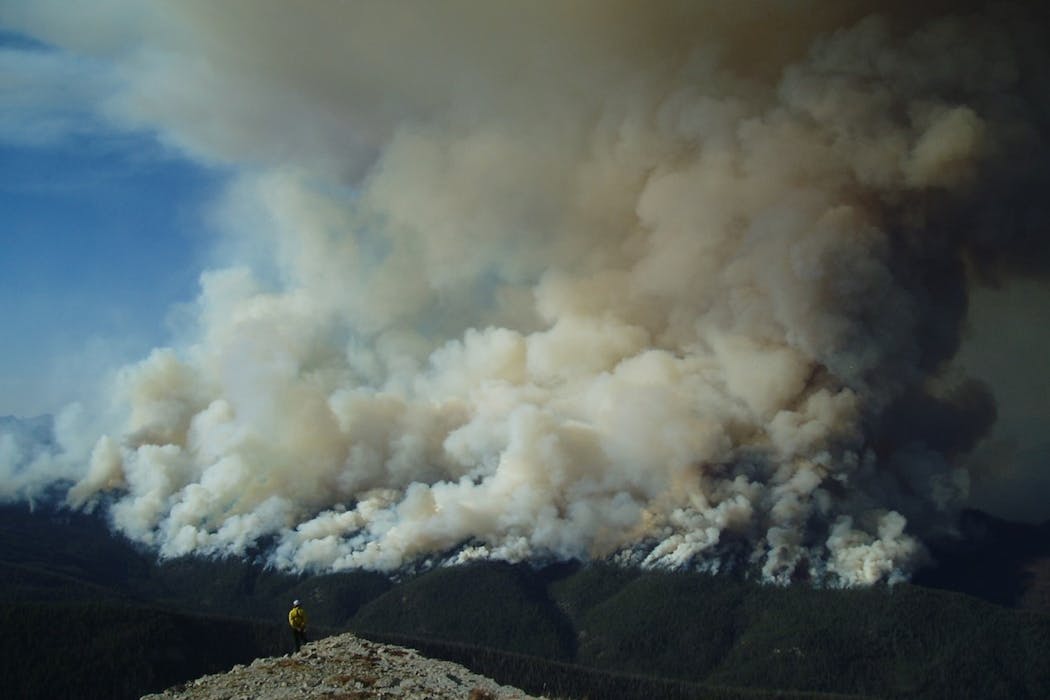
For instance, many wilderness areas are experiencing uncharacteristically severe wildfires. These events are a result of climate change, fire suppression and the prevention of traditional Indigenous forest management practices, including burning. Together, those forces have resulted in large-scale disruptions of historical cycles of fire, in which wildfires were often more frequent but less severe.
Scholars recognize prescribed burning as an effective strategy to protect forests from catastrophic fires, though it remains controversial in wilderness as human intervention. Government policy allows lightning-ignited wildfires to burn in federal wilderness areas in certain circumstances, but most of these fires are still suppressed – a human intervention that is widely accepted.
In California’s Sequoia-Kings Canyon and John Krebs wilderness areas, recent intense wildfires have killed unprecedented numbers of giant sequoias, a species that historically thrived because of more frequent, less-intense fires. The 2020 Castle Fire is estimated to have killed between 7,500 and 10,600 large sequoias – or 10% to 14% of all sequoias in the Sierra Nevada – many of them in wilderness.
In New Mexico’s Dome Wilderness, repeated intense fires have killed entire forests, transforming these lands into shrublands. Models indicate that up to 30% of forested landscapes in the Southwest are vulnerable to this type of change.

The absence of fire can also be a problem for wilderness ecosystems. In the Boundary Waters Canoe Area Wilderness, researchers anticipate a significant decline in the area’s pine-dominated forests unless fire is reintroduced – with the potential for these forests to disappear within 150 years.
Helping fire resume its natural role on the landscape – through prescribed burning or letting natural fires burn, overseen by firefighters and land managers – isn’t easy. Tree-ring histories and archaeological, paleoecological and ethnographic records show that frequent burning of resting areas and campsites by the Anishinaabe people along commonly traveled waterways helped create the Boundary Waters’ open red pine forests. But the wilderness-protection group Wilderness Watch says that prescribed burning by federal land managers today constitutes “a prime example of humans imposing their will on Wilderness to try to create managers’ desired conditions rather than allowing nature to shape the area.”
And fire isn’t the only concern. A combination of climate change, invasions by a nonnative fungus called white pine blister rust and outbreaks of mountain pine beetles have led to whitebark pines’ listing as a threatened species. An iconic tree that can live between 500 and 1,000 years, whitebark pines are common in high-elevation wilderness areas in the West, where they provide key habitat and food for wildlife, help regulate snowmelt and reduce soil erosion.
For the Confederated Salish and Kootenai Tribes, whitebark pines are culturally significant, with their seeds serving as an important traditional food. The tribes have declared they feel a responsibility “to do all that we can to ensure the survival of this beautiful and ancient tree,” and developed a restoration plan for the Flathead Reservation in Montana, which includes the Mission Mountains Tribal Wilderness. But in federal wilderness, their approach – active tending through prescribed fire and replanting – would likely not be allowed.

Reimagining federal wilderness management
Within tribal wildernesses, Indigenous nations honor spiritual connections between people and the land through relationships of reciprocity, as seen in the Mission Mountains Tribal Wilderness. There, members of the Confederated Salish and Kootenai Tribes are guaranteed the right not only to use the resources by hunting and fishing but also to connect with the landscape through cultural, spiritual and religious practices.
In recent years, managers at several federal wilderness areas have worked to include tribes in decisions about how these lands are stewarded. In California, a 2021 agreement gives the Federated Indians of Graton Rancheria a voice in the management of native tule elk at Tomales Point, most of which is part of the Phillip Burton Wilderness. In 2024, after pressure from the tribal community and others, the National Park Service began removing a 2-mile-long fence that prevented the tule elk from roaming freely and introduced new signs and interpretive programs that incorporated traditional ecological knowledge.
The long-debated question of how to best steward wilderness is increasingly urgent. In addition to its “untrammeled by man” provision, the Wilderness Act also says wilderness areas should be “protected and managed so as to preserve (their) natural conditions.” So the question remains whether people should leave small slices of nature entirely alone, even as humans alter the conditions of the planet, or whether some careful actions could help protect these precious places for generations to come.
Sean Parks, Jonathan Long, Jonathan Coop, Serra Hoagland, Melanie Armstrong and Don Hankins contributed to this article.
Clare E. Boerigter receives funding from the USDA Forest Service.
Read These Next

Why the assault weapons debate is a culture debate
The Supreme Court’s decision to hear two assault weapons cases caps a multi-decade dispute over restricting…

What the law says about armed officers at polling places
What does the law say about armed officials at the polls? That’s one of four questions that a legal…

These state supreme court races could decide abortion access and trans rights
Ohio, North Carolina and Michigan have open seats on their state supreme court, and these hotly contested…