Data centers told to pitch in as storms and cold weather boost power demand
The government directed data centers to turn on backup generation in parts of the US. Expanding distributed generation could improve grid resilience.

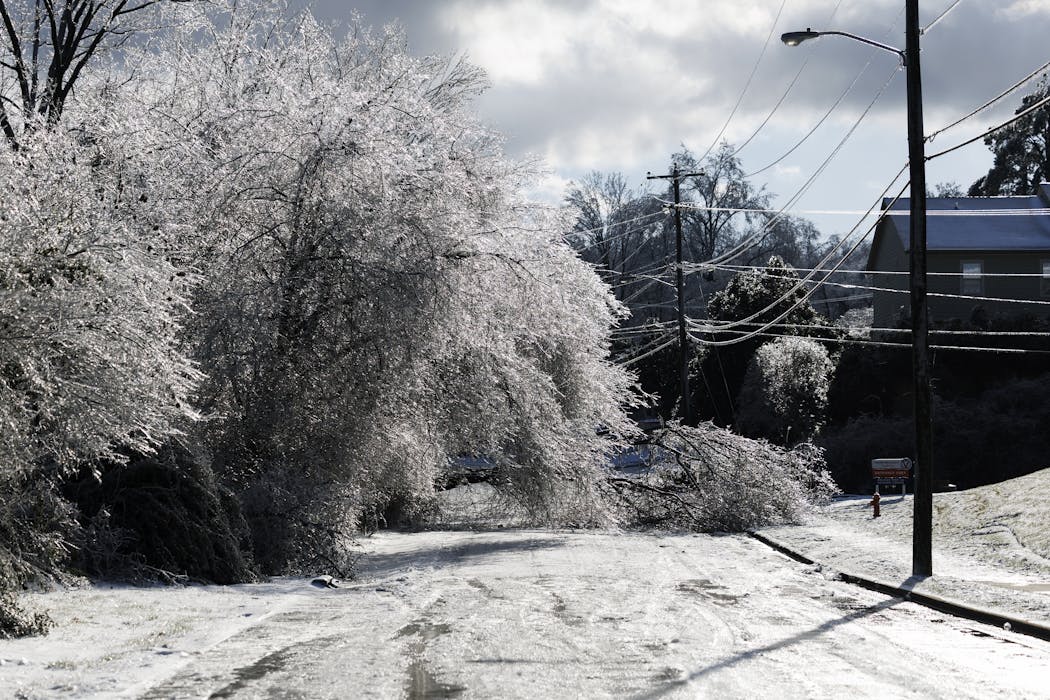
As Winter Storm Fern swept across the United States in late January 2026, bringing ice, snow and freezing temperatures, it left more than a million people without power, mostly in the Southeast.
Scrambling to meet higher than average demand, PJM, the nonprofit company that operates the grid serving much of the mid-Atlantic U.S., asked for federal permission to generate more power, even if it caused high levels of air pollution from burning relatively dirty fuels.
Energy Secretary Chris Wright agreed and took another step, too. He authorized PJM and ERCOT – the company that manages the Texas power grid – as well as Duke Energy, a major electricity supplier in the Southeast, to tell data centers and other large power-consuming businesses to turn on their backup generators.
The goal was to make sure there was enough power available to serve customers as the storm hit. Generally, these facilities power themselves and do not send power back to the grid. But Wright explained that their “industrial diesel generators” could “generate 35 gigawatts of power, or enough electricity to power many millions of homes.”
We are scholars of the electricity industry who live and work in the Southeast. In the wake of Winter Storm Fern, we see opportunities to power data centers with less pollution while helping communities prepare for, get through and recover from winter storms.

Data centers use enormous quantities of energy
Before Wright’s order, it was hard to say whether data centers would reduce the amount of electricity they take from the grid during storms or other emergencies.
This is a pressing question, because data centers’ power demands to support generative artificial intelligence are already driving up electricity prices in congested grids like PJM’s.
And data centers are expected to need only more power. Estimates vary widely, but the Lawrence Berkeley National Lab anticipates that the share of electricity production in the U.S. used by data centers could spike from 4.4% in 2023 to between 6.7% and 12% by 2028. PJM expects a peak load growth of 32 gigawatts by 2030 – enough power to supply 30 million new homes, but nearly all going to new data centers. PJM’s job is to coordinate that energy – and figure out how much the public, or others, should pay to supply it.
The race to build new data centers and find the electricity to power them has sparked enormous public backlash about how data centers will inflate household energy costs. Other concerns are that power-hungry data centers fed by natural gas generators can hurt air quality, consume water and intensify climate damage. Many data centers are located, or proposed, in communities already burdened by high levels of pollution.
Local ordinances, regulations created by state utility commissions and proposed federal laws have tried to protect ratepayers from price hikes and require data centers to pay for the transmission and generation infrastructure they need.
Always-on connections?
In addition to placing an increasing burden on the grid, many data centers have asked utility companies for power connections that are active 99.999% of the time.
But since the 1970s, utilities have encouraged “demand response” programs, in which large power users agree to reduce their demand during peak times like Winter Storm Fern. In return, utilities offer financial incentives such as bill credits for participation.
Over the years, demand response programs have helped utility companies and power grid managers lower electricity demand at peak times in summer and winter. The proliferation of smart meters allows residential customers and smaller businesses to participate in these efforts as well. When aggregated with rooftop solar, batteries and electric vehicles, these distributed energy resources can be dispatched as “virtual power plants.”
A different approach
The terms of data center agreements with local governments and utilities often aren’t available to the public. That makes it hard to determine whether data centers could or would temporarily reduce their power use.
In some cases, uninterrupted access to power is necessary to maintain critical data systems, such as medical records, bank accounts and airline reservation systems.
Yet, data center demand has spiked with the AI boom, and developers have increasingly been willing to consider demand response. In August 2025, Google announced new agreements with Indiana Michigan Power and the Tennessee Valley Authority to provide “data center demand response by targeting machine learning workloads,” shifting “non-urgent compute tasks” away from times when the grid is strained. Several new companies have also been founded specifically to help AI data centers shift workloads and even use in-house battery storage to temporarily move data centers’ power use off the grid during power shortages.

Flexibility for the future
One study has found that if data centers would commit to using power flexibly, an additional 100 gigawatts of capacity – the amount that would power around 70 million households – could be added to the grid without adding new generation and transmission.
In another instance, researchers demonstrated how data centers could invest in offsite generation through virtual power plants to meet their generation needs. Installing solar panels with battery storage at businesses and homes can boost available electricity more quickly and cheaply than building a new full-size power plant. Virtual power plants also provide flexibility as grid operators can tap into batteries, shift thermostats or shut down appliances in periods of peak demand. These projects can also benefit the buildings where they are hosted.
Distributed energy generation and storage, alongside winterizing power lines and using renewables, are key ways to help keep the lights on during and after winter storms.
Those efforts can make a big difference in places like Nashville, Tennessee, where more than 230,000 customers were without power at the peak of outages during Fern, not because there wasn’t enough electricity for their homes but because their power lines were down.
The future of AI is uncertain. Analysts caution that the AI industry may prove to be a speculative bubble: If demand flatlines, they say, electricity customers may end up paying for grid improvements and new generation built to meet needs that would not actually exist.
Onsite diesel generators are an emergency solution for large users such as data centers to reduce strain on the grid. Yet, this is not a long-term solution to winter storms. Instead, if data centers, utilities, regulators and grid operators are willing to also consider offsite distributed energy to meet electricity demand, then their investments could help keep energy prices down, reduce air pollution and harm to the climate, and help everyone stay powered up during summer heat and winter cold.
Nikki Luke is a fellow at the Climate and Community Institute. She receives funding from the Alfred P. Sloan Foundation. She previously worked at the U.S. Department of Energy.
Conor Harrison receives funding from Alfred P. Sloan Foundation and has previously received funding from the U.S. National Science Foundation.
Read These Next

A molecule’s ‘handedness’ can determine whether it’s an effective drug – 4 examples of pharmaceutica
The 2026 Nobel Prize in chemistry gave a hand to handed molecules – and the processes chemists use…

Why the assault weapons debate is a culture debate
The Supreme Court’s decision to hear two assault weapons cases caps a multi-decade dispute over restricting…

Leap seconds have helped keep clocks synchronized with Earth’s rotation, but their time may be over
If you think about leap years, it may seem like humans have a very odd way of measuring time. Sometimes,…