Columbia is keeping its gates closed, raising the question of what universities owe their neighborho
Conflicts between universities and their surrounding neighborhoods are far from new.

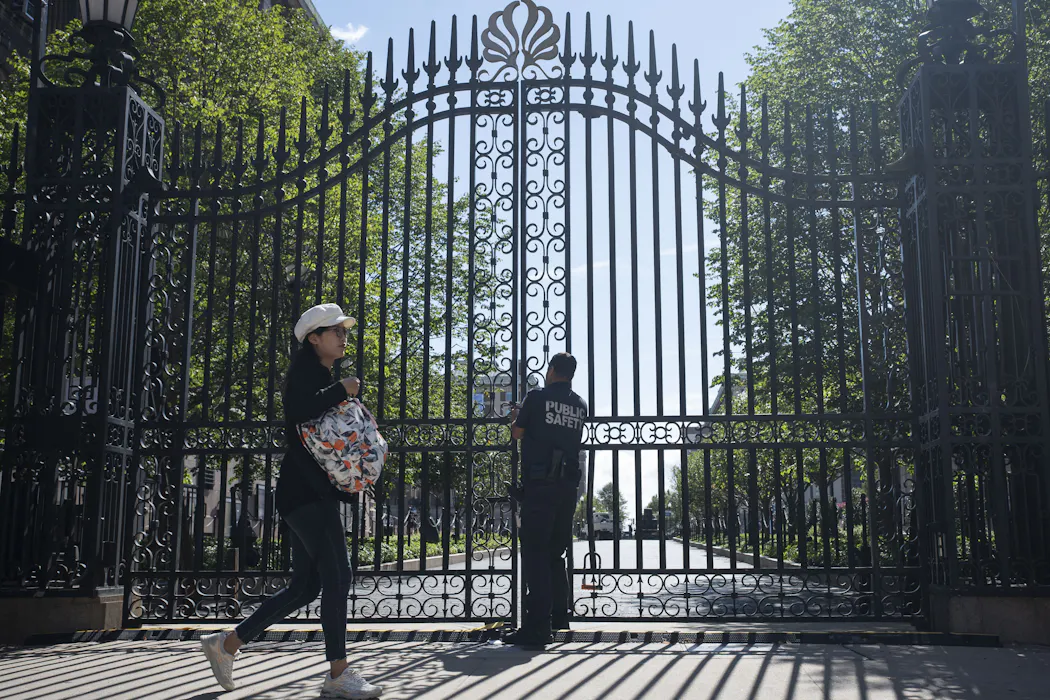
The Gaza war protests that overtook some colleges and universities in 2023 and 2024 have long dispersed – but one very clear remnant of the demonstrations remains at Columbia University’s Morningside Heights campus in New York City: a closed campus.
Columbia’s administration first shut the gates in April 2024, following pro-Palestinian rights protests and waves of police arrests. New York City politicians said that these disruptions were fueled by “outside agitators.”
Now, only students, faculty, staff and alumni with a school ID are able to enter Columbia’s quad.
Some of Columbia’s neighbors sued the university in January 2025, saying that the closure created a “six-block barrier between Broadway and Amsterdam Avenue from West 120th to West 114th Street” and violated the Americans with Disabilities Act and Rehabilitation Act.
A New York Supreme Court judge in Manhattan dismissed their suit on Nov. 10, 2026, saying that “even if Columbia previously granted unrestricted public access to College Walk, as it remained their private property, nothing prevented them from restricting access at any time.” The plaintiffs quickly appealed the decision.
Columbia has maintained that safety concerns meant it needed to close its gates, and that the campus is private property.
Nonetheless, in the past, Columbia allowed neighbors to cross the campus as a scenic shortcut through the neighborhood. Nearby nursery schools used the campus green as a place for children to explore and play.
As a college professor of law and political science, and an elected official in the western Massachusetts town where I teach, the Columbia campus controversy feels familiar. These “town-and-gown” disputes have, from time to time, raised questions about what universities owe the community beyond their gates.

Town-and-gown conflicts
From at least the 1950s until 2024, Columbia had an open campus policy. In 1953, New York City approved closing the campus’s central West 116th Street stretch to cars, with the understanding that pedestrians would be able to walk across the campus.
The recent closure stirred up tensions between the school and its neighbors. But such strains are as old as universities themselves. Some commentators suggest that conflict between universities and their surrounding communities can be traced back to medieval Europe.
“The early universities in cities such as Bologna and Paris took a very different form to the institutions we know today. They were loose communities of masters and scholars who lived amongst the people of the town,” the education historian Harley Richardson wrote in 2020.
Townspeople often resented those scholars and students because “They couldn’t understand the scholarly Latin spoken by the students” or whether “the long gowns they wore” were “intended to convey a superior social status,” Richardson wrote.
One of the most notorious town-gown incidents that turned violent occurred in Oxford, England, in February 1354 on so-called St. Scholastica Day, honoring an Italian saint who founded the order of the Benedictine nuns.
Trouble began in a local tavern when some students complained loudly and aggressively about the poor quality of the wine they were served. Things escalated when the tavern-keeper, who was also the mayor of Oxford, responded with insults. A fight broke out and drew in a large number of townspeople and students who rushed to the scene. It took the intervention of the king to restore order.
Conflicts between universities and their local towns or cities have also been very much a part of the story of higher education in the United States.
Most often these disputes have focused on issues like where a university should build a dormitory or whether it should pay fees to the city where it is located.
And as in England, these conflicts have occasionally turned violent.
One such incident happened in New Haven, Connecticut, in 1806, when riots broke out between Yale University students and locals who were on their way to church.
Universities’ civic responsibilities
What, if anything, do universities owe their communities?
The popular phrase “the ivory tower” captures one vision of a university. It suggests that universities serve society by being left alone to conduct research and educate students, disengaged from the larger community’s immediate concerns. In this view, people outside of universities benefit indirectly from the inventions and innovations that universities produce, as well as from the jobs they create.
Another vision, which came to prominence in the 1960s, called on universities to be good citizens of their surrounding communities. This view urged university leaders to invest in their neighborhoods.

Colby College, in Waterville, Maine, exemplifies this approach. It has spent US$265 million on construction and other investment projects over the past several years, with an eye on revitalizing its struggling downtown district.
Others schools, including the University of Notre Dame, the University of Pennsylvania, the University of Southern California and the University of California, San Francisco, have invested substantial amounts of money in developing their towns and cities and supporting neighbors. Trinity College in Hartford, Connecticut, for example, announced in September 2026 that it would pay for the full tuition, housing and meals for local residents who are admitted as students.
Some universities have been sending students out into the communities around them as one way to support their city. For example, Columbia Journalism School students are often tasked with developing a reporting project in a particular New York City neighborhood.
And some leaders in higher education now talk openly about orienting their schools toward the promotion of the greater good.
Closing gates or building bridges
A university investing in its surrounding community does not guarantee the end of tensions, which to me seem an inevitable part of the higher education landscape.
But when universities show their communities that civic responsibility is core to their mission, they build goodwill and offer a way of bridging divides when conflicts occur.
I don’t know how the Columbia campus dispute will resolve. But as newly elected New York State Assemblyman Eli Northrop observed: “Columbia is successful when Morningside Heights is successful and when the relationship between the neighborhood and the university is good.”
Austin Sarat does not work for, consult, own shares in or receive funding from any company or organization that would benefit from this article, and has disclosed no relevant affiliations beyond their academic appointment.
Read These Next

Sewing an infinity of phalluses – how Japanese artist Yayoi Kusama confronted the male-dominated art
Critics have attributed the repetitive, labor-intensive nature of Kusama’s work to be a product of…

Georgians mark 2 years of pro-EU demonstrations – defying campaign to wear protesters down
So far, the government has not crushed the protest movement. But in critics’ eyes, it has used psychological…

Why American consumers are still spending and powering the US economy – and why this could soon fizz
The American consumer has kept hanging on despite inflation, tariffs and high interest rates.