Philadelphia’s Academy of Natural Sciences just closed – a blow for budding young scientists like me
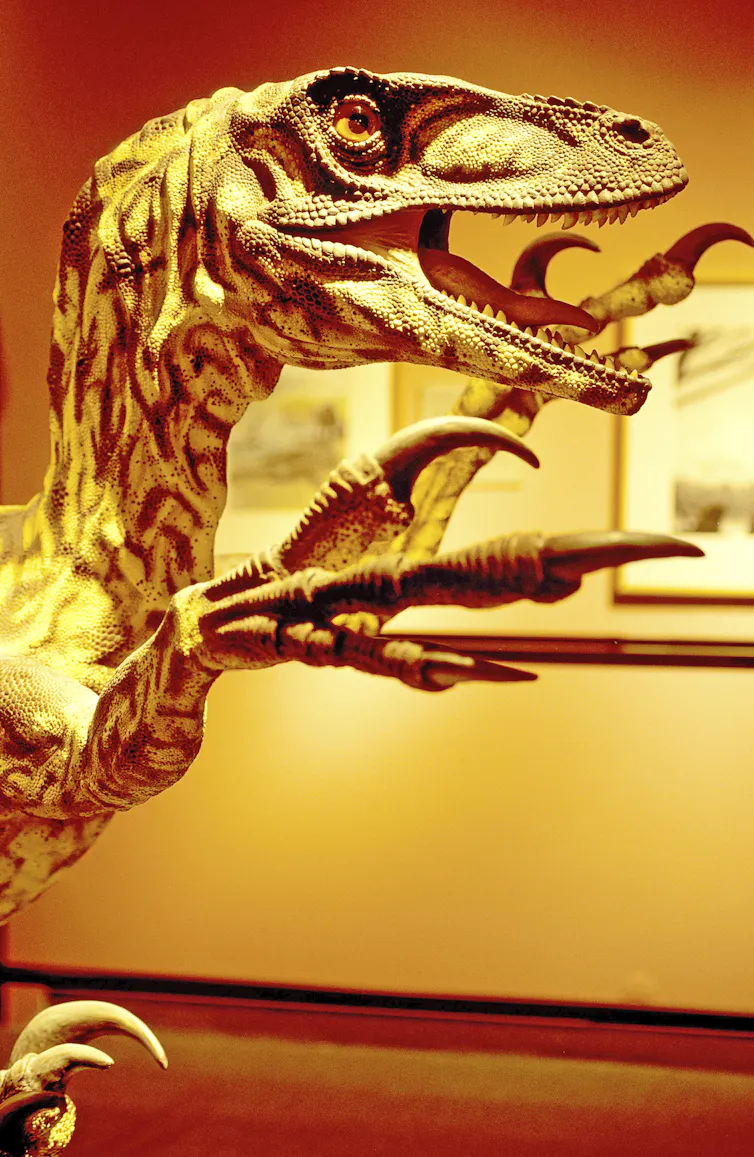
Generations of young Philadelphians experienced science firsthand by wandering through Dinosaur Hall, examining dozens of wildlife dioramas or visiting the butterfly garden.

When I was a freshman in college at Villanova University outside Philadelphia, I visited the Academy of Natural Sciences for the first time.
My friends who were Philly natives were my tour guides, and I was inspired by their passion for the exhibits. I listened not only to the facts they shared about the museum, but also their childhood stories surrounding it.
As a kid, I remember going to the American Museum of Natural History in New York City and looking up at the massive dinosaur displays. I wondered how creatures as big as those used to walk the same ground as me. My favorite exhibit was the Hall of Ocean Life, where behind the staircase you see a dark, unlit diorama of a giant squid attached to a sperm whale.
The museum gave my curiosity a place to grow.
Now, as a Ph.D. student in physics, I research black holes, with the goal of one day becoming a professor and mentoring students. I was shocked when I heard the news that the Academy of Natural Sciences would be closing.
Over 200 years of hands-on science
Founded in 1812, the Academy of Natural Sciences in Philadelphia is the country’s oldest natural science museum. For two centuries, it has played a vital role in scientific research, education and public engagement. The academy’s research centered heavily on biodiversity, evolution, paleontology and environmental science. In 2011, Drexel University acquired the academy and manages its endowment.
The academy had offered a range of experiences, from the Dinosaur Hall to its butterfly garden, and provided generations of visitors with opportunities to explore science beyond classrooms and textbooks.
On Sept. 1, 2026, however, Drexel University abruptly announced that the museum would close by the end of the month, citing financial difficulties and declining attendance. The last day it was open to visitors was Sept. 27, 2026.
Critics of the decision to close are rallying to “Save the Academy” and reopen it. Even members of the Philadelphia City Council expressed surprise that they had not been approached for support before the closing was announced.
The William Penn Foundation offered to cover operating subsidies for at least another year, potentially giving the academy time to explore a sustainable future. However, the museum remains closed for now, and Drexel maintains it needs a long-term financial solution. At a hearing on Oct. 26 that lasted nearly four hours, Philadelphia City Council members tried to understand why the museum closed and what Drexel would need to reopen it. The hearing is scheduled to resume on Nov. 16.
Cultivating future scientists
While museums may be viewed simply as sites for school field trips or family outings, their impact extends far beyond entertainment.
Natural science museums preserve scientific history through linking the past to future generations, supporting research and introducing young people to subjects they might otherwise never encounter. Philly kids who visited the academy could experience different ecosystems, from the snowy lands of the bobcat to rainforests home to giant monkeys. These dioramas are a snapshot in time that allow children to cultivate their own imagination and passions.
Not everyone has the opportunity to attend college or pursue a career in STEM. Museums help close that gap, giving families, students and children a chance to experience science firsthand – something that textbooks, social media and even classrooms sometimes cannot do.
Thinking back to my own childhood, I can pinpoint how my academic interests were fostered through museums, whether gazing up at galaxies at the Hayden Planetarium or sleeping under the belly of the blue whale in the Hall of Ocean Life. I was able to talk to real scientists in careers I dreamed to achieve, and I was told it was possible for me.
These experiences were integral to my becoming a first-generation college student and pursuing a career in academia. They made a career in science feel tangible rather than mystical or intimidating.
Read more of our stories about Philadelphia and Pennsylvania, or sign up for our Philadelphia newsletter on Substack.
Lili Mei Granda Argianas does not work for, consult, own shares in or receive funding from any company or organization that would benefit from this article, and has disclosed no relevant affiliations beyond their academic appointment.
Read These Next
Allegheny County is reassessing every property – here’s how your tax bill is calculated now
A court has ordered Allegheny County’s first full reassessment since 2012. A finance scholar explains…
Why achieving your goals can leave you feeling so empty
There is an irony in Anne Carson’s Nobel win: The highest award in literature has gone to a writer…

Florida Department of Health considers dropping 4 school vaccine requirements – here’s what that cou
Most parents of young children today haven’t experienced the devastating childhood diseases that used…