Detroit wants to elevate youth voices in leadership – that means giving them real power
Building relationships and creating equitable opportunities are critical to engaging Detroit’s young people in safe and positive activities.


Detroit police officers detained more than 180 minors during a fireworks celebration on June 22, 2026. Most offenses were curfew violations, and the event was generally peaceful.
Large gatherings of young people in public spaces coordinated through social media, known as “teen takeovers,” have drawn concern from local law enforcement in Detroit, Pittsburgh, Raleigh and other cities across the country this summer.
Some argue that takeovers happen because teens do not have spaces to gather in less disruptive ways.
In response to this issue, Detroit created a youth advisory council in April 2026 to build out safe, structured and fun teen spaces. The city also brought back its Midnight Basketball League for Detroiters ages 18 to 26, part of a broader public safety and community engagement initiative.
In my experience as a youth violence prevention researcher, I’ve learned that working with teens to come up with solutions takes advantage of their ability to think outside the box and create new things.
Done well, solutions cocreated with teens could make communities better for all of us by increasing safety and social opportunities.
On the other hand, this strategy could turn into tokenism – a surface-level effort to create the appearance of inclusion without making structural changes or sharing power. When that happens, adults just pretend young people are included but still hold all the votes and make all the decisions, no matter what youth advisers say.
Collaboration and a common purpose
There are many ways to fail at youth partnerships. I have learned that the hard way.
Once, a young adult advisory board member in Mobile, Alabama, told me, “Honestly, people are irrelevant after they hit 25.” She was frustrated as the local government pushed yet another strategy to reduce violence, in a move that she perceived to be superficial and politically motivated. She had been fighting for systemic changes to address the deep, root causes of violence that left her community enduring tragic loss after tragic loss. She looked me up and down and then said, “No offense.”
There’s no doubt that leaving an engaged young woman like this one so disillusioned is a failure. I would like Detroit to avoid this experience.
I have worked with multiple youth advisory boards around gun injury prevention, positive youth development and public safety using an approach called participatory action research.
In participatory action research, communities partner with researchers to move toward community goals. For example, they might work together on health and wellness goals, such as public safety or physical activity. Community representatives and researchers together select the research goals, design the research process, interpret the results and determine next steps.
I have worked with youth advisory boards that include children as young as 11 years old, and young adult advisory boards that include adults as old as 25. In addition to moving toward shared community goals, young people who are involved in participatory action projects experience growth in leadership, academics and in their social lives. They were also more likely to solve problems without violence, research I published with colleagues shows.
Building relationships first
In my experience, young people are used to adults who pop in and out of their lives. They will not waste their energy and truth on me unless I prove that I am sticking around and that I follow through.
One metaphor I use to explain this is the “trust bank.” Adults cannot make withdrawals on teens’ trust, in this case by asking them to share their life experiences and invest their energy and effort into cooperating with adults, if the adults have not built up their trust account.
Trust is built slowly and patiently over time. Adults are considered more trustworthy when they are warm, personable, committed and available.
Trust can be promoted when at least one adult serves as a consistent coordinator and facilitator. Having one adult check in with youth advisory council members before and after meetings can provide a meaningful and sustained point of connection.
Be real partners
Real partnership is characterized by sharing power, including collaborative goal-setting, shared decision-making and transparency. In the case of Detroit’s youth advisory council, that also means deciding together what the problems, the causes of those problems and the possible solutions are – not just the adults assuming the root cause of the takeovers is a lack of youth spaces and then initiating their own solutions.
Power-sharing can be difficult for everyone. It is more complicated when different age groups are involved or when there is pressure to reach benchmarks, such as a desire to show results to funders or voters.
As an example of sharing power, one of our young adult advisory boards challenged another researcher and me to share full budget information on a grant-funded project, including salaries and overhead costs. This transparency resulted in changes in wages and incentives, following a protracted negotiation with human resources.
Paying them for their time makes it possible for young people under financial strain to participate. Wages or stipends even the playing field with the adults, who are also being paid to work for the good of the city.
Meet young people where they are
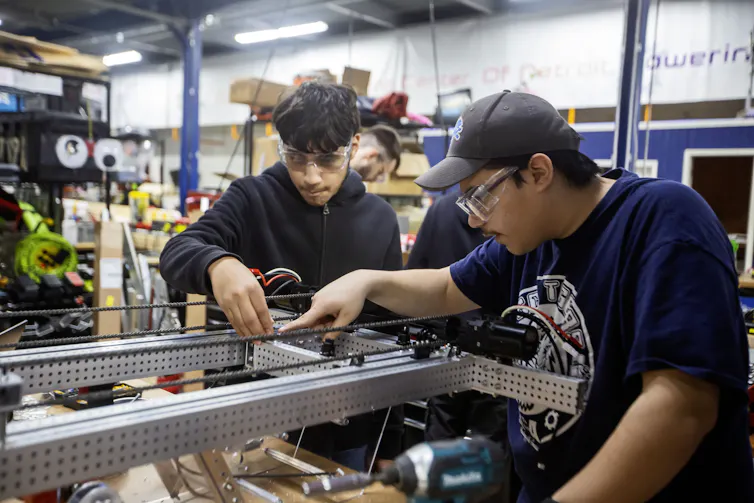
I believe that the most successful partnerships occur when adults meet young people where they are, both developmentally and physically. For example, expecting teens to commute to meetings may exclude those who have fewer resources or less motivation.
Instead, organizations that want to collaborate with teens can set up meetings where teens already are, such as in schools, or where they are comfortable and can easily get to, such as libraries or Boys & Girls Clubs. Those organizations could also pay for ride-sharing, gas or public transportation. For example, one youth advisory board I worked with met at a park that served as an after-school site and was within easy walking distance of two apartment complexes.
At the core of youth participatory action is anti-adultism. It pushes back against both an ideology that frames adults as superior over children and the practices that are based on this belief, such as excluding teens from decision-making. This pushback emphasizes the need to include young people in decisions that affect them and to empower them to express opinions and take action.
In my experience, adults who impose rigid standards on youth advisory boards about timeliness, clothing or oral or written communications will not have a productive, mutually beneficial relationship with them. Instead, adults can become curious about young people’s expectations of themselves and others and cocreate a climate and culture that works for everyone.
If adults believe that young people are not fully engaged in the work or following through on their commitments, I recommend both one-on-one and group conversations to brainstorm solutions for full participation.
With curiosity and humility, adults can ask:
How youth are experiencing the partnership and shared work.
What might be getting in the way of full participation.
What needs to happen to make participation better and easier.
This evidence-based, collaborative approach to solutions aligns the adults and youth together against a shared problem rather than against each other.
Teen takeovers showcase teens’ extraordinary abilities to identify collective problems and to enact creative solutions – whether or not these solutions are acceptable to adults in power.
Rather than treating young people as an invading force, Detroit can build a partnership with them to devise a flexible, responsive and sustainable strategy that supports the whole community.
If you’re a teen living in Detroit, we want to hear your ideas about how the city can better support you. Send us your ideas at detroit@theconversation.com.
Krista Mehari has received funding from the Centers for Disease Control and Prevention, the National Institute for Minority Health and Human Development and the Office of Disease Prevention, The John Templeton Foundation; the Spencer Foundation; and the National Institute of Mental Health. The contents are those of the author and do not necessarily represent the official views of, nor an endorsement, by CDC or the U.S. Government. The CDC had no role in the study design, data collection procedures, data analysis or interpretation, or in the writing of the report. She is a member of the Board of Directors of the Society for Prevention Research and is on the Advisory Board of Greater Good in Education.
Read These Next

Indian Gen Z ‘cockroach’ protesters aim to upend assumptions about democracy – and populism – in Mod
The protests challenge the government’s view of who “the people” are, what democracy means, and…

Chiricahua is the nation’s newest national park – what does that mean?
What comes next for Chiricahua, now that is has been officially redesignated as America’s 64th national…

An AI model’s false tip to Philadelphia police reveals how digital agents can do as they’re told and
An expert on AI governance explains why these rare mistakes may soon be common, and with much higher…