College professors face an emerging challenge: We know students are no longer reading entire books
Some teachers increasingly are shifting their approach to reading, assigning fewer books than they once did.

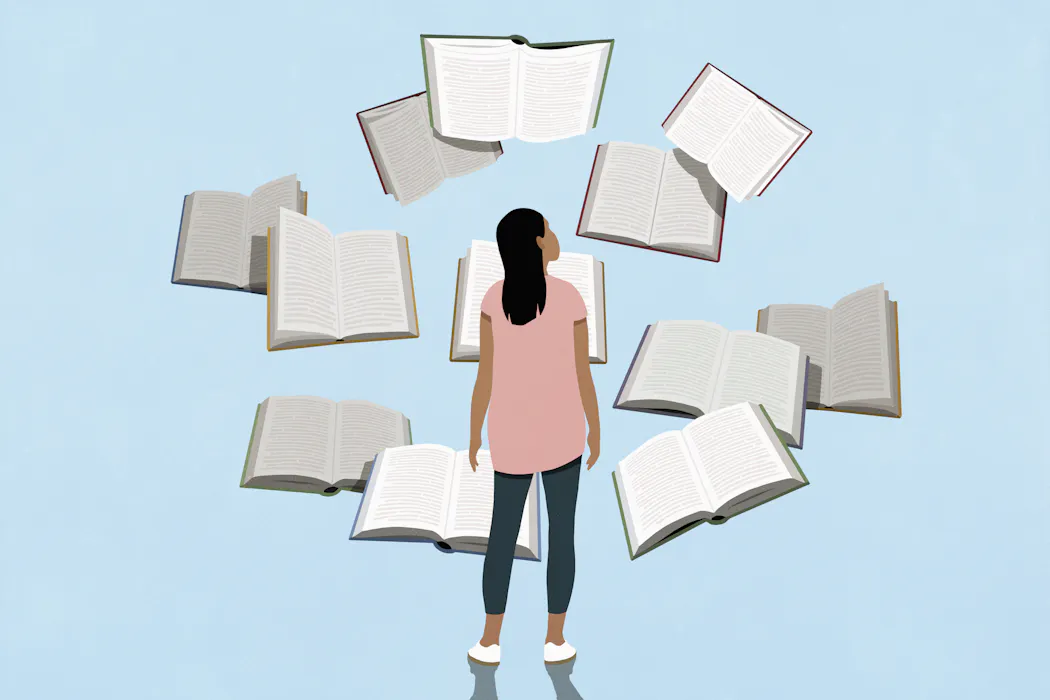
Anyone who has spent time on a college campus lately has probably heard laments from faculty about their students’ reading habits, or rather nonreading habits. Such complaints are more than an unfounded nostalgia for a bygone age.
Reading – not just any kind of reading, but reading long, complex, challenging books – is quickly vanishing from the American scene.
As Sunil Iyengar, who directs the Office of Research & Analysis at the National Endowment for the Arts, observed in 2024, approximately 49% of adults reported reading at least one book in the past year. That compares with nearly 55% of adults who reported the same 10 years earlier.
This decline in reading is also reported across some American high schools.
A 2024-2025 survey of 1,250 high school English teachers showed that they assigned an average of 2.81 books for their classes to read, from start to finish, each year.
A separate 2008-2009 nationwide study, which surveyed 400 English school teachers in ninth, 10th and 11th grades, found that they assigned an average of four books annually.
Some high school students are not asked to read any full books at all. Instead, they are assigned excerpts of books or short readings.
“Education Week” reporter Sarah Schwartz wrote in 2025 that there are signs of classrooms shifting away from long-form reading well before high school – as early as elementary school, in some cases.
As someone who teaches humanities and social sciences at the college level, I find these figures shocking, if not surprising. My classes are packed with many texts to read – often long, dense things – and my instruction has been premised on the idea that students would do the reading assignments. In my office, I sometimes hear students complain about the reading load and ask me for skimming strategies.
I generally resist their request and offer to help them learn to do close reading instead.
So the decline in reading poses a real challenge for me and my students, on a personal level, but also for American higher education more broadly. Colleges and universities have not yet figured out a way to respond, leaving teachers like me to devise our own responses.

The history of reading in the United States
Reading has long been a core part of American education.
In 1636, when Harvard University opened its doors to train Puritan ministers, administrators assumed that the entering class was highly literate – not only in English, but in Greek and Latin, as well.
And as Rutgers University English professor Jack Lynch writes, “Early Americans were uncommonly interested in the power of the printed word, and therefore in literacy.”
In 1647, Massachusetts mandated that every town that had more than 50 households needed to ensure that “all such children as shall resort to him to write and read.” The purpose of this instruction was so children could read and study the Bible.
Thomas Jefferson and other founders also wanted the U.S. to be a place where reading was common.
In 1787, Jefferson praised newspapers and the free press. “Were it left to me to decide whether we should have a government without newspapers, or newspapers without a government, I should not hesitate a moment to prefer the latter,” Jefferson observed.
In an 1815 letter to John Adams, Jefferson wrote, “I cannot live without books.”
In the 1800s, schools began to teach students to read phonetically, by sounding out words. “McGuffey Readers,” a series of elementary school reading books that emphasized phonics, were used in American schools starting in the 1830s.
Between 1836 and 1960, approximately 120 million copies of these books were sold, “matched only by sales of the Bible and Webster’s Dictionary,” according to Ohio University’s Ping Institute for the Teaching of the Humanities.
Higher education’s first reading crisis
As U.S. colleges and universities tried to expand and draw in more students in the 19th century, they faced their first literacy crisis.
Students were admitted to newly formed public universities lacking the reading skills those schools expected. Students had to be able to read in order to gain admission, but they weren’t necessarily used to reading complex texts.
Some colleges and universities, like the University of Wisconsin, responded to this challenge by starting college preparatory programs to make sure incoming students were ready for the academic challenge.
In 1915, Ernest Moore, then a Harvard professor of philosophy, reported the results of what many consider “the earliest sustained attempt to formally help college students with their reading.”
Rather than treat reading instruction as a separate and distinct thing, Moore embedded it in a broad study skills program to help students see the value of reading to all aspects of their education.
The University of Chicago, University of Illinois and Columbia University soon imitated this approach.
During the 20th century, standardized tests came into vogue in higher education, as a way to “measure the academic, affective, and physical conditions brought to the ivy halls by entry-level freshmen. The results were used by colleges to steer students to various forms of remediation,” according to education scholars Jennifer C. Theriault, Norman A. Stahl and Kelly J. Meyers.
The current challenge
Approximately 32% of 12th graders scored below basic reading levels in 2025, compared with 24% of 12th graders who scored below this level in 2002.
In 2025, Martin West, academic dean and education professor at the Harvard Graduate School of Education, also noted that “American students’ literacy skills peaked in roughly the middle of the last decade and have fallen significantly since that time.”
If literacy is a key part of the American story, that narrative seems to be fraying at the edges.
I believe that reading long, hard books remains the best way to help students learn to think for themselves about the world they live in and the past from which it emerged.
Still, some college professors have adapted by assigning less reading and lowering their expectations of students.

Why read?
There may be another way.
This summer, I enlisted a few colleagues to offer a course, titled “Why read?”, to a few of our students. We met twice a week for three weeks and discussed pieces about the value of reading by scholars like University of Chicago’s Martha Nussbaum and Columbia University’s Edward Said.
It was clear to me that the students had very different approaches to and comfort with reading difficult material. I tried to help them see that when it comes to reading, similar to physical exercise, the most benefit comes with the most exertion. Reading longer things requires patience and attentiveness, it cultivates the capacity to follow an argument or a plot, and it requires sustained effort to decode meanings.
Surely, this single course won’t end students’ entrenched habits and reverse their retreat from reading. But before we ask our students to read difficult material, those of us who teach in college owe it to all of them to explain that reading books in their entirety matters. If we won’t, or can’t, then higher education will have a bleak future.
Austin Sarat does not work for, consult, own shares in or receive funding from any company or organization that would benefit from this article, and has disclosed no relevant affiliations beyond their academic appointment.
Read These Next

Offering cash for votes is quite common – but here’s why it doesn’t work
Money or other material benefits are often not enough to override a voter’s preferences and partisanship.

El Niño is threatening California’s fragile coast again – the 1982-83 El Niño opened eyes to the ser
The destructive 1982-83 El Niño, then the strongest on record, eroded cliffs, leaving homes hanging…

Horror’s monsters find new meaning with queer and trans audiences – how ‘Teenage Sex and Death at Ca
Horror as a genre has traditionally been rife with transphobia and homophobia. But LGBTQ+ fans love…