AI schools like Alpha promise efficiency, but can’t replicate the messy process that helps kids lear
AI schools try to tailor learning to match students’ abilities. But they can’t help young people learn who they are.

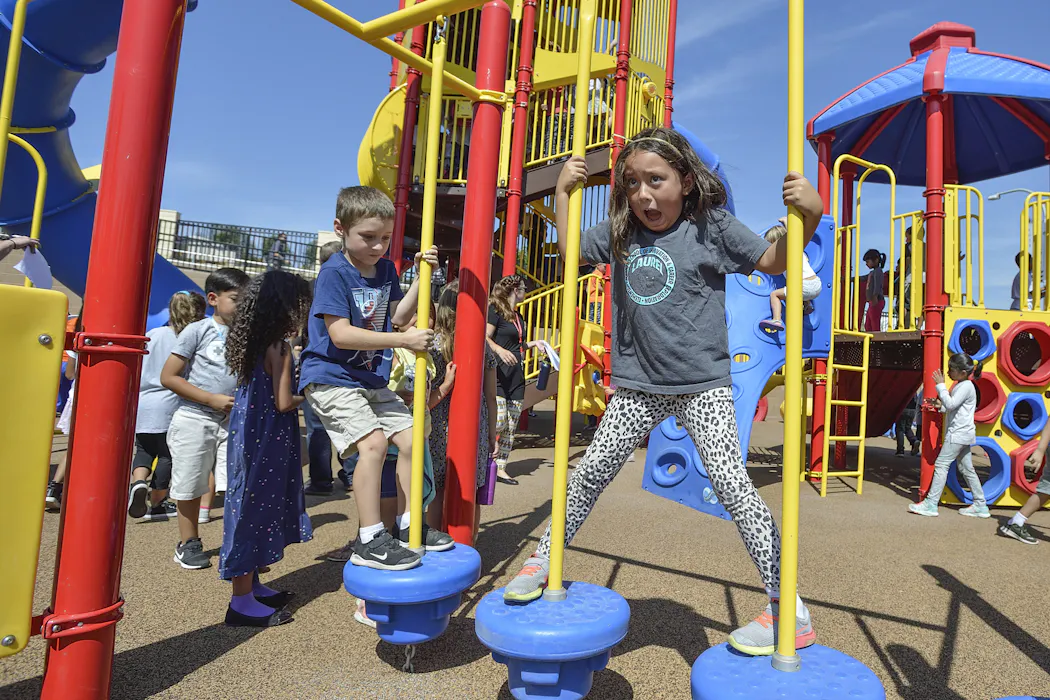
A child at a playground tries to climb, jump or negotiate with a peer, and their attempt does not work. They fall, get left out of a game or reach another impasse. Then they try again.
Failure, conflict and frustration might look like a struggle, but this is often how children learn.
I have spent 20 years studying digital literacy and how technology reshapes learning. My work turns on a simple question: What do people gain, and what do they lose, as society largely moves from traditional print to online learning? With this in mind, I believe that this question is growing more urgent as artificial intelligence-driven schooling gains ground.
AI-powered educational programs like Alpha School, a growing private network of schools, replace much of the school day with adaptive software that adjusts lessons to each student’s pace and abilities.
The pitch is personalized learning: Give each student the right material at the right moment, and they will succeed academically.
The deeper you look at how children learn, the clearer it becomes that this growing brand of alternative schools might remove the discomfort that often comes with learning – taking away what matters most as kids develop.

Welcome to Alpha
Alpha School was launched in 2014 by the tech entrepreneur MacKenzie Price and the private equity billionaire Joseph Liemandt. It is perhaps the most well known of the growing list of AI K-12 schools operating in the United States.
Alpha represents a particular vision of education reform – one that has caught the attention of the Trump administration. Education Secretary Linda McMahon toured its Austin, Texas, campus in 2025, and first lady Melania Trump invited an Alpha student as her guest to the State of the Union address in 2026.
Alpha operates more than a dozen campuses across major cities like New York and Miami. Annual tuition ranges from about US$40,000 to $75,000 per year, depending on the school’s location. Students learn core subjects like math, reading, science and social studies from adaptive AI software for one to two hours a day.
Students spend the rest of their time in workshops on topics like public speaking, coding, outdoor education and other projects. Their sessions are led by adults – typically not accredited teachers – whom the school calls guides.
There are other similar schools, including Unbound Academy, a tuition-free Arizona charter; and Novatio, a virtual private school. These are separate from Alpha in name, but they share overlapping leadership and online programs.
The Alpha model promises parents that they can get the right material to the right student at the right moment, confirm mastery and move on to other things that might have more relevance in the real world.
But delivering content efficiently is not the same as understanding how learning happens. Decades of research suggests that effective learning is not always efficient.
Alpha says its students received higher standardized test scores than their peers attending non-AI schools. Those numbers come from Alpha’s own internal data and have not been independently verified.
A 2026 investigation by the independent 404 Media news organization found that the school’s AI-generated lesson plans were poorly constructed and often illogical, raising questions about student growth.
But the deeper problem may not be whether the numbers are accurate; it is what the numbers cannot reflect.
What struggle is for
Cognitive psychologist Robert Bjork studies how when a student struggles to recall an answer before being instantly given the answer, this learning helps cement their knowledge.
Developmental psychologist Jean Piaget described something similar. Children learn when the world does not behave as they might expect. So when a child, certain that a tall, thin glass holds more water than a short, wide one, pours the liquid back and forth and discovers their misjudgment, this helps them gain a clear understanding of what is happening before their eyes.
School is also where children learn who they are and what they are passionate about and believe in, often with the help of other people.
Psychologist Lev Vygotsky argued that a child’s development is fundamentally social. A student’s understanding of particular subjects forms in collaboration with teachers, peers and the daily friction of being one mind among many.
Alpha’s students spend time with adult guides and other students on collaborative projects, but the bulk of the academic learning itself happens largely alone at a screen.
Child psychoanalyst Erik Erikson mapped childhood as a sequence of stages in which children work out not just what they know, but who they are as people. These are not lessons you complete in an app. They are learned among friends and classmates.

What an app cannot teach
The limits of AI learning have shown up in one of the most ambitious recent attempts to have kids learn from an AI tutor.
In 2023, Khan Academy, a nonprofit online site that offers free learning, launched Khanmigo. This AI chatbot is designed not to hand students answers, but to coach them toward understanding. Its founder, Sal Khan, initially described the goal as giving every student access to something like a personal tutor.
But Khan Academy describes Khanmigo in more modest terms than it once did. Khan Academy now says Khanmigo is meant to be used with adult supervision.
An AI bot can prompt, explain and guide, but it cannot replace human teachers who notice confusion on a student’s face.
Chatbots see when a student answers a question incorrectly. But curiosity, resilience, belonging and the slow work of figuring out who you are cannot show up on a dashboard.
The risk is not that these schools are bad at producing high test scores and other metrics. It is that they optimize for the part of childhood that fits on a chart and let the rest become an afterthought.
When critics raise these concerns, AI schools counter that a human adult is present as students complete lessons with an AI bot. But presence is not participation.
What this model may lack is the thing those humans are supposed to provide. Conversation, challenge and being known by others are what makes school more than a place to absorb content.
A tool is not a school
None of this means AI can’t help children learn.
But a child on a playground learns because she falls and tries again and again, in front of people who notice. That may not be something an AI model can deliver in two hours a day. A question worth sitting with is not whether these schools work, but what people are willing to trade for the parts of AI learning that might work well.
W. Ian O'Byrne receives funding from the U.S. National Science Foundation as part of the AI Cyberpathways grant. He is Director of the Initiative for Literacy in a Digital Age.
Read These Next

Chiricahua is the nation’s newest national park – what does that mean?
What comes next for Chiricahua, now that is has been officially redesignated as America’s 64th national…

Offering cash for votes is quite common – but here’s why it doesn’t work
Money or other material benefits are often not enough to override a voter’s preferences and partisanship.
Human rights could improve – or worsen – based on how nations use the UN treaty against cybercrime
If the treaty enters into force, responsible nations will have to carefully monitor how other countries…